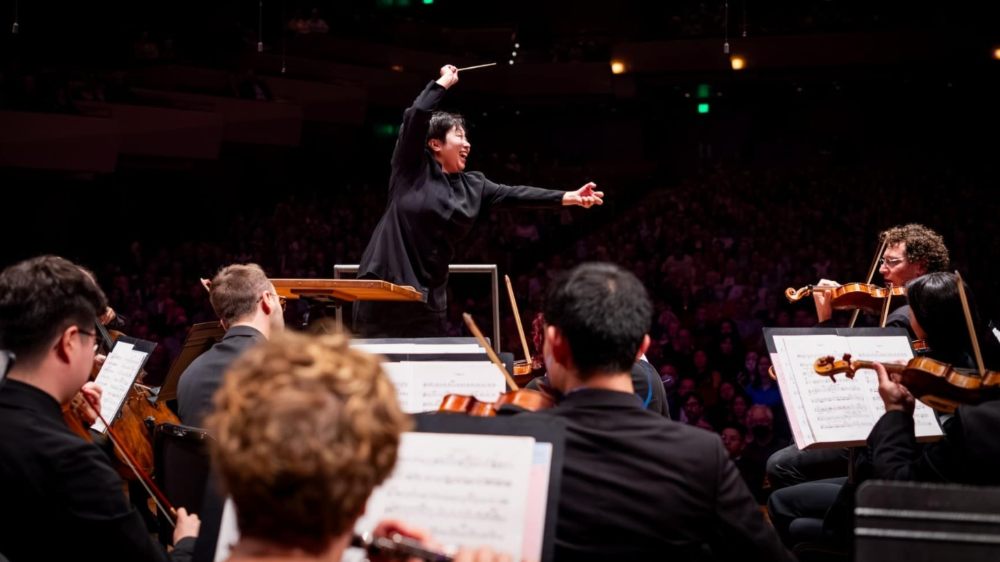

The Seattle Symphony’s June 13th performance of Gustav Mahler’s Symphony No. 7 was long awaited. It has been over 20 years since the Orchestra last tackled it and the reasons for its absence are part of the controversy surrounding the work itself. Mahler gave its premiere in Prague, fearing that audiences in Vienna, who were becoming antagonistic to his directorship at the opera, would be hostile to this innovative score.
Bruno Walter, his right-hand man, was baffled by the piece and did not champion it after Mahler’s death. Walter Damrosch, of the New York Symphony, savaged it in print. Ferocious praise from Arnold Schoenberg only inflamed conservatives. Even today, Mahler’s 7th is the least popular, least performed and least recorded of his musical legacy.
Yet there are a few, myself included, who look on this boldly experimental and – one might say – maniacally mesmerizing score with enthusiasm and admiration. (A confession: the last movement’s opening fanfare is my iPhone ringtone.) So, the return to the Seattle Symphony stage of this messy, marvelous work was something to celebrate. And celebrated it was by bassoonist Paul Rafanelli with a touching dedication of the concert to the late Speight Jenkins, whose devotion to the operas of Richard Wagner (from which Mahler drew profound inspiration) left an indelible mark on the Seattle music scene.
All of Mahler’s universe-building symphonies test the mettle of orchestras and their leaders, but the Seventh in particular presents a number of daunting challenges. The writing is virtuosic. There are unique instrumental colors to balance, for example from a guitar and mandolin duo to a garland of cowbells. There are cheeky references to Wagner, Boccherini, Mozart, and even Lehar, so a conductor must have a sense of humor that is rare in Mahler.
The score sprawls and yet is beautifully symmetrical; five movements, with a shadowy Scherzo at its hub, flanked by two contrasting “Nachtmusiks” and framed by lengthy episodes that jar with frenetic rhythmic and harmonic turns. It was sketched out during a happy time in Mahler’s life, only to be completed years later in darker days surrounding the death of his eldest child, his own diagnosis of devastating heart disease, and the deterioration of his marriage to the formidable Alma. A disquieting tension between the lighthearted and the tragic pervades.
Interpretations of Mahler Seven swing wildly from ultra-romantic indulgence (e.g. Bernstein and Kubelik) to flinty musical absolutism (Boulez and Gergiev). Conductor Xian splits the difference. The outer movements blazed with driving sonic brilliance, the inner ones with delicate detail. This was not a comfortable, gemütlichkeit reading, but one that ably negotiated the thorny mood and tempo shifts the composer laid along the way.
There were a number of fine instrumental turns. Ko-ichiro Yamamoto played the opening tenor horn solo (a tricky instrument to keep in tune) with an apt, mournful longing. David Gordon’s stratospheric trumpet fanfares were solid and square. Jeff Fair’s horn calls, echoed by John Turman’s muted response, had a rapt autumnal tone. The delicate interjections by mandolinist Arthur Zadinsky and guitarist Michael Nicolella were comfortably audible within the larger orchestral fabric. Above all, Erik Schweikert’s thundering and exhilarating introduction to the final Rondo was a star turn on the timpani.
I had my quibbles. Ensemble was ragged at times, but the 7th is a ragged work and relatively unfamiliar to the orchestra, so a listener can afford to be lenient. The volume itself was near earsplitting in places, but a wise audience member (myself included) knows to move to back rows when Mahler is on the program. The first Nachtmusik (which the composer suggested was inspired by Rembrandt’s famous “The Night Watch”) needed a steadier, pompous swagger for the march. The impish Turkish marches could have thumped and jangled more. Placing the horn choir at extreme stage right allowed their bells to face out to the audience to grand dynamic effect but also gave an unconvincing impression of tonal detachment. Greater rhythmic “schwung” in the Scherzo might have enhanced the vulgarity of Mahler’s wicked parody of the Viennese waltz. The 2nd Nachtmusik could have had a little extra freedom and bounce to add to its amusing evocation of a rustic serenade. And, if I may echo Saturday Night Live (and risk eardrums), the clangorous coda could have done with more cowbell.
But these are admittedly very personal, subjective observations. Mahler’s Seventh Symphony is a complex and purposely elusive work that can sound wildly different but nonetheless persuasive in a variety of interpretations. Xian Zhang’s and the Seattle Symphony’s presentation was satisfying enough, giving hope to Mahlerians that the next performance of this wild and witty work will return in future seasons with greater frequency. Hopefully, perhaps, with a little more cowbell?
Discover more from Post Alley
Subscribe to get the latest posts sent to your email.


I was slow to come around to this symphony, as its unpopularity in comparison with the rest of Mahler’s nine (or ten and a quarter) influenced me not to give it the attention that it requires. The one movement that grabbed my attention on the very first hearing was the first Nachtmusik, which remains my favorite of the five movements. But I have gradually come around to appreciating the rest. I attended the Thursday evening performance of the SSO. It was only the second performance of the work that I have attended, the other being by the Boston Philharmonic Orchestra conducted by Benjamin Zander. I had a favorable impression, but I’m not sufficiently familiar with the work to comment on the performance in any detail.
Gemini says:
That sentence hits on a real turning point in Mahler’s life where his professional success, his radical musical vision, and the toxic politics of Vienna all collided. The context of that blog post is a review of his Symphony No. 7, which he premiered in Prague in September 1908.
To understand why he bypassed Vienna for the premiere, you have to look at what was happening to him both artistically and personally at that moment:
1. The Vienna “Hostility”
Mahler had spent a decade (1897–1907) as the director of the Vienna Court Opera. He was a ruthless perfectionist who completely transformed the company, raising the musical standards to legendary heights and revolutionizing stage design.
However, his uncompromising nature made him plenty of enemies. By 1907, a perfect storm of factors made his position in Vienna unbearable:
The Antisemitic Press: Despite his conversion to Catholicism, nationalist and right-wing newspapers ran a relentless, exhausting campaign against him, weaponizing his Jewish heritage at every turn.
Opera House Fatigue: He clashed with the singers (whom he forced to actually act, rather than just stand and sing), the administration, and audiences who grew tired of his demanding personality.
Personal Tragedy: 1907 was a brutal year for Mahler. His eldest daughter died of scarlet fever, and he was diagnosed with the severe heart condition that would eventually kill him.
Defeated and exhausted by the constant vitriol, Mahler actually resigned from the Vienna Opera in late 1907.
2. Why Prague was a “Safe Haven”
Because Vienna had become so hostile, Mahler knew that if he premiered his brand-new Seventh Symphony there, the Viennese critics would sharpen their knives and slam the piece just to spite him, regardless of the music.
Prague offered a completely different atmosphere. The city was celebrating the Diamond Jubilee of Emperor Franz Joseph, and they were eager to host a major cultural coup. The musicians there revered Mahler, and the audience wasn’t wrapped up in the toxic, localized politics of the Vienna Opera house. Prague gave him a fair, respectful hearing.
3. The “Innovative Score”
The blogger’s note about the “innovative score” is highly accurate—the Seventh Symphony is arguably Mahler’s most experimental, bizarre, and modern work.
If Vienna was already looking for a reason to tear him down, the Seventh would have given them easy ammunition. It is incredibly jarring and strange for its time:
It is framed by two movements called Nachtmusik (Night-music), one of which was inspired by Rembrandt’s painting The Night Watch.
Mahler introduces completely unexpected, non-traditional instruments into the symphonic orchestra, including a mandolin, a guitar, and a garland of alpine cowbells.
The piece moves from deep, spooky, nocturnal shadows into a final movement that is almost wildly, aggressively joyful—a chaotic burst of light that left early listeners incredibly confused. Even his closest friend and champion, the conductor Bruno Walter, admitted he didn’t know what to make of it.
By taking the premiere to Prague, Mahler shielded his wildest musical experiment from the Viennese critics who were waiting to ambush him. It was a tactical retreat that allowed one of his most complex works to be judged on its own merits.