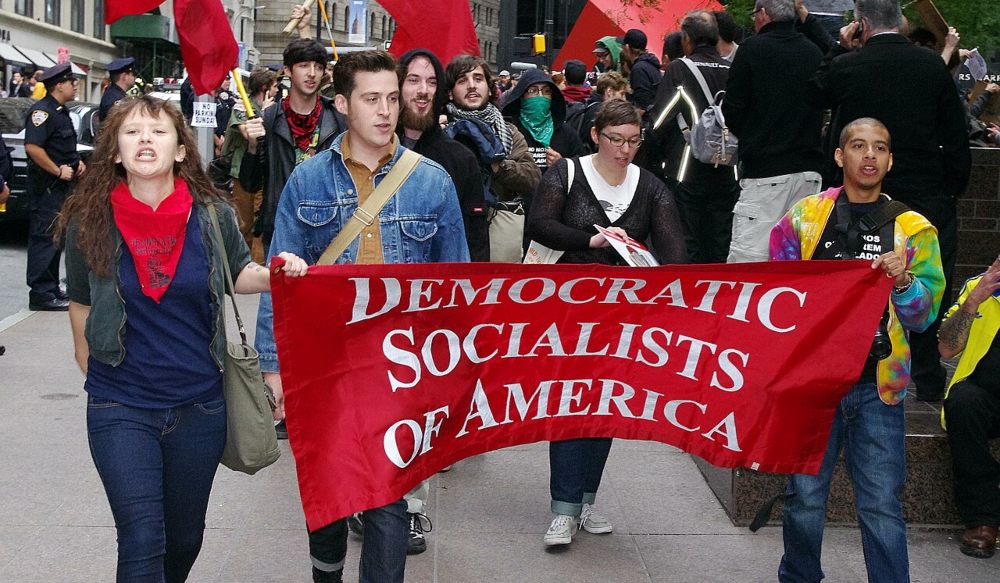

There is a power struggle within the Democratic Party. It is often framed as a clash between far-leftists and moderate Democrats. That framing is simplistic and inaccurate. It only reinforces stereotypes about each faction and does not lead to a better understanding of the dynamics shaping this struggle.
The clash is essentially between democratic socialists and social Democrats. Many Democrats, inside and outside the party, may not subscribe to either orientation. But the conflict between these two orientations will determine the party’s future.
The root of their disagreement is reflected in the labels for each group that promote democracy and social welfare. Democracy is a process for achieving a range of objectives. Socialism is both an objective to achieve and a condition to maintain.
For Democratic socialists, democracy is a means to achieving socialism. The objective is to build a democratic socialist society. The Democratic Socialists of America is pushing the Democratic Party to adopt the principles articulated in DSA’s platform.
As with all ideologies, socialism has many interpretations and proponents of those interpretations. Nevertheless, the baseline for socialists is the concept of creating a more perfect society. Socialism is an aspiration much more than a process, whereas democracy is a process through which aspirations are pursued.
Democratic socialists and social democrats share objectives, including a more equitable distribution of resources. It is an established socialist belief that it’s both possible and necessary to achieve a sustainable state in which economic equality, social justice, and peaceful harmony prevail. Social democrats recognize conflict as a permanent condition underlying the democratic process. There is no final, harmonious paradise, only a constant journey toward one, without assuming a perfect, stable destination.
Socialism, as interpreted by DSA and many who consider themselves socialists, holds that a socialist state is possible when capitalism is replaced with workers’ control of the trifecta of power, which is the means of force, access to resources, and dominant beliefs (see A Paradigm of How POWER Works). In this narrative, there is a conflict between the capitalist and worker classes over the acquisition of those powers.
The Social Democrats are at a disadvantage compared to the Democratic Socialists because they lack a clear goal for victory. They do not subscribe to the notion of an inherent class conflict that will lead to the end of the marketplace and a capitalist class. Unlike socialists, they accept that there will always be a marketplace and private property (see A Rational View of Capitalism vs Socialism in America & History).
But Social Democrats also believe the marketplace must be regulated to address the social and economic needs of all people. They want more equality, not in the form of equal outcomes, but in the form of fair opportunities for all to improve their lives and to be protected from discrimination based on the color of their skin, gender, beliefs, or culture. In other words, diversity in these areas is accepted as a permanent condition that a democratic society accepts and protects.
Consequently, social democrats’ social policies are not based on class conflict but on the assumption that a democratic process, equally accessible to all citizens, can lead to ongoing improvement in their material and social conditions.
DSA is the primary organization challenging the perceived lethargy and incompetence of the Democratic Party’s policies, similar to what social democratic parties have promoted in Europe.
How big is the DSA? How effective has it been at gaining support for its candidates? And what government and economic changes does it propose?
How big is the Democratic Socialists of America?
DSA announced on social media X that it recently surpassed 120,000 members, calling itself “the largest socialist organization in United States history.” Previously, the Socialist Party of America, under Eugene Debs, reached its peak in dues-paying membership in 1912, with 113,000 members. Keep in mind that America’s population is now more than three and a half times larger, so, to be comparable in size, DSA would need to have over 420,000 members.
Another comparison could be drawn with the fastest-growing group in the Republican camp, the reactionary Turning Point USA student organization (see The unspoken label for a growing political movement is “Reactionary”). A ChatGPT review of all relevant data indicates that TP USA currently has about 50,000 active, dues-paying student members nationwide. TP USA claims 650,000 lifetime student members; however, this is a cumulative total over the organization’s history, not current membership.
How effective has DSA been in electoral politics?
DSA was founded in 1982 and had 6,000 members in 2015. It wasn’t organized to endorse or campaign for candidates. Rather, as initially led by Michael Harrington, DSA’s formal “strategy” was to realign the Democratic Party further to the left by working from within. When Senator Bernie Sanders ran in the 2016 presidential campaign as a self-identified democratic socialist, membership grew by more than 100,000.
Since 2016, DSA has endorsed and canvassed for candidates who align with its values, including Democrats, independents, and third-party candidates. Nevertheless, its most notable successes have come from challenging incumbent Democrats in high-profile races and securing victories for its candidates as democratic socialists. These include U.S. representatives Alexandria Ocasio-Cortez and Rashida Tlaib (both elected in 2018) and New York City mayor Zohran Mamdani (elected in 2025).
As of 2025, over 250 DSA members were elected to public office across 40 states. That’s a lot, but one must consider that there are over 500,000 elected public offices, including 537 federal and roughly 7,000 state legislators. In comparison, there are 3,200 state legislators and hundreds of mayors in the nation’s major cities who are declared members of the Democratic Party. DSA has a long way to go to have a national impact, despite President Donald Trump and the Republican Party broadcasting that their elections are a national security threat.
Their successes have largely been concentrated in large, democratic cities. DSA members hold seven of 50 seats in Chicago, four of 12 in Portland, Oregon, four of 13 in Minneapolis, and four of 15 in Los Angeles. By winning elections in major cities, DSA benefits from national media coverage, and consequently, its importance and its message for change are amplified many times over those of an organization of its size.
But candidates who call themselves democratic socialists may not be DSA members or even receive DSA’s endorsement. For instance, Katie Wilson, who self-identifies as a socialist, won the election for Mayor of Seattle, running against a moderate incumbent. Individual DSA members supported her, but she did not receive DSA’s official endorsement. DSA refused because she was not willing to commit to the organization’s formal “party strategy” and strict platform requirements.
So, what does DSA stand for? Looking at their platform is a good place to begin. Still, traditionally, party platforms, while consisting of core statements of beliefs and goals, are aspirational, not binding, and not comparable to contracts. DSA’s platform is a mix of sweeping objectives and specific changes to pursue.
The DSA Platform
The general tone of DSA reflects the classic narrative of 19th-century socialist founders, beginning with Karl Marx. Its five-page Platform’s Preamble & Mission Statement nicely summarizes its major objectives. Workers are identified as its constituency a dozen times, and that emphasis continues throughout the remaining 15 pages of its platform.
In comparison, the 2024 92-page Democratic Party platform mentions workers frequently, though not as often, with no mention of the “working class” and more than half a dozen mentions of the “middle-class”. As expected, DSA makes no mention of the middle-class, but the working-class is scattered throughout.
DSA’s mission is that “working people should have power over our lives, and that includes a government and economy by and for the working class.” This raises the question of who represents the working class. If you go down the road of the two most prominent countries that tried to develop a socialist society, Russia and China, that would be the socialist party.
DSA sees itself as “a working-class alternative to the Democratic Party, capitalists, Democrats, and the far right” that “perpetuate violence and injustice at home and abroad.” As such, it “stands against the capitalist class and the politicians that serve their interests.” Basically, it’s class warfare, and DSA is leading it. Not sure how that’s going to go over as a campaign slogan – but hey, they got DSA members elected in the big blue cities.
The rest of the DSA platform is divided into four sections outlining what they are fighting for: working-class communities, an economy for the working class, a working-class foreign policy, and a working-class democracy.
Choosing just one specificity from each of the above sections, we would have the following. For working-class communities, universal healthcare with no premiums, co-pays, or deductibles. For a working-class economy, a 32-hour workweek with no reduction in pay or benefits. For a working-class foreign policy, end economic sanctions that affect the sovereignty of countries whose governments act independently of the United States, such as Cuba, Venezuela, and Iran.
The most far-reaching changes
A week ago, their platform merely mentioned replacing the Electoral College with a national popular vote for President. But in the last week, DSA announced that if they, i.e. the workers party, ruled the nation, it would be to eliminate the U.S. Senate and replace the President and the Supreme Court with an Executive and a Judiciary chosen by, and subordinate to, a new expanded Congress based on proportional representation.
However, there was no mention of when a vote was taken to adopt this as the new DSA program. The decision simply came down from their National Political Committee (NPC). Although the authors of this measure say they worked on the draft for months and “involved the political breadth of our big tent organization,” it is unclear who selected the members who drafted this platform.
The final decision to pursue these changes was not approved by DSA’s National Convention but by a majority of 27 members of its National Political Committee. Five factions are represented in the NPC, and it appears that the majority believe “radical change brought about by workers to transform culture and the economy” is necessary.
There is no mention of how DSA would approach amending the Constitution, balancing the budget, or enforcing the measures through the federal government. That gap would likely be highlighted by voters, the public media, and candidates running against DSA members.
If this is DSA’s permanent decision-making process, it could easily foster the top-down decision-making of the old Soviet model of democratic centralism, in which policy is set by a small upper-level central committee and then carried out by larger lower-level bodies, such as a convention or an assembly of “workers.” It will be interesting to see whether any objections to the new program are raised at their NPC on July 31st in Chicago.
Could DSA take over the Democratic Party?
This question is existential for some Democrats, like Jonathan Cowan, President of Third Way. He argues that the far-left DSA is poised to take over the Democratic Party if it isn’t stopped. That is stretching the imagination, even though DSA’s mission statement says, “an independent political party, rooted in the working-class majority is necessary,” implying that it could be them or they could take over the Democratic Party.
Cowan’s main point is that the DSA’s program will turn off voters and cause Democrats to lose elections in swing districts or states. He cites the slogan “defund the police,” which few Democratic candidates endorsed, as an example. Cowan concluded that it “helped lead to a dozen unexpected House losses for the party. The DSA’s rise could do the same. Every viral statement from a socialist will become a mailer in the swing districts.” DSA’s elimination of the Senate and Supreme Court might not be a major draw for voting for DSA-endorsed Democratic candidates.
“The DSA’s main target isn’t moderate incumbents but progressives,” Cowan notes, pointing to Diana DeGette (D-Colorado), a member of the Congressional Progressive Caucus (CPC) who lost re-election to a DSA challenger. The CPC has nearly 100 members who promote progressive ideals, grounded in the belief that “government must be the great equalizer of opportunity for everyone.”
The closest CPC has to a platform is its Progressive Promise. There is a significant difference between CPC’s Progressive Promise and DSA’s platform in what they hope to accomplish.
The DSA embraces the traditional socialist future of a worker-controlled government without capitalism. CPC makes no mention of doing so; it is committed to regulating the marketplace to ensure a satisfactory level of welfare for all. Income inequality and racial justice are listed as CPC’s objectives; DSA makes no mention of them in its preamble or mission statement. Instead of reforming the economic system, DSA declares that the “capitalist economic system is the cause of violence, unemployment, and a climate crisis,” and that it needs to be abolished.
However, evaluating DSA solely by its published positions may not accurately reflect its members’ beliefs. This is because DSA has a decentralized structure, with local chapters and ideological caucuses enjoying significant autonomy. Like all political organizations, it will have factions spanning the left-to-right political spectrum. The beliefs an organization promotes depend on who controls its equivalent of an executive board, and this latest DSA announcement shows that their NPC is firmly in charge of their national policy.
DSA has a 25-member National Political Committee (NPC) that serves as an executive board and is elected at its national convention every two years. The majority faction on the NPC promotes revolutionary socialism, which opposes social movements that seek to gradually ameliorate capitalism’s economic and social problems through political reform. “Revolutionary” action is understood as a radical change brought about by workers to transform culture and the economy. Violence is not necessary, but it is not excluded as a last resort for achieving a non-capitalist state.
Bottom Line
DSA is not a national threat, and it will not take over the Democratic Party. It has, however, tapped into the national anger against established authorities who appear unable to adjust the economic system to meet their daily needs.
That may be why, according to a Fox News poll this past March, 49% of registered voters, including 72% of Democrats and 60% of independents, described capitalism as working “not very” or “not at all” well. CNN cited a Marquette Law School poll showing that DSA now has higher favorability than sitting congressional Democrats among Democratic voters and leaners.
Rahm Emanuel, the former Chicago mayor, aptly summarizes the Democratic Party’s major problem as having “lost the plot” broadly, becoming mired in niche concerns rather than mainstream voter priorities. DSA may be a serious problem for the Democrats if it hinders their chances of winning swing districts. However, spending time trying to kill the squeaky canary in the coal mine isn’t the solution – it’s getting the hell out of the mine to live another day.
Discover more from Post Alley
Subscribe to get the latest posts sent to your email.


Megan Romer, the DSA national co-chair, appeared recently on the news on July 26, 2026. Shannon Bream, the host, presented items from the DSA platform in a rapid true/false format.
Here is the list and her responses:
Abolish the Senate → True
Replace the presidency and Supreme Court as we now know them → Yep
Abolish ICE → Absolutely
Abolish borders and give amnesty to anyone currently in the U.S. illegally → As a long-term plan, yep
Defund the Pentagon → Absolutely
Abolish prisons, at least in large part → Yeah, again that is part of a long-term program
Government or public ownership of most large corporations → Yeah, absolutely
The DSA is not a moderate organization. It is not slightly left of center. It is an extreme left organization, regardless of what marketing materials may say.
Thanks for commenting. There is a more serious problem in DSA presenting proposals that provide no level of realism or making any real effort to explain them to the public. They are the manifestation and result of DSA adopting the same centralized decision-making process generated by a doctrinaire caucus that controls the DSA platform that occurred with SDS in the late sixties.
Their current DSA platform has no record on their website of being approved at a convention or at the biennial meeting of DSA members. Their ideas will only benefit the Republican Party. It provides them with mana from heaven to save them from defeat by Democrats in November. It allows Republicans to attack Democrats who support DSA and, by extension, their platform, which the majority of DSA members have not even signed off on.
I think the thing that’s left unsaid with the DSA, is that it’s an anti-semetic organization. It has a problem in trying to balance their hatred for Netanyahu, with a hatred for Israel and ultimately Jews in general. there’s never a mention of Hamas or Hezbollah in it’s discussion of the Middle East. It’s really not much different than saying somebody hates the United States and Americans because they dislike Trump’s policies. There is a young DSA member running for state representative out here on the Olympic Peninsula and I listened to his spiel during a League of Women Voters, Clallam County debate and would never consider voting for him in a million years. He certainly embraces all of the issues that Nick pointed out, and his answer to virtually everything was to raise taxes.
This is very true. And the amount of virulence shown to Jewish nationalism AKA Zionism versus the fact that black nationalism and Islamic nationalism are actually promoted locally goes unchallenged. We constantly see the city promoting the Black Power movement, the myth that the Black Panther Party was persecuted for giving free breakfast to kids, the pan-african flag created by black separatist Marcus Garvey raised by the city every February.
The flag was created in regard to Jamaican colonization by the British. Garvey was 100% on board with the kkk’s plans for racial separatism. Trying to pretend that flag means something different than it actually does is not dissimilar to what Trump does when it comes to denial of racism.
So what we see from the DSA is:
Palestinians have the right to self-determination but Americans have no right to object to millions of people entering our country illegally.
Murdering innocent Jews, including in the US due to the wrongs of Israel is understandable and even okay to celebrate. Making the same statements about a demographic who makes up a tiny percent of the population but most of the gun violence would be unfathomable. Anyone celebrating the death of Mike Brown would not be allowed in the same communities that allow celebrating the death of innocent Jewish civilians.
Giving people from cultures far more oppressive than Israel such as Somalia, positions of power is admirable. Jewish people have to denounce Israel but Somalians in position of power somehow can praise Somalia to high heaven without anybody objecting. The Somali mayor of SeaTac along with the Somali Port of Seattle commissioner invited Somali officials over to tour government offices in this region along with cementing future plans to become a sister city. There was no outrage that we would allow a country with such horrible human rights records into our government offices and become sister cities with them. Nobody points out that clearly these two officials are acting out of cultural allegiance with Somalia not the good of our city.
Anti-Semitism is caused by wrongdoings committed by Jews. Racism and Islamophobia are just an irrational bigotry. Despite Muslims and most racial minorities committing far more civil rights abuses than jews, along with many making constant and unreasonable demands on society the negatively impact others, such as illegal immigration, affirmative action, or restorative justice instead of incarceration. It is clear that most restorative justice is wanted simply because of the demographic who disproportionately commits violence. If most gun violence was committed by white women none of these people would want to stop incarceration.
We should cut off it to Israel because of the violence of the Israeli settlers. We should give more aid to the south end because of the violence of that community all throughout the city. We should all clearly feel guilty for not caring enough about the deaths on the south end. A demographic who makes up a tiny percent of the population who commits most of the gun violence all throughout this region certainly should not feel guilty over how their Community destroys the quality of life for everybody throughout the region. Clearly we should just give them more money, more clout and more compassion. Clearly nobody should actually tabulate how much taxpayer funds is already going to this community who claims to be underserved while getting more funds directed towards them than every other community combined.
It’s noble when people bring up the violence and abuse committed by Jews in Israel. Or even wrongdoings by Jews in the us. It’s racist to bring up the violence and abuse committed by certain minorities right here in the city.
The problem is with their incessant bashing on Zionism and Israel is that there are many minorities who are far guiltier of blatent ethno nationalism, civil rights abuses, and weaponizing charges of bigotry to silence legitimate grievances that are completely taboo to object to. It’s even taboo to object to the pattern of these communities successfully getting more funding as a result of their violent Behavior and abuse. We subsidize the communities who destroy the quality of life for this whole city to a far greater extent then everyone else. Perhaps we should start a boycott, sanction and divest movement in Seattle towards communities whose reaction when they see people of their demographic victimizing others is to make a list of more resources they want taxpayers to provide for them. Maybe the lack of push back to that blatant greed and dishonest placing of the blame is part of the problem.
Pramila Jayapal cosigned a resolution condemning Trump when he used the phrase “Kung flu” claiming it was hate speech that would cause hate crimes.
Since then she has endorsed half a dozen candidates whose anti-jewish rhetoric is not just worse than that phrase, but as bad if not worse than the worst of his rhetoric. It appears that singling out any other minority even occasionally for criticism is taboo. But obsessive criticism of Jews and Israel is considered noble by the same crowd.
Just a few observations. Instead of trying to get these people to criticize Israel less they should be pushed to criticize other minorities more. See how well that takes.
Hi Nick.
I wonder if you are avoiding — for understandable political reasons — the elephant in the DSA tent?
Another characterization/explanation of DSA is at
https://podcasts.apple.com/us/podcast/blue-city-blues/id1777289409?i=1000779282847
Thanks to all for commenting on this piece. The elephant in the DSA tent appears to be the belief that DSA is either antisemitic or promotes tolerating antisemitism. This is not a side issue, as I believe it will be pushed by the Republicans to discredit any Democratic candidate who self-identifies as a socialist, or more directly, any candidate who has received DSA’s endorsement or is a DSA member.
To avoid a never-ending debate about whether DSA is antisemitic, one should identify which definition of antisemitic is being used. In one popular sense, it simply means “hating Jews” or wishing to exterminate them as individuals. This is pretty much the old Nazi line. I haven’t found that language in DSA literature.
Another definition of being antisemitic is supporting the extinction of Israel as a separate nation. Since Israel describes itself through its quasi-constitutional Basic Laws, including the 2018 Basic Law: Israel as the Nation-State of the Jewish People, extinguishing Israel could imply that the Jews could be stripped of a safe haven. Ironically, the Israeli Jewish conservative religious group Neturei Karta believes that a Jewish state should not exist until the Messiah arrives – they are not anti-Jewish, obviously.
A third belief that is often considered as antisemitic by non-Jews and Jews, is being anti-Zionist. This is probably the major concern of many who accuse DSA of being antisemitic. Being anti-Zionist is seen as selectively opposed to Israel as a religious state while ignoring Islamic republics like Iran, Saudi Arabia, or Pakistan, where apostasy and blasphemy are punishable by death.
But even here there are significant differences. Although conservative media, in the US and in Israel, call out that Iran threatens the existence of Israel, according to the Times of Israel, “Iran’s goal is to abolish the regime… [and that] this doesn’t mean the mass slaughter of the country’s Jews.” Of course, there is always the question of whether you believe them. Did the indigenous occupants of the New World believe the European settlers when they said they simply wanted to live in peace with them? Didn’t turn out to well for the hosts. Nevertheless, Iran hosts the largest practicing community in the Middle East outside of Israel.
I think the problem here is with DSA coming under the influence of a fundamentalist Marxist caucus that sees Israel as European imperialism subjugating the indigenous Arab population. They make no mention that a two-thirds majority of the U.N. General Assembly approved the application to admit Israel as a member of the UN by United Nations General Assembly Resolution 273. The majority of those approving the resolution were non-European.
Israel’s Prime Minister Benjamin Netanyahu has not helped dispel the image of Israel as a renegade state that does not abide by UN standards of humanitarian conduct in Gaza by trying to eliminate Hamas. According to a senior Israeli army officer, their forces killed about 70,000 people. He did not acknowledge that a vast majority of those killed in Gaza were civilians – most were children and women, according to local authorities.
It could be argued that DSA has opened the door to antisemitism for those who were already inclined, by how its leadership frames the Gaza war as a war of liberation from Israel’s oppression. Attacking the state of Israel for some, then, may not be limited to just Israel’s government but all Jews.
Accusing a broad swath of people associated with socialist or progressive policies of antisemitism could be used by those who simply want to win elections and exploit the plight of Palestinians to their advantage.
Meanwhile, DSA needs to make clear that Israel has the right to self-defense but not the right to wage war against the Palestinian civilian population. If they ignore that distinction, they will hinder the pursuit of a permanent, meaningful peace. And voters do not want to see the fighting in the Middle East continue.
I think you’re one of the few writers on Post Alley who actually responds to comments. So thank you, Nick
And whileI think your comment deserves an entire article so I’m not going to comment here in substance! I’ll wait for later. 😊
And btw I’d like to mention to management that I didn’t… (which is always true with Post Alley)… I didn’t receive a notice of any further follow-up comments on your post.
Post Alley has been like that for years and I think it’s unfortunate because this medium could be a truly genuinely vibrant part of Seattle life but the commenting system are so poorly done.
Oops–watch out for naive people thinking that a new form of “communism” is really okay. Yeah, capitalism is bad in so very many ways, as are disenfranchising forms of government like MAGA supports.
But doing away the senate, for instance (like DSA proposes) would subvert the principle of three branches of government that our American democracy is founded on, as would replacing the Supreme Court. Of course there are problems in those institutions–as there will always be in any form of government, no matter the philosophical system that creates or destroys them.
I’m all for getting rid of ICE and reforming, not abolishing, our prison system. And retraining and educating, not defunding, our police, whom we actually need for public safety.
As for borders, that’s tricky–but abolishing them would be fruitless unless there was a one-world government which no sensible people want.
There are intelligent ways to make changes to national and global problems, but ill-conceived and sweeping revisions to basic democratic tenets are not the way to go.
I’ve never liked any politician who toes the party line. Pretty sure that the DSA has just as many self-serving, ignorant and biased supporters as their opponents.
It’s very important to remember that capitalism is an economic system rather than a strictly political one like democracy–we can reform the first without destroying the second, if we are very careful.
Vote your conscience, not your fears and prejudices.