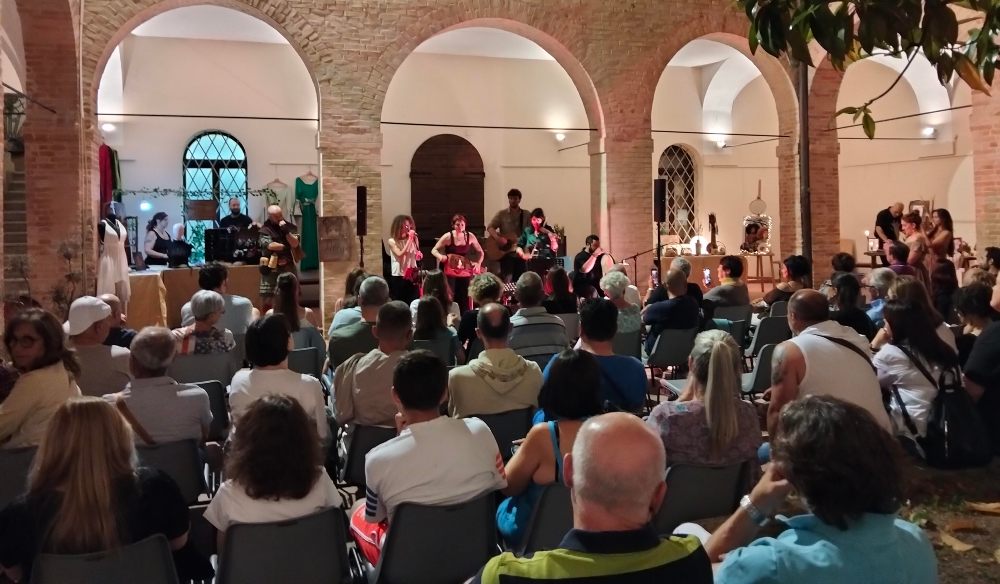

Sometimes this little town we live in takes me by such a complete surprise that I am stunned.
On a recent Thursday evening, in the courtyard of city hall, which began its life as a monastery, suddenly my ocular waterworks freely flowed.
I had been invited to sit in the front row of the seating, rows of which had been set up for parents and relatives of students of the town’s combined primary and middle school. The students were presenting an end-of-the year pageant. I was given this honor because I had taught classes in freehand drawing as a volunteer. As a guest instructor, I was specifically asked to use English so that the students could understand proper pronunciation.
Teaching language skills through art seemed like a novel idea. I enjoyed every minute of it and looked forward to interacting with the eager young people. Some would give me hugs as I entered the classroom. Now, when I walk through town, inevitably, one of the children will greet me with a big grin, calling me by first name. It is sweet beyond belief.
After I finished the teaching gig, the children used their newly learned skills to create a series of postcards, printed in packs and containing student drawn images. Perusing the cards, I saw that they were using the techniques I had taught them.
With my front row seat, I settled in for the live pageant. It was the story about how the town was founded over a thousand years ago. Now, I know this story, having read it in numerous publications and on-line. I also knew that the town’s origin was inextricably tied to the Catholic faith.
To give a Cliffs Notes version, the town was founded by an order of monks who were fleeing rampaging mobs of Saracens from North Africa. In the centuries following the fall of the Roman Empire, Saracens were slowly sweeping up the west side of the peninsula, burning villages to the ground and murdering monks and Christian followers.
The Farfa Monastery, located north of Rome, was warned of an impending invasion. The monks packed up their religious icons, piled them on donkey carts, and walked eastward through the formidable Apennine Mountain range. On a hill on the Adriatic side, they founded this place. They built a new and grander monastery and enclosed the village with a high, thick, defensive stone wall.
At it happens, our house was originally one of the watch towers for the wall. It bears evidence of that ancient era with a creaky wooden door leading to a hidden exit through the city wall. This secret passage would allow townspeople to escape into the countryside should an invading force succeed in getting inside. It never happened, but the exit remains.
Back to the pageant. The play went well beyond the history of town building. The script was infused with religious symbolism, artifacts, costumes, skits, and spoken dialog. For primary students, the “production values” were exceedingly high. Seven year old peasant girls appeared, carrying baskets of food on their heads. Boys dressed as monks looked dignified and pious (well, at times).
The history of the town is inseparable from the Catholic religion. To tell the story of the town origins requires descriptions of deeply religious individuals and events. The kids performed various skits to illustrate angels, saints, and supplicants.
Gradually, I realized what I was seeing. It took a while to grasp what was going on.
At one point, groups of children, addressed in expertly-made costumes, created living dioramas of scenes. Big posters of famous religious paintings were mounted nearby so you could compare the 2D fresco version with the 3D live version. My first reaction as an American living in Italy was, honestly, “Wouldn’t the Christian nationalists eat this up? This is exactly what they want to see in public education.” I was on the outer edges of being horrified. A public school actively depicting biblical scenes. But wait, there’s more.
In a scene invoking the Virgin Mary, Mary was played by an African girl – possibly a pretty accurate representation of a Galilean woman of that time. In another scene, the baby Jesus was played by a girl wrapped in a sheet. Both played their roles with dignity and pride. Indeed, every child had obviously practiced many times, as they duplicated precisely the beatific postures and facial expressions of their counterparts in the paintings. I do not consider myself religious, but I was thoroughly impressed.
The audience gave enthusiastic applause to each change of scene. I was awestruck.
Subsequent portions of the pageant were more secular, simply explaining the history of certain buildings in the town. And the intertwining of civic life with religious beliefs is an undeniable fact. Right now, as I write this, I know it’s noon because the church bells are beginning their melodious chiming. As if not to be outdone, a church in the town across the valley from us tolls its own mid-day marker. At one point in the past, seven churches performed the daily reminder. I cannot image that sonorous cacophony.
At the conclusion of the pageant, which lasted almost two hours, the entire student body formed a tiered chorus and enthusiastically sang “Che sara,” complete with required exaggerated hand motions that emphasize the lyrics. This is not the “Che sera, sera” song you might be thinking of, the one Doris Day made famous in the 1956 Hitchcock film with Jimmy Stewart. Rather, this is a song from the early 70’s sung by Jose Feliciano and an Italian quartet known as “Rich and Poor.”
Both the music and the words reflect bittersweet thoughts around leaving one’s town of origin for a more expansive life, with friends and family left behind. This is a major theme of Italian cultural life, reflected in both multiple waves of emigration to other countries over the last 150 years and films like Cinema Paradiso. Some of the more poignant lines of this Che sara:
Town of mine, set on the hill spread out like a sleeping old man.
Ennui, abandonment, emptiness are your ailments.
Town of mine I’m leaving you, going away…
What will be of my life, who knows?
What will it be?
Che sara? Che sara! … Che sara! (repeated as an uplifting refrain)
Following the final verse, the entire audience joined in for a rousing reprise, some standing and waving their arms, their strong but world-weary adult voices counterpointing with the childrens’ more innocent tones.
And that was the moment I lost it.
Goosebumps.
Then streaming tears.
Discover more from Post Alley
Subscribe to get the latest posts sent to your email.


Delightful story. Thank you for sharing it so vividly.
A truly wonderful writing by a gifted and willing observer of other cultures. I always enjoy reading Mark’s passages. This one, a real gift. Thanks.
Sir
Lucky you, and lucky us for being able to read this. Many thanks, kind Sir.
Lovely