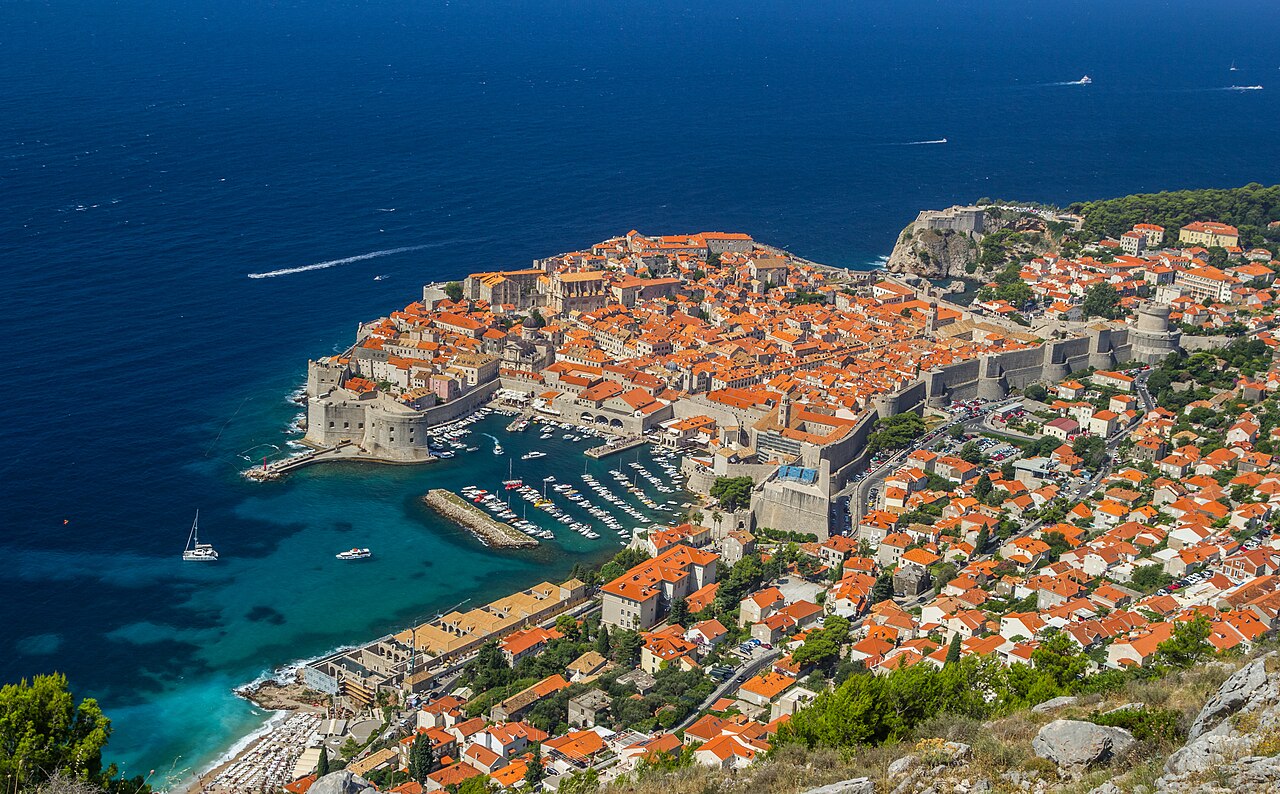

In December 1990, I was riding in a car along the coast of the Adriatic Sea near the medieval fortress city of Dubrovnik in Croatia, when the engine coughed, sputtered, and died. The driver was a mechanical engineer I’d met the week before in Ljubljana, the capital of Slovenia. He had been there on business; I was there to report on that state’s imminent secession from the Socialist Federal Republic of Yugoslavia. Between his grade school English and my high school French, we’d struck up a conversation on an overnight train, and, as was so common in the East in those days, he invited me to stay with his family and see the countryside.
We were on one of those excursions when the engine stopped. My host popped open the trunk, where the small engine was housed in his two-seater, and diagnosed the problem as a failed distributor. He somehow repurposed the foil lining from our cigarette packs to reinforce or replace the wiring, and the engine sparked, barely, back to life.
The car limped a few miles to a community of small, tidy homes on high ground where his in-laws lived in a quaint villa overlooking the walled city.
My host’s father-in-law was a retired general of the Yugoslav People’s Army. He and his wife were somewhere in their 70s. Neither spoke a word of English, but she was very gracious and welcoming and immediately poured all of us a round of the national drink, a plum brandy called slivovitz.
The General was a bit shorter than me — and I am not tall — but he was powerfully built. He crushed my hand in his while looking me in the eye and then dismissed me from his thoughts.
There followed some animated conversation I could not comprehend, but I gathered another crisis was unfolding that required the General’s wife to accompany my host somewhere while he sought assistance from a nearby mechanic. He asked that I remain behind.
The General could not have been less pleased. He motioned for me to follow him into his den, a small room full of military memorabilia, and directed me to sit with the kind of abrupt gesture one might employ tossing away a piece of trash. He asked me a few things I could not interpret. He tried again in Italian and then Russian. I responded with my high school French. He shrugged. I tried my phrasebook German. He glared.
The General was a career soldier of an Eastern Bloc army, involuntarily hosting a sample of the enemy he had spent his professional life training to fight. I felt for him.
I pulled out my travel notebook and sketched a map of Europe, marked Paris, and said “Septembre.” He nodded. I drew a line to Berlin, then across Germany to Poland and the Soviet Union, then back through Czechoslovakia, Hungary, and Austria, and finally to Yugoslavia, mentioning what highlights I could.
After watching the Berlin Wall come down on television during a meeting at work the year before, I had determined to quit my publishing job in New York City and travel behind the newly fallen Iron Curtain to report on what I saw as a freelance writer. I’d been pursuing that goal, unsuccessfully, for three months, following street demonstrations, conversing in crowded bars and churches, and trying to sleep on trains. I met Romanians sneaking into Poland, Russians with bags full of dollars, and men like my host — the engineer — caught up in the holiday atmosphere of sudden social and political changes, never dreaming of what might follow.
The General refilled our glasses. He was losing interest in my monosyllabic French monologue when some disturbance outside interrupted us. A group of teenage boys was marching down the street singing and waving the national flag together with large and mostly empty bottles of beer. Neighbors streamed out of their houses, sending their sons to join the march while singing along from porches and sidewalks. The General burst into song himself and clapped me on the back to get me to join in, which, well into my second or third brandy by then, I did with gusto.
I learned later that this was a bit of local tradition for boys the night before induction into the army for their obligatory national service. They march down the streets of their neighborhoods, calling out their friends to join them, singing and drinking late into the night to ensure they looked and felt their best the next morning when they reported for basic training.
No one watching this joyful spectacle could imagine that, in less than a year, the soldiers who boys like these became would be firing mortars into this very neighborhood to support an attack on Dubrovnik; that snipers and artillery would target civilians trapped and starving in cities across their own country; or that ad hoc militias would sweep through their own neighborhoods to evict, arrest and murder their own people by the thousands in a bloody orgy of hate not seen in Europe for 50 years.
But the singing cheered the General.
He began to enthusiastically describe his own career, in his own tongue, gesturing to the many military citations and souvenirs decorating his den. I could not decipher any of them, but I understood he was somehow attached to an armored division, judging by photos of him being saluted by phalanxes of tank crews.
I drew another map of Europe in my notebook, this time trying to tell the General about my Uncle Edward, for whom I am named, and who drove a tank in Patton’s Third Army, nicknamed the Spearhead Division for its lead in so many attacks liberating Europe from the Nazis.

“Normandy,” I said, writing 1944 on the map. Then, “Battle of the Bulge” and “Crossing the Rhine,” places where my uncle fought. I didn’t know what I could draw to convey the Spearhead Division’s liberation of the Dora-Mittelbau concentration camp in Nordhausen, Germany. Instead, I sketched a family tree, with my stick-figure uncle in a tank crushing a swastika, and my connection to him.
The General may or may not have understood who Uncle Ed was, but he recognized the other names I spoke. He put down his glass and pulled up the left sleeve of his sweater. On his forearm was tattooed a long, jagged number. I had met people with these numbers before, but no one with a tattoo so sloppy and haphazard. I later realized it must have been done to him when he was a very small boy, and that the tattoo had stretched and distorted as his arm grew and he survived to maturity.
I did not know what to say, but found myself instinctively standing at attention, so I put my hand over my heart, as if I was about to recite the Pledge of Allegiance.
The General picked up his glass. “Normandy,” he said, and we drank.
First published in Key Peninsula News
Discover more from Post Alley
Subscribe to get the latest posts sent to your email.