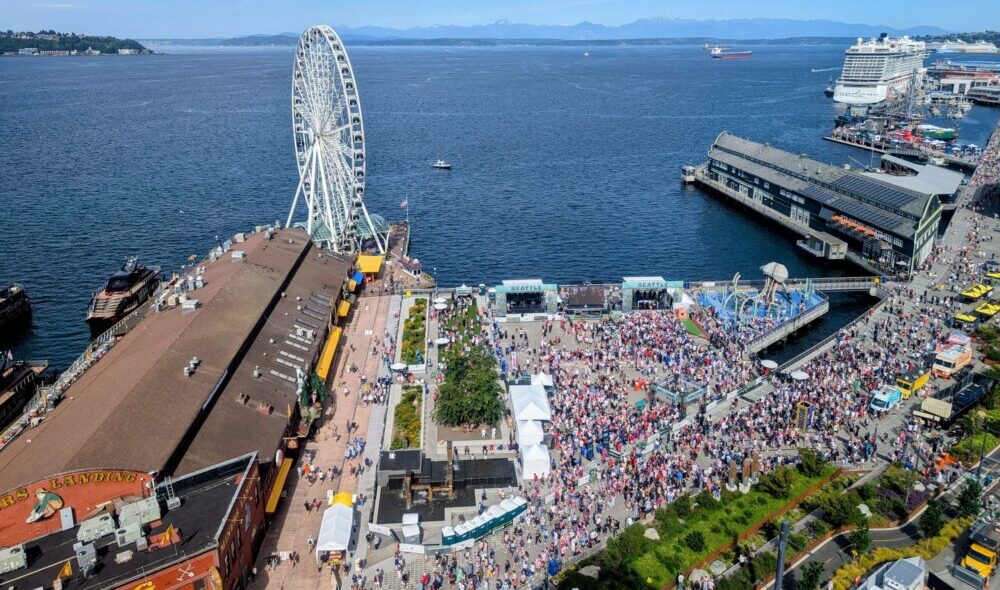

After a professional lifetime of journalism experience in Seattle, which included national and global sports, I presumed I had seen most everything. I was not prepared for what happened Friday in ol’ Dad Yesler’s little sawmill town.
The men’s World Cup came to town for a soccer match and was overwhelmed by a cultural waterfall. A shame for the Australians, unfortunate victims of a vibe measured in megatons.

“I feel the energy here,” Zlatan Ibrahimović, the iconoclastic Swedish superstar now working as a Fox Sports TV talent, said pre-match from the studio desk in Los Angeles. “Imagine what they feel in the stadium today.”
No imagination was required for the 66,925 ticket-holders, and thousands more headed to large public TV parties. They marched boisterously from the Harbor Steps and Waterfront Park through Pioneer Square, some reveling in the equine presence of Seattle’s Buffalo Soldiers on the Juneteenth holiday. In what is likely North America’s loudest open-air stadium, attendees and teams then gathered for the ritual salutes.
No music. No lead singer. Just a National Anthem that no one in the chorus will forget — perhaps a message to the world that the American sense of pride can neither be hijacked nor compromised.
In times of intense political strife, it was comforting to imagine that all the Americans in the crowd, for a moment, shared a single view. Fanciful? Yes. But this was not a day for rationality, only for sports irrationality.
I’m often bemused by those who say politics should stay out of the sports-industrial complex. While I wish it were so, In modern, professional sports, for better or worse, the two are always intertwined because so much money is available. Even when presidents are not narcissistic vulgarians, these power enterprises feed off each other.
Consider the Olympic Games. The Opening Ceremonies always include a parade of nations. As far as I know, the only multi-nation sports festival that skipped the custom was the 1990 Goodwill Games in Seattle, where all of the 2,300 athletes walked, hopped and gleefully trotted into Husky Stadium en masse, giving the world a glimpse athletics without flags. As you may have since noticed, neither the custom nor national goodwill caught on.
Belting out the anthem Friday caught on in other public places, such as Buckley’s on lower Queen Anne, Seattle’s best sports bar, where I joined several friends for the match. Tentative at first, the overflow of Yanks quickly grew loud and met the anthem moment. As did the game. The dominant, exuberant 2-0 triumph clinched the Group D stage for the Americans, who previously beat Paraguay 4-1 in their tournament opener. I felt bad for the Aussies, whom I enjoyed when they hosted the 2000 Summer Olympics in Sydney. I learned something then that likely still applies to their days in Seattle: Win or lose, they always seem to buy the next round. More, if necessary. So no gloating.
The Yanks, who were a modest 17th in FIFA’s final power rankings before the tourney, are guaranteed to move from the group stage to the knockout rounds, regardless of the outcome of their final group game Thursday in Los Angeles against Turkey.
Since several days remain to speculate on their chances ahead of a largely meaningless match, now is a worthy time to consider just what fueled (besides breakfast beers) the human tsunami that delighted global soccer, and marked the apex moment in Seattle’s sports-hosting history.
Seattle first became a national soccer headline on April 9, 1976, when the inaugural sports event in the then-much-hailed Kingdome was a North American Soccer League exhibition match between the Seattle Sounders and the New York Cosmos, featuring Pele. A crowd of 58,818, a record for North American soccer, watched the Brazilian superstar score twice. The NFL Seahawks and MLB Mariners came after, not before.
In the 50 years since, the Sounders have undergone multiple iterations and emerged as two-time champions in Major League Soccer, where they remain a premier franchise. The men’s and women’s college programs at Seattle Pacific University, Seattle University and the University of Washington are robust. And the Washington Youth Soccer Association registers about 86.000 kids annually. and has more than 150,000 members, including coaches, officials, administrators and volunteers. Enthusiasm is deep and wide.
From this passionate foundation grew an enterprise that in 2018 helped the U.S. soccer federation successfully pitch FIFA on a novel three-nation format, including expansion to 48 teams, to host the 2026 World Cup. In June 2022, Seattle was one of 11 U.S. cities chosen to host.
“I sobbed on TV when we were announced as a city to host,” Adrian Hanauer, Sounders majority owner, told The Athletiic, the New York Times sports section. “We arrived as one of the top soccer markets in North America,”
The most pivotal development in Seattle’s soccer history came in June 1997. After the Kingdome roof failed and the Seahawks nearly relocated to Orange County, Microsoft co-founder Paul Allen offered to buy the team.
The deal: Allen would buy only if the city and state provided $300 million in public funds the billionaire would use to replace the Kingdome with a top-shelf, open-air stadium just south of downtown that would also host the Sounders. Allen also agreed to fund all costs for a statewide election on the controversial Referendum 48. It received 51.1 percent approval. All parties agreed afterward that the soccer community’s embrace of the idea and the energy it poured into the campaign—which required a stadium that met international soccer standards—created the positive result.
The through-line from 1997 to the payoff Friday was underscored this week not only by the success of the first two of six Seattle matches — Belgium and Egypt drew 1-1 Monday — but by a story in The Athletic. Writers covering all matches in all venues were polled by editors to rank each venue by five criteria: Match-day experience, match atmosphere, transport and location, aesthetics and suitability for soccer/football.
The Seattle Stadium (Lumen Field) tied for first with Atlanta’s Mercedes-Benz Stadium. Each scored 47 of a possible 50 points. Worst was Met-Life Stadium in New Jersey, where the championship match will be held July 19.
Pity that there’s no re-draw for locations after the group stage. i think I know which site U.S. coach Mauricio Pochettino would want.
“After the game, I was emotional,” the Argentinian told reporters post-game. “The fans were amazing . . .The warm reception, the way they support us and the way they celebrate the victory. The players were very emotional too.
“It was amazing, and a perfect connection between the energy from the stands and the team.”
What else was needed? The all-sunny day peaked at 75 degrees. Beautiful day for a perfect connection to the Beautiful Game.
It took 50 years to nail the landing. But hey, it’s been 96 years since the U.S. won two in a row at the World Cup. Maybe all us anthem singers are in tune with each other and the sport.
Soccer is all about patient build-up.
Discover more from Post Alley
Subscribe to get the latest posts sent to your email.


Friday in the Square was crazy! In a good way. I’ve got my fingers crossed we get to host another USMNT game in the Round of 16.
There’s a slight chance the U.S. may meet Iran. Location unclear, but could be the Strait of Reflecting Pool.
Thanks for summarizing the decades-long “soccer backstory” which made Seattle’s World Cup celebration happen – not to mention triggering my own personal wave of nostalgia (you’re good at that).
You mentioned the perfect weather. My wife and I attended the opening ceremonies (celebration really – as you described) for the Goodwill Games on a 90- degree day at Husky Stadium (ugh). We attended several events, including a summer hockey game at the Tacoma Dome (yes, they used to play hockey there).
Regarding soccer, my personal favorite Sounders iteration was the NASL version that played at Memorial Stadium. Small venue, packed house – an unbeatable experience (Pele actually played a game there as well). The “Pele game” was the Kingdome’s opening event, and I remember being wowed by the building (yeah, yeah, I know) but also how strangely subdued it felt relative to Memorial Stadium.
Paul Allen was well into the philanthropy stage of his career; his purchase of the Seahawks from the odious Ken Behring kept the team in Seattle. As you described, Lumen Field is a great venue for soccer. Aside from the incredible game-day experience, the bulding’s architecture beyond compare (the view inside of the north end zone and downtown is iconic).
Of course, the new billionaire owners will very soon and disengiously deem Lumen Field as an “outdated and inadequate” home for an NFL franchise (not one iota of philanthropy coursing through their veins – that world doesn’t exist anymore). Followed by the inevitable “build us a new one or we’ll be “forced” to consider alternative locations” blackmail/thuggery. I hope we can call their bluff, but who am I fooling?
Soccer fans also helped push the Lumen Field vote across the finish line, as the proposition voters dangled the prospects of MLS and the World Cup in the stadium. Both arrived to roaring successes. There’s only one thing that keeps Lumen from absolute perfection for the NFL and soccer: no permanent grass field.
NFL owners want turf. Easier/less costly to maintain. Avoids the non-aesthetic, messy mud bowl spectacles in Nov/Dec. Makes it easier for teams to employ their pass-happy offenses (fans love this) all season. Short of MLS teams building their own stadiums (some have) this won’t happen
There’s a slight chance that Iran and the U.S. may meet. Possible location: The Strait of Reflecting Pool.
Memorial Stadium is being made over into a modern facility by the Kraken ownership. Their nickel, the public’s gain. Good of you to keep memories alive.
Should have replied sooner to this.
I thought that a “new” Memorial Stadium with ~ 25,000 seats would be ideal Adrian Hanuer/Sounders/City of Seattle Partnership. Perfect size venue, close to downtown, but heavy use by HS soccer/football would probably make a natural grass field impractical. Nostalgia only gets you so far I guess.
So off to Longacres we go?
New Memorial will seat roughly 6-8,000, and wide enough to accommodate soccer/rugby (old Memorial was very narrow for soccer). The MLR Seattle Seawolves will likely be the main non-HS tenant.
I’ve heard talk about both the Sounders looking for their own stadium and the next Seahawks owner wanting to replace Lumen Field. I disagree with both ideas, but that’s a discussion for another time.
Nicely written, Art; of all the local punditry and journalism regarding sports, yours “takes the cake” (in all the best ways).
I hoist a beer from Buckley’s in your direction.
A local soccer blog recommended visiting the stadium areas and tourist spots even on non-game days, just to soak in the atmosphere of a massive international tournament. I did that yesterday, and it was electric. Judging from T-shirts and soccer jerseys (Purdue, Atlanta United, Bosnia & Herzegovina), lots of domestic and foreign visitors were absorbing the waterfront and enjoying Seattle and its residents. The scene is replicated across all the other host cities in all three countries, and is exactly what the USA and the world needed.
While what’s coming out of the White House shows America as its worst, the World Cup is showing America and Americans at their best. Thank goodness.
Particularly these days, it’s great to be around people smiling, laughing and singing.