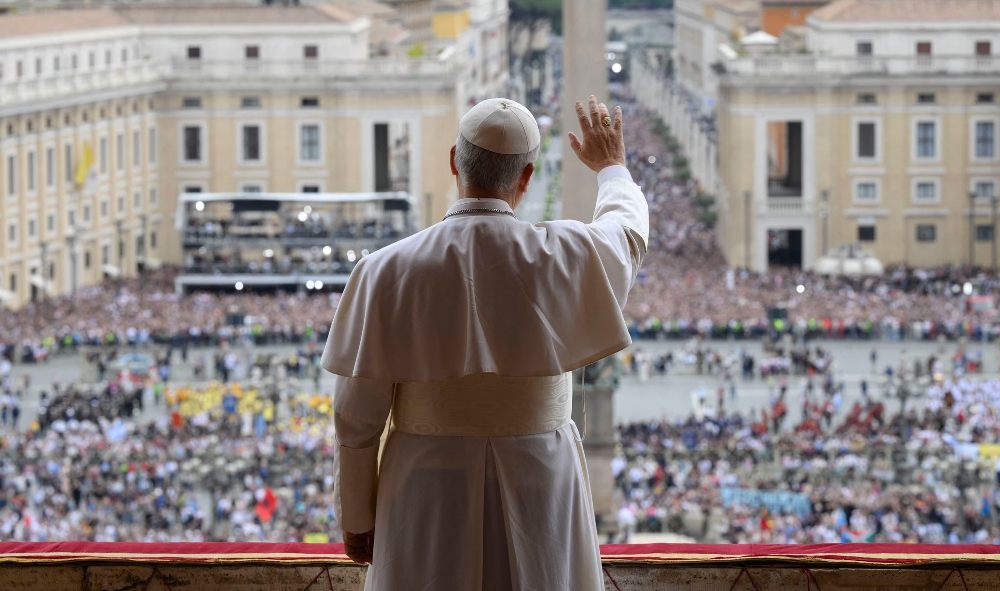

In 2005, white smoke rose above the Vatican, signaling the election of Pope Benedict XVI. That same year, the Seattle Seahawks finished their season 13-3, earning the number one seed in the NFC, and making their first Super Bowl appearance in franchise history.
Light years later, in 2013, the Catholic Church welcomed Pope Francis. Once again, the Seahawks finished 13–3, securing the NFC’s top seed, and going on to win the first Super Bowl in franchise history.
Last year, in 2025, the world watched as Pope Leo XIV stepped onto the balcony of St. Peter’s Basilica as the Church’s newest leader. Meanwhile, the Seahawks posted a 14–3 record, once again claiming the number one seed in the NFC and going on to win the Super Bowl.
Three papal transitions, three dominant Seahawks seasons, and three instances in which Rome chose a new spiritual leader and Seattle somehow found itself at the top of the football world.
At first glance, I enjoyed this thought insofar as a brief reflection of random trivia. After all, Popes come and go; football teams rise and fall; and the world keeps on moving. But I also believe that the brain is a stubborn pattern-seeking machine. As my mom often states, “there are no coincidences in life.” You can tell someone not to read meaning into coincidence, and yet they will wander right back to the dots and begin connecting them with neon thread. And at some point, the question presses forward anyway: why do Seattle’s best seasons blossom precisely when white smoke curls above the Vatican?
Statistically speaking, a conclusion most would deem “right” is easy: that this is merely a coincidence, or selection bias, or an overly enthusiastic fan with too much time and an internet connection on her side. But statistics, for all their elegance, are often allergic to wonder. I find they are good at flattening the world into neat lines and probabilities but are less good at explaining why certain coincidences feel so strangely charged. And this one does. It’s not just that these events happen in the same year around the same time — it’s that the moments in question are both about faith and expectation, of crowds holding their breath, waiting to see what kind of future will be announced to them.
Every time a new pope steps out onto the balcony, millions of people turn upward, both physically, and metaphorically. They imagine renewal, direction, and the possibility that institutions and people can change. The world becomes briefly, collectively focused. You can feel a pause in the static. I like to imagine that somewhere in that pause — maybe over Puget Sound, maybe just above Lumen Field — something shifts. Teams, like people, are porous. They absorb mood, myth, and story. And a city high on hope plays differently.
Of course, I’ve taken Stats in high school and college, and I know that that’s not how causation is supposed to work. If I were to line up a statistician and a theologian and ask which direction the arrows run, I’d get diagrams, p-values, and probably a sigh. But what if the mechanism is less linear? Maybe it isn’t that the Pope personally blesses the Seahawks’ offensive line (though that image is quite tempting) but that society becomes briefly synchronized around ritual and symbolism.
Institutions as old as the Church tug subconsciously at how we think about discipline, sacrifice, and destiny; and a papal transition reminds the world that leadership can change without everything falling apart. That eras can turn. Teams entering new eras, with new rosters, new strategies, and new leaders, suddenly find themselves moving with that same current instead of against it.
There is also something fitting about Seattle specifically being the beneficiary. As a Seattle native, I know I’m biased, but this is a city that lives at the intersection of the sacred and the secular: we offer tech campuses against backdrops of evergreen forests, coffee shops built in the form of chapels (shoutout to the Starbucks Reserve Roastery), and stadiums that function like cathedrals of noise. Seahawks fans, “the 12th Man”, as they’ve dubbed themselves to reflect the fans as the 12th player on the field, already think of themselves as participants in something quasi-religious. They stand, they chant, they wear ritual vestments in Energy GreenTM. Why shouldn’t they be sensitive to tremors in the global liturgical calendar?
You could call all of this magical thinking. But magic, like correlation, is often just a placeholder word for the phrase “we don’t completely understand this yet.” We accept that global markets shudder because of “investor confidence,” that a speech can “change the mood” of a nation, and that morale wins wars. We don’t insist on measuring every invisible current to believe that it’s there. And if collective emotion is powerful enough to sway economies, then why not football? Why not the precise arc of a pass on a freezing December afternoon?
And maybe the deeper truth here isn’t really about popes or Seahawks at all. Maybe it’s about the hidden architecture of meaning that human beings build around their lives. We tell ourselves stories so the world feels less like static and more like music. A papal election in Rome and a dominant football season in Seattle are, in most universes, unrelated events. But in ours, or at least in mine, I believe it can become a kind of call-and-response, proof that we are not just drifting through unrelated headlines, but living inside a narrative where threads surprise us by touching.
Correlation can become causation not just because a statistician proves it, but because we allow it to matter. The Church chooses a leader; a city chooses belief; a team chooses to play like the world is shifting underneath their cleats. And somewhere in that complex human choreography, I believe causation sneaks in through the side door.
So, maybe it is a coincidence. Maybe the statisticians are right, and these events share nothing except a place on the calendar. But every now and then the world seems to move in patterns too elegant to ignore. A new pope steps onto a balcony, a city rediscovers hope, and the Seattle Seahawks remind us that belief has always been one of the most powerful forces in sports.
Discover more from Post Alley
Subscribe to get the latest posts sent to your email.


A beautifully written commentary about connection, which may or not be a real connection. But, we can believe if we want to believe. Please include more of Carolyn’s commentary. It’s always a pleasure to simply enjoy exceptional and clear writing.
I loved this article. As a lifelong catholic and diehard Seahawks fan, this was right up my alley. There is so much humor and charm in Carolyn’s writing, I hope to read more from her in the future!
What Nate said!
This article was very insightful; I really enjoyed it and would recommend it to my friends. I am not biased at all
Go hawks
Ms. Yee
Many thanks for such a fun column! More, please.
Regards
A.S.