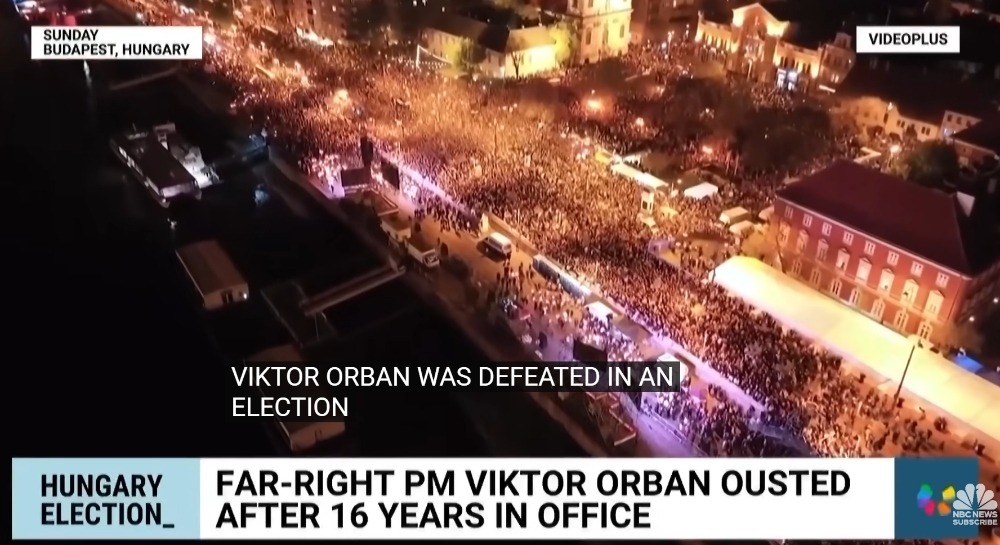

Jubilation over the election defeat of Hungarian Prime Minister Viktor Orban after 16 years in office has spread far wider than the crowded banks of the Danube where thousands partied like it was 1989.
The landslide victory of opposition candidate Peter Magyar in Sunday’s election heralds a dramatic shift in Budapest’s politics, away from Orban’s alliance with the regime of Russian President Vladimir Putin and the authoritarian creep of U.S. President Donald Trump.
Orban spent his premiership dismantling the former Soviet satellite’s post-Cold War democracy. He has been a thorn in the side of the European Union for years. He defied EU immigration policies by building a Trump-inspired barbed-wire wall to keep out African and Asian asylum seekers and torpedoed EU assistance to Ukraine in its fight against Russia’s invasion now in its fifth year.
Magyar, 45, and his Tisza party are expected to quickly clear the way for a 90-billion-euro ($104 billion) wartime loan to Ukraine that was approved by all EU states last year. Since then Orban had been exploiting the EU’s policy of requiring unanimous final votes on important policy initiatives, holding up assistance to Ukraine and frustrating Kyiv’s desire to align with Western democracies.
Trump deployed Vice President J.D. Vance to Budapest a week ago to bolster Orban’s last-ditch battle against sinking poll numbers on the eve of the election. Magyar’s opposition movement had been rising ahead of the vote as Orban’s Fidesz administration faced accusations of rampant corruption and collusion with the Kremlin.
Vance appeared with the embattled Hungarian leader at rallies ahead of the vote and accused the EU alliance of “one of the worst examples of election interference I have ever seen or ever even read about.”
The vice president also rattled U.S. allies in February 2025 when he disparaged the EU and NATO at the annual Munich Security Conference during a visit to boost the electoral prospects of Germany’s far-right Allianz fuer Deutschland. Vance’s intervention then failed to deliver an outright victory for the movement that had been gaining support amid similar anti-immigrant sentiments.
Orban’s polling numbers continued to tumble after Vance’s visit, spurring predictions by Trump administration critics of coming setbacks for congressional Republicans in the U.S. midterm elections in November.
Public sentiments that had been increasingly critical of Orban and Fidesz drove record turnout to Sunday’s vote in which Magyar’s Tisza party won a supermajority of the 199-seat Parliament. That will allow the new leadership to quickly reverse the anti-constitutional changes Fidesz lawmakers made in attempts to tilt the electoral system in favor of the longtime incumbents. The victors are also expected to seek unblocking of 17 billion euros ($20 billion) in EU funds withheld from Hungary for the defeated administration’s democratic backsliding.
The ousted prime minister was more gracious in defeat than was Trump when he lost to President Joe Biden in the 2020 U.S. election. Trump declared the election stolen, boycotted Biden’s inauguration and spurred the Jan. 6, 2021, rioting at the Capitol aimed at blocking certification of the 2020 vote.
“I congratulated the victorious party,″ Orban told followers Sunday night when the returns reached an insurmountable volume in favor of Magyar. “We are going to serve the Hungarian nation and our homeland from opposition.″
Magyar campaigned on the pocketbook issues that, as among American voters, are foremost in the minds of Hungarians struggling with high inflation and shrinking growth. Hungarians also had grown increasingly wary of Orban’s cozy relationship with Putin at the expense of Western democracies.
Hungary was the first Eastern European country to adopt political reforms in the late 1980s, after the last Soviet leader, Mikhail Gorbachev, struggled and eventually failed to end the economic and political disasters that led to the 1991 collapse of the USSR.
Orban was a leader of Fidesz in its earliest iteration as the opposition party joined other democratic forces to defeat communism during the first multiparty elections in the Communist bloc in March 1990. His politics turned to the right and inclined toward Russia after his return to the Hungarian leadership in 2010 after a period out of office when his Fidesz allies implemented new laws consolidating the party and its leader’s authority.
While expectations of a retreat from Orban’s autocratic legacy are eagerly awaited, Magyar has suggested he would retain Hungary’s reliance on Russian energy imports. Tisza also takes a skeptical view toward some suggested reforms to EU immigration policy
“Orbán’s defeat capped a week of failure for Vance and Trump, a sign of Trump’s own diminishing power that may end in a midterm defeat as humiliating as Orbán’s,” wrote Jennifer Rubin, a former Washington Post columnist now posting The Contrarian blog via Substack. “Trump, despite his bluster, looks smaller and more isolated than ever.”
Trump’s waging war against Iran without the approval of Congress or NATO allies and his intensifying feud with Pope Leo XIV over the war’s deadly consequences are further undermining his standing with U.S. voters and Western allies. Trump on Monday posted an image of himself clothed and illuminated in the manner Jesus. The heavenly portrayal outraged leaders of the world’s 1.4 billion Catholics as well as some of the Christian nationalists in his MAGA movement who denounced the divine self-image as sacrilege.
Orban and his Fidesz party campaigned on a stridently anti-Western platform, posting billboards disparaging Ukrainian President Volodymyr Zelensky and blaming Kyiv for Hungary’s stagnant economy and failure to timely repair a fuel pipeline from Russia that crosses Ukraine enroute to delivery to Hungary and Slovakia.
European Commission President Ursula von der Leyen cheered Magyar’s victory as a huge relief from the Hungarian leader’s ability to block alliance policy and priorities. She called for the alliance members to “also look at the lessons learned inside the European Union” and remove the shackles of the unanimous vote requirement on important foreign policy matters.
Putin invested heavily in Orban’s corrupt and illiberal administration, conscripting members of the once-leftist Fidesz party to leak information to Russia on EU strategy and security on aid to Ukraine and its hopes of joining the 27-nation economic bloc and ultimately NATO.
Discover more from Post Alley
Subscribe to get the latest posts sent to your email.