
I was born in 1942, just 10 months after Pearl Harbor and our entry into what would become known as World War II. Uncles were in the war. One died in the last months of the war in the Pacific; I knew Uncle Russell only from talk and pictures, one of him in his uniform with three-year-old me. The other uncles, who had been in Europe and North Africa, didn’t talk about it much. My dad had been semi-safe during the war, putting radios into B-29s in Utah, flying with them to make sure they worked. Mom took his job at the Post Office and her mom cared for me.
It was only much later, when my high school teachers were GI Bill guys who’d been in the War and were often the first in their families to go to college, when that grandmother who cared for me prayed every day over 80 years to allow the Lord to help her forgive the Japanese for Russell’s death, and when I began reading about the War, the Holocaust, and the Japanese internment camps, that the extent of that war—the reason it was called a World War, become part of my knowledge.
I knew about the atomic bomb when I was still in elementary school, because they were doing tests in the Nevada deserts and we could—or thought we could—see mushroom clouds in California. We could not fathom the numbers of deaths and the severity of destruction of these bombs. I remember early wondering about why the second bomb, on Nagasaki, was dropped, and remember seeing pictures of people dying of the burns from those blasts.
We learned the horrors of Hitler and the killings of Jews and Gypsies. I did not learn until later that the concentration camps also held, and killed, gays and communists. We did learn about Stalin and the labor camps, about brutalities there. Because WW II slipped into the Cold War, and Stalin, our erstwhile ally against Germany, became our enemy, his atrocities were told. Arthur Koestler’s Darkness at Noon taught us about mind-bending and brain-washing and forced confessions.
Only later—maybe after Kurt Vonnugut’s 1969 book, Slaughterhouse Five—did we begin to realize how much civilian damage the allies had perpetrated in the bombings of Dresden and other civilian cities in Germany, and in the fire-bombing raids on Tokyo before the atomic bomb.
In general, growing up in the 1950s, we saw ourselves as war victors with good hearts. After the War, we were caught up in the Marshall Plan that helped get Germany on its feet, and the promotion of small consumer products from a defeated—and military-free—Japan. We quietly reintegrated Japanese—including many who were already American citizens—out of the internment camps and into society. Our family sent CARE packages to Norway. We were benevolent war winners.
In the 1950s, there were Red Scares, the John Burch Society, and President Eisenhower’s warnings of a “military industrial complex” that might push us into future wars willy-nilly. We were largely unaware of anti-colonial uprisings around the world, but especially in Africa.
We were aware of Civil Rights activities at home, and followed Martin Luther King’s arrests, marches, and words across the South. American Indians took heart from Black activists, and began their own journey of discovery of and righting of ancient wrongs—of crooked treaties and stolen lands. Of boarding schools and prohibitions against Indian dress and religion.
When John F. Kennedy asked us to “do for our country,” we wanted to. He led me and thousands of others into the Peace Corps, where we believed again that we were the white hats extending hands across the globe.
And then came Vietnam and Laos and Cambodia, thousands of our own people killed and millions of people from those countries. Dark times again, but maybe, buoyed by the positive 1950s, many young people thought we could stop that war. Songsters and the organizing principles learned in Civil Rights work gave us courage, and, with great difficulty and the loss of thousands of additional lives, Vietnam ground to a close.
Today—thousands of innocent civilians flee drought and oppression and poverty in North and Southern Africa and South America and Yemen, Syria, Afghanistan, Myanmar, and more. China oppresses Tibetans and Uyghurs.
We shrug with indifference about the endless war in Ukraine, as thousands—maybe millions—of Russian troops and poor mercenaries from around the world become drone and missile fodder in that awful war. Ukrainians die too, in schools and apartment buildings attacked by missiles and drones
Meanwhile, we seal our borders tight, and let other countries take care of migrants sent by war and climate disasters. (Our population is shrinking, as more people leave—voluntarily and by force—than are born and immigrated in.)
And the bombs and missiles we build, drop from our own and Israeli planes on civilians and militants alike in Iran. In Lebanon and still in Gaza the Israelis hunt for the last Hamas—and probably create more Hamas sympathizers in the doing.
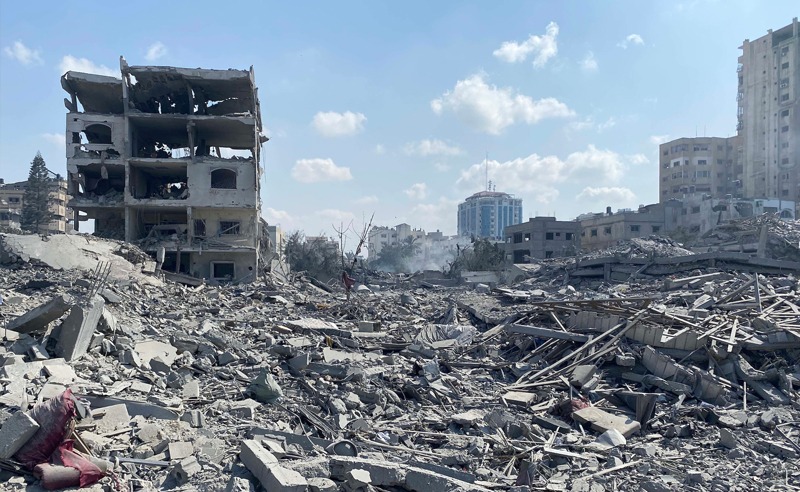
This little corner of “Holy Land,” of Gaza and West Bank and Israel and into Lebanon might currently be the darkest place in the world. More might be dying in Somalia or Sudan or Russia, but Gaza, home to the major religions practiced in the West, has been destroyed as over 60,000 Gazans have been killed, and millions have lost their homes. Similar bombing tactics are reducing Lebanon to rubble too, and homes and orchards in the West Bank are reduced for new Israeli settlements. The early war photos from Iran show us similar rubble.
The very dark part of this entire scene is how Israel has become a pariah state in the larger world. And how, simultaneously, Anti-Semitism is growing rapidly in our country, and in England and other Western places too.
Anti-Semitism is as old as the Christian scriptures, but we thought we had largely overcome it in the aftermath of World War II, in some Jewish people taking up good lives in America, England, and other countries, and Israel forming a state and taking in refugees from the diaspora.
Now, in London, a woman on BBC radio says that she no longer feels safe in England, where generations of her holocaust surviving family have thrived and now feel threatened. Synagogues are attacked in our country, where American Jews have traditionally and generously supported the state of Israel. Yet many are opposed to Israel’s multi-fronted war. Anti-Semitism doesn’t care.
And our president uses the Anti-Semitism tag in what seems to be his own wars on universities. Jewish students—and Muslim students too—are caught in the middle of a conflict that they did not begin and do not fathom.
None of us do. It is hard to fathom long-distance killings by drones and missiles, killing on the basis of religion. Hard to imagine regimes that kill or permit the killings of their own citizens, as the regime in Iran continues to do. Regimes—or democracies like Israel’s and our own, that destroy ancient churches, mosques, and new hospitals, schools, and apartment buildings.
What the new apparatuses of war have given us is rubble on industrial scale. Not since World War two has there been such rubble and so many refugees. “Rubble and refugees” is the new hallmark of our dark times.
Discover more from Post Alley
Subscribe to get the latest posts sent to your email.


Thank you so much. It helps to read the darkness articulated.
I wonder if Trump privately dismisses the horrific numbers of dead civilians with his infamous “losers and suckers” taunt describing American soldiers who were killed fighting in the Second World War. Trump has since denied making those comments. But former House Chief of Staff John Kelly, and Associated Press reporters asserted that they heard Trump using those very words.