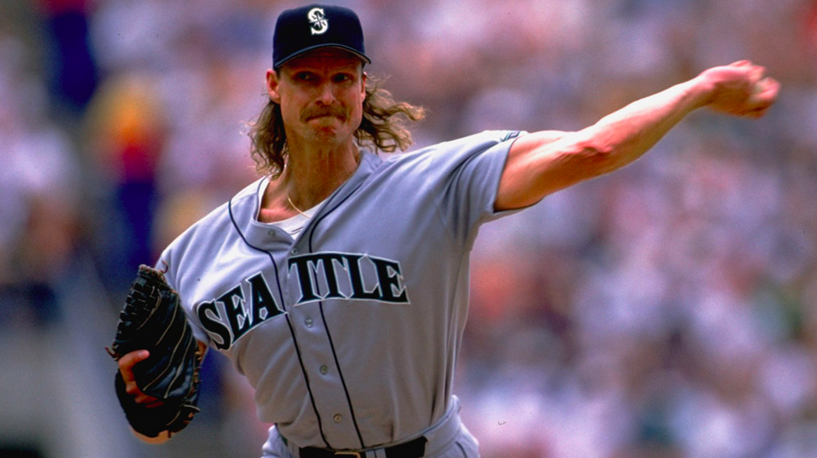

A good case can be made that in the mid-1990s, the three best players in Major League Baseball were Mariners. Randy Johnson won the 1995 Cy Young Award as the American League’s best pitcher. In 1996, Alex Rodriguez won the American League batting title and finished second in the Most Valuable Player voting. And in 1997, Ken Griffey Jr. won the MVP award unanimously.
Record numbers of historically woebegone fans, including nearly 3.2 million in 1997, watched the spectacle in the Kingdome. Also watching was nearly every baseball front office with a team in contention, certain that the low-revenue Mariners would never be able to keep all, or any, of their superstar talents, when their contracts were up.
They were right.
Johnson was traded to Houston in mid-1998, Griffey was traded to Cincinnati after the 1999 season, and Rodriguez left in free agency for Texas after the 2000 season. As longtime Mariners fans recall, each departure was accompanied by lamentations, condemnations and recriminations.
This recounting here is inspired by a warm ceremony Saturday at the ballyard when Johnson, now 62 and 28 years removed from his last Mariners game, finally received the club’s highest honor. The retirement of his jersey number 51 included hugs, laughs, video salutes from baseball legends and flattering accounts of remarkable deeds done by the Big Unit. All the event lacked was couple of cherubs with trumpets.
The Mariners often don’t handle exits well. But they sure clean up nicely for returns.
Alas, there was no pre-event press conference to quiz Johnson about his eventful decade in Seattle. His only public words came in an 11-minute speech that he read in a sincere, stoic fashion. While it lauded teammates, fans and the organization, it lacked Johnson’s fastball — the oral kind. That omission was probably part of the deal to make the Saturday event happen: No lamentations, condemnations or recriminations from the Unit, and no annoying questions from the media.
The club wanted no repetition of what happened a year ago, when the event was announced.
In a mid-game interview in the ROOT Sports booth, Johnson volunteered that he was dismayed the jersey retirement honor hadn’t come earlier. He believed it was a diss directed by former CEO Howard Lincoln. He was in ownership when Johnson, Griffey and Rodriguez departed. Johnson said, “I felt like under his leadership, my contributions over 10 years were swept under the carpet.”
Lincoln retired in 2016. Johnson ended his 22-year career in 2009. Apparently, some feelings die hard.
Absent the horse’s mouth, I sought out Jay Buhner, noted Johnson horse whisperer and one of the heroes of the 1995 team that helped save baseball for Seattle. He interrupted a stay in Maui to fly in for the event and was hanging out in the Mariners dugout. He wasn’t surprised to learn Johnson still sometimes holds the world at the length of his considerable arm.
“Why are you gonna put that little cloud over things?” he said of Johnson’s ceremony agenda. “Can’t you just say thank you, and be appreciative? That’s something that pisses me off. People here love him.”
Like others around the club back in the day, Buhner found Johnson’s combination of intensity, remoteness and obliviousness a hard cope. It wasn’t helped by the fact that he shared a clubhouse with fellow superstars Griffey and Rodriguez. Each thought the club favored one or the other. Getting this clubhouse to work together might have been the greatest feat of Lou Piniella’s 10-year managerial tenure in Seattle.
Eventually, things unraveled. Nearing the end of his contract, Johnson in 1998 wanted to be the game’s highest-paid pitcher, which meant topping the $11 million annually going to Greg Maddux. But the Mariners decided not to make an offer. Johnson sulked. His first-half record was 9-10 with a 4.33 ERA. After a trade-deadline move to Houston, he finished 10-1 with a 1.28 ERA. Teammates and fans were furious.
Years later, Piniella told me for my book Out of Left Field that ownership devised a plan for a new stadium that amounted to sacrificing the 1998 and 1999 seasons financially. The state and county approved funding to replace the Kingdome in 1995, and the owners wanted the much larger revenues as soon as possible. A fast-track schedule was set for opening day of 1999. That was soon pushed back to the ’99 mid-season. Fearful of further delays, owners became risk averse. They eventually made big offers to Griiffey and Rodriguez, but neither wanted to play in the pitcher-friendly new park — or in Seattle. No choices were left.
“We were tearing down the team to get ready for the new park,” Piniella said. “You couldn’t do it at once. It had to be done over a two-year period. We took our lumps, but it was the right thing to do. If we get beat, so be it.
“No question there was a conscious decision. I was asked if I was prepared. I said yes. I couldn’t say that to the fans, players or anybody, but that’s exactly what it was. We were putting together a new stadium, and it turned out to be a nice strategy.”
The secret plan paid off. Safeco Field opened in mid-1999. The re-made Mariners, flush with new revenues, won 91 games in 2000 and reached the AL Championship Series. In 2001, they put together one of the greatest regular seasons in MLB history — 116 wins. The All-Star Game was coincidentally in Seattle, where eight Mariners were selected: Freddy Garcia (RHP) and Mike Cameron (CF), both acquired in the Johnson and Griffey trades, along with Ichiro Suzuki (OF), Edgar Martinez (DH), John Olerud (1B), Bret Boone (2B), and relievers Jeff Nelson and Kazuhiro Sasaki. All managed by Piniella. It made for one of the greatest weekends in Seattle sports history.
Johnson in 2001? He helped the Arizona Diamondbacks, in their fourth season, beat the Yankees, who eliminated the Mariners in the playoffs, to win the World Series. Johnson was 3-0 with a 1.04 ERA.
The Unit replicated in the Series the legendary deed performed in the Kingdome during the fateful 1995 series against the Yankees — pitching in relief on short rest. His walk from the bullpen to the mound to begin the ninth inning remains the single most intense moment of sports passion in my experience, in part because of the tension of an unknowable outcome.
“It was hair-raising — I know it sounds funny for me to say that,” chrome-domed Buhner said. “His career was on the line (due to the potential for injury). But we’d gone the whole year to get to this point, and he’s stepping up for us. Then he did his thing. Just chills.”
Now that the Johnson arc in Seattle has become a full circle, it’s easier to remember Johnson for deeds over words.
Discover more from Post Alley
Subscribe to get the latest posts sent to your email.


Excellent perspective. Totally agree. Spot-on… Art! THANKS.
One of the most mysterious dudes I’ve encountered.
Your articles always provoke a smile and the occasional chuckle, Art; thank you. Author, author!
Working my way up to a bellylaugh.
Having been a big fan in those days, I remember very well when Randy was in the dugout as he waited to hear of his fate. During that broadcast, we all found out when he was traded. Thanks Art for a good look back to that interesting adventure.
Mid-game trades are rare. Just like Randy.
Nobody but Art Thiel can put the game, and Seattle’s tangled sports history, into such clear perspective.
I loved prime Randy Johnson here, between 1993 and 1997; you knew you were going to see at least 10 strikeouts and 100-MPH heat. At the same time, given what seems to be a prickly personality, I wouldn’t go out of my way to meet him.
Thanks hugely, Art! I’ve been reading your sports columns for years, and they are always very insightful and enjoyable, and I especially like your look into the politics and the personalities behind the game.
I was a huge Randy fan (and still am) and was sad to see him go. Superstars in every field are sometimes not the warm and fuzzy personalities we would wish that they were, but for me it’s the talent and dedication that is more important. I’m not sure that it’s always possible to have both; the warm and fuzzy can be a distraction from the focus required to perform at that level. It sure seemed at the time that they were sacrificing the team to build a new stadium, and we were all pissed off. I still don’t like that. But it’s in the past so it is what it is. I’m just mostly glad that Randy won a Series ring, something that sadly Ichiro never got to achieve.
Thanks again!