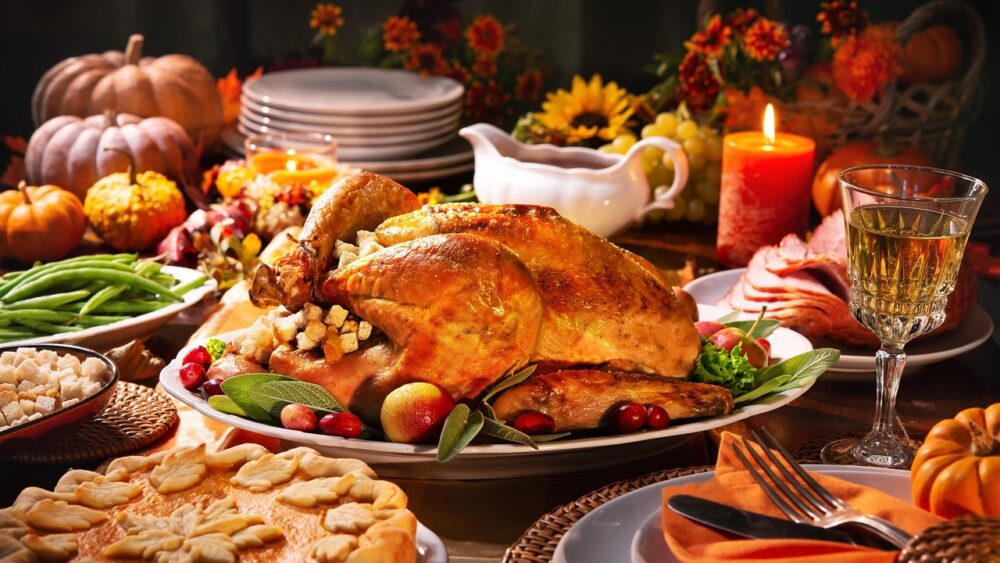

This week, for the fourth year in a row, my wife has been asked by one of the local restaurants to be the guest chef for an authentic American Thanksgiving Dinner. Although we view this as a holiday unique to the United States, it seems to be one of the many things about American that completely fascinates Italians. Not long after the restaurant announced the dinner, reservations began to roll in.
This, to me, is surprising in that the manner in which Italians dine is entirely different. Large meals, especially for holidays and special occasions, are eaten in a sequence of courses. Each item is presented on its own plate – often artfully arranged. The idea is that each dish should be savored on its own and enjoyed along with conversation and, if course, copious amounts of wine.
A number of years ago, we invited an Italian friend to join us at home for the Thanksgiving dinner. She said she had always wanted to have an authentic version. When we presented here with a single plate piled high – as usual – she looked dismayed. We watched her use a fork to slowly group the foods into different sections, eating them in the normal Italian order. So much for ingrained eating behavior.
Over the ten years we have lived in Italy, we have noticed other “Americanisms” creeping in. A few years ago, on the evening of Halloween, a handful of children came to the door, knock, and screeching “Dolcetta o scherzetto!” — the Italian version of Trick or Treat — when the door opened. In recent years, the number has increased to small mobs of kids roaming about, going door to door with their screams and open sacks. I’ve spotted no costumes yet, but that could be next.
A few years ago, Italian merchants adopted “Black Friday” as a marketing technique. But here it’s not just the days immediately following the fourth Thursday. It is essentially an entire six weeks prior to Christmas. Despite the verbal connection to a specific day, discounts on clothes, toys, and even foods are available from mid-November. Big signs and ads proclaim this on-going offer. Regardless of the positive meaning here, to me, Black Friday will always mean out of control adults in a suburban Walmart threatening to gouge each other’s eyes out over the last Cabbage Patch doll or 72″ big screen TV.
Year by year, English words are sliding into advertising and daily conversation. Words such as “shopping,” “stop,” “smart working,” “weekend,” and “fake” are making frequent appearances. Cuss words – always ripe for linguistic plagiarism – abound. We once had a conversation with a young couple, the male of which would frequently punctuate his points with “What the F*ck!”
I find myself confused when Italian friends tell me they are taking a “Pullman” — i.e. a charter type bus, as opposed to a city bus. I have always associated that term with a particular type of railroad car – containing sleeping compartments — in use for a century across the U.S. until the 1960’s. For some inexplicable reason, Italians have adopted it.
A recent malapropism here has sounded, to me, like fingernails on a blackboard (Talk about dating myself instantly). A couple of years ago tourism bureau of our region of Marche adopted a slogan to promote English-speaking people to visit this area. I look at it as monumentally terrible advice from someone.
The big tagline that dominates every ad is “Let’s Marche!”
I am troubled as well as bewildered. Most English-speaking people have no idea that the Italian word “marche” (unlike in French) is pronounced “mark’ay.” The tagline invites an unknowing reader to deliberately say the name of the region incorrectly. Or else, the play on words doesn’t work.
I suppose someone thought it might be cute to imply marching, but that makes no sense either. Apparently, someone did point this out. The graphic designer added “Go” in between the two words as if it were an editorial correction. Unfortunately, Let’s Go Marche” makes even less sense. Someone else might have interjected, because another version has “Visit” as the insert. Again, in a different font, like it’s a correction. Ok, “visit” does make sense. But inspiring? Hardly. Some rethinking is probably in order.
Nonetheless, the regional tourism bureau has touted that the number of annual international visitors increased from half a million to three quarters of a million — an impressive 50% increase. However, to put that in perspective, the numerical uptick is essentially a rounding error for nearby Tuscany’s 15 million visitors per year. A mecca for international travelers, Marche is not. However, it is immensely popular with Italian families who flock to its beaches, seaside camping grounds, weekly festivals featuring food and live music. Marche is a summertime destination to escape the high temperatures and daily tourism chaos in the bigger cities.
On their vacations Italians can enjoy “hamburgers” cooked on a “barbecue” or “Tex Mex” tacos at the many “street food” festivals. They can polish off the meal with slice of “cheesecake.”
But hey, Americans have their own baffling linguistic problems with expecting to find food in Italy like spaghetti and meatballs, pepperoni pizza, chicken parmesan, fettucine alfredo, and garlic bread. None of which are actually found in Italy.
Discover more from Post Alley
Subscribe to get the latest posts sent to your email.