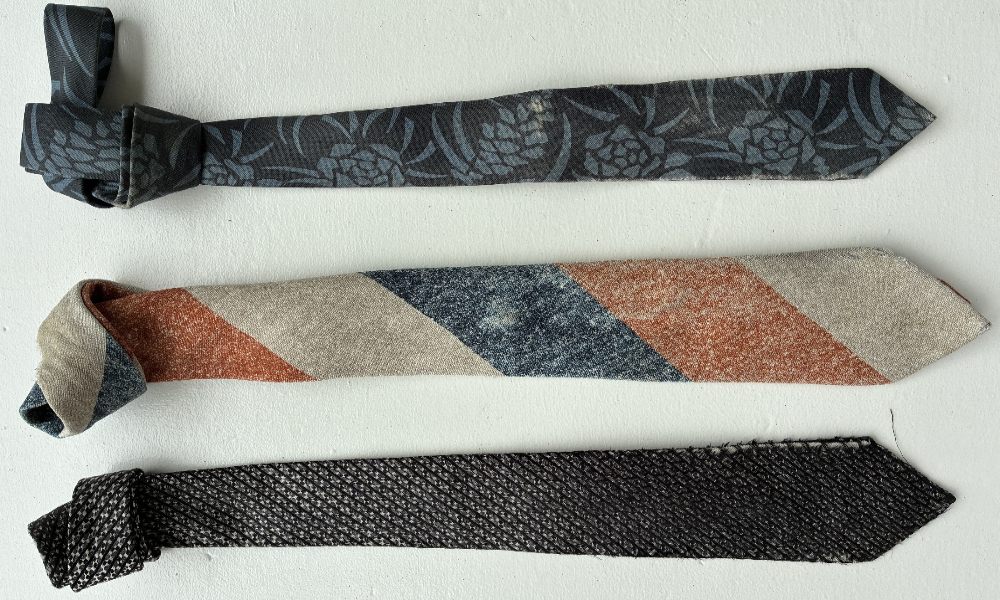

Three veteran ties, each with long and highly praised careers, meeting on a summer’s morning. They are each stars, for more than forty years, seizing mornings and days, honoring evenings, charming partners, completing a subtlety and style. They were champions, and as times changed and new rivals emerged, many ties retired and dated themselves.
But not these three. When you put these three on, you were dressed, you were as good as could or would need be. They are De Niros and Bacalls. When they were correctly matched, with shirt and collar, jacket and pants, when they were in place, then forget it. They were the condition, the optimism, the detail, the sense of attention.

They are each, in their own way, remarkable, but it would not have been possible to predict how illustrious their careers would be. Illustrious, for a tie, is of course many factors but none more obvious than simply, “Nice tie.” People have lost the habit of a tie. Few think of it as a figure, as a sound, as a factor — it is as if you simply left the cello out of the orchestra, left the bass out of a rock band, left the belt out of the design of pants. Yet, they see perfectly the tie when it is in its best place.
I suggested to Filson, the clothing design company, that they present two new ties each year. There are few companies further from even the thought of ties than Filson, no one wears a tie with a Filson shirt, nor even imagines doing so. But I imagined a very specific Italian design for the Filson, a few lines simply and I could see that, while still a long shot, it would be quite handsome. It would be Filson, out ahead.
The tie has poor connotations, of politics and power and class, but these would be gone should the new generation take up ties. Had you asked me to invest in the Thermos bottle, forty years ago, I would have thought of Ralph Kramden and laughed. But had I done so, today I would be wealthy.
The three ties do each show the wear and tear of time. They have never been dry cleaned, which can take some of their very blood. But they have gone to work, many many times, and been handled, tied, and faced the weather. Their edges are worn, their stitching softened, their tips rubbed plain. They are, so to speak, nicked ties.
The villains to a tie are the oil of one’s fingers, the bit of cappuccino left in the cup, the gravy or the tomato soup. Sometimes, when in a hurry or things go poorly, the tie is all but torn off to be removed. The best of times are when the tie is being put in place and adjusted. Then, like its true cousin, the silk scarf, the tie is an elegance, felt in the palm of one’s hand, folded carefully over, dimpled, secured and touched, as you touch a child’s arm.
The oldest of these three ties, and perhaps the subtlest, is the Gianni Versace, narrow with a repeated pattern of black and silver, on the diagonal. You feel the pattern, you never specifically see it. It is a tie you could wear to your greatest wedding, your longest dinner or a Saturday morning. It is the pure intelligence of a tie — I shall miss it immensely. One six-inch length of its edge has lost the stitch. It has perhaps a dozen more occasions. I may not be able to wear it but I will never give it up. It was expensive at the moment and is now, of course, invaluable.
The lovely three-color band tie surprised me – it was a gift from my daughter, who found it at NK, the Department Store in Stockholm and knew it would please me. Sweden is not known for ties but this one from Stenstrom, with a sky-blue backing, simply outworked its modesty. It seemed that each time I wore the tie, it gained confidence and power. Soon enough, I would bring it for its wonderful buoyant spirit and know that it would simply please. It has lost some color and has frayed its tip but remarkably, like a Swedish actor, it is still near perfect.
The third tie is an Armani summer tie – narrow and natural. The wonderful architect, Glenn Murcutt in Sydney tells the story that when his spirits need a lift, he goes downtown and buys an Aalto glass vase. He has them in every room. That is how I felt about Armani ties. They never failed to cheer me. I have bought them in Milan with Bill Stout, in New York City on visits, at Butch Blum in Seattle. They are my favorite author, so to speak, and I have read and loved all of them.
This one, this skinny thing, is perhaps the hardest worker for it has little to work with — simply a deconstructed sketch of a flower, interpreted up its length and back. Still, when it is in the frame of a simple colored shirt, even a textured one, then it is not unlike Mick Jagger, rehearsing in plain clothes. It is what you quite naturally see.
At the moment, there is a sad bigotry to ties. It is the tie as a kind of noose. Red means this, blue means that, stripes mean this. And the blaring does little to the honor and history of the tie. But, like music, like art, like film, like theater, like literature, it is the actual detail, the actual presentation, the actual voice that eventually comes and wins. We are the full range, like it or not, of color and flower, of passion, sound and touch. We are not two-tone, we are a thousand tone, and a thousand more in seconds.
You wear a different tie on light days than dark, on warm days than cold, on winter days than summer. You wear a heavy tie, for its warmth, and a bright, light tie for its dance. And you never wear the same tie two days in a row – there is always someone who will notice.
The brilliance of this world – that is its brilliance.
Discover more from Post Alley
Subscribe to get the latest posts sent to your email.


Peter
Thanks for another great column. Undoubtedly a sign of our ages that nostalgia evokes so many memories.
For me wearing a three piece Italian suit from Jeffrey Michael (with one of my 50+ ties on, of course) every day on my way to my job of managing The Seattle Club.
Years ago when I was buying ties, I was a Hermes tie guy. I think would still be, if I bought ties. Thanks for this story!
These are the ties that bind, and they are lovely. A fine eulogy to a subtle garment that reminds me that there is beauty in the details. Did you know Bruce Springsteen wrote a song about ties? https://www.youtube.com/watch?v=5LqOgFrfuJY
I’ve always thought Pediatricians have the best ties, but it’s a niche market.
Thanks Peter. Nice ties, but I’ll stick with the two I own. Pepe Le Pew in vivid black and white and King Kong holding his blonde love on top of the Empire State Building. Either goes with everything I could possibly think of wearing.
Lovely! I’m hanging onto my collection, both bows and longs, no matter what, just to honor their service and, perhaps, to remember ‘me’.