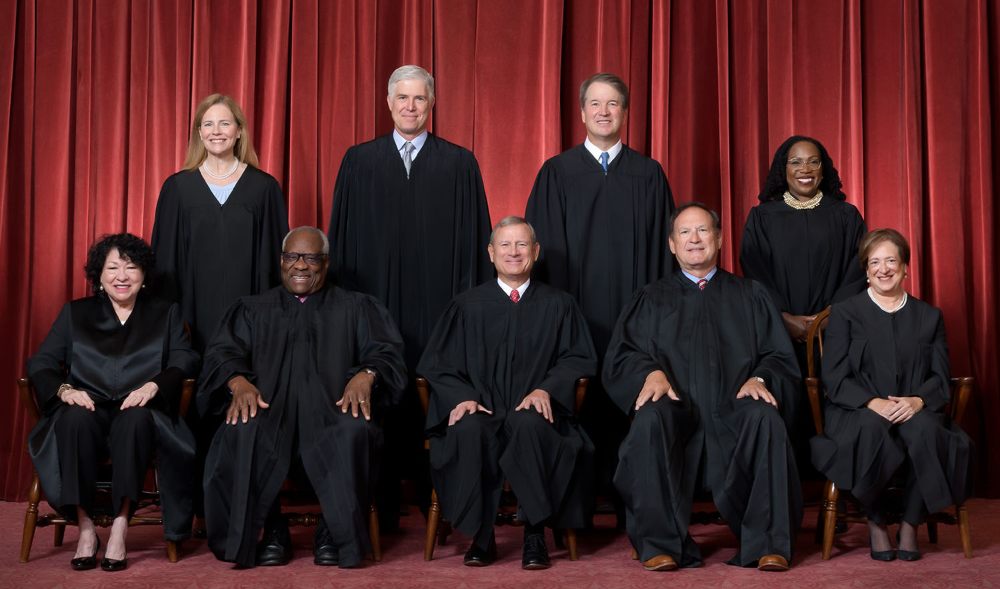

The US Supreme Court’s conservative majority has committed another judicial abomination, driving a final stake into the heart of the 1965 Voting Rights Act and in the process giving Republicans a good chance of holding onto their majority in the House of Representatives and giving Donald Trump a good chance of dodging his much-deserved third impeachment.
The Court outlawed so-called “racial gerrymandering”— the creation of majority-minority districts designed to ensure Blacks, especially, fair representation in the states of the Old Confederacy in the US House.
The Voting Rights decision lowered the public’s respect for the Court to a record 61% disapproval, according to Gallup and the Marquette Law School. Also, 68% say the Court is “primarily motivated by politics” rather than the law, and 57% say the Court is “going out of its way” not to rule against Trump. Seventy-four percent favor 18-year term limits for justices (as opposed to current lifetime appointments) and 81% favor binding ethics rules to stop, for example, Clarence Thomas from taking expensive favors from persons with business before the Court.
Despite Chief Justice John Roberts’ frequent claims that the Court is not political, it is seen by the public as pro-Republican and pro-Trump—partisan rather than politically neutral. Roberts, sadly, has led the decades long effort to eviscerate the Voting Rights Act. In 1982, as a young Justice Department lawyer in the Reagan administration, he argued vociferously against reauthorization of the Voting Rights Act. All six of the majority justices were appointed by Republican presidents—George HW Bush appointed Thomas; George W Bush, picked Roberts and Samuel Alito; Trump, put Neil Gorsuch, Brett Kavanaugh and Amy Coney Barrett on the bench.
Their latest decision was blasted by the Court’s liberals, Elena Kagan, Sonia Sotomayor and Ketanji Brown Jackson. Kagan, the lead dissenter, said the majority was acting as if “the long history of racism in the South” had simply evaporated and had no influence on how electoral maps are drawn today. In a more colorful expression of the same thought she said that “to dismantle the protections of the Voting Rights Act now, when the winds of voter suppression are gaining strength, is like tearing down the roof in a hurricane because the floor is currently dry.”
Kagan also said that by weakening the VRA, the majority was “inviting the return of the very racism the 15th Amendment (granting Blacks the right to vote) was designed to extinguish.”
Jackson said the conservatives were guilty of a “cynical abandonment of principle” and when it comes to the voting rights of minority citizens “principles give way to power.” Alito acted deeply offended, as if Jackson was accusing him of acting in the interest of the GOP, which she justifiably may have been.
The liberal justices also asserted that the conservatives had abandoned their own rule that redistricting should not take place with an election close. Voting in Louisiana had already begun.
When the Gallup Poll asked Americans last year whether racism is a serious problem in America, 64% answered that it is—83% of Black adults, 64% of Latino adults and 61% of white adults. These are all people who live in the real world. But Roberts and Alito, from their white palace on Capitol Hill, repeated their oft-stated false argument that minorities no longer need protection for their voting rights because Blacks and whites achieved parity in turnout in 2008 and 2012. Those were years when Barack Obama was on the ballot.
Since then, the disparity between Black and white turnout has widened as Southern states adopted new voter suppression measures such as limits on polling places and hours, bans on mail-in voting and strict ID requirements. Trump is advocating more such measures this year. The Court’s latest decision, giving states the ability to eliminate majority-minority districts, is sure to limit Black (and also Latino) turnout, widening the gap still further.
In 2016, the gap between white and Black turnout in the South was 9.2 points; in 2020, 8.4 points —somewhat smaller, perhaps owing to a backlash against Trump and Joe Biden’s selection of Kamala Harris as his running mate. In 2024, it was 12.8 points, the result of a significant drop in Black working-class turnout and disappointment with Biden that erased Harris’s appeal.
Several Southern states either anticipated the Court ruling in Louisiana v. Callais or began swiftly afterward to redraw their district maps to eliminate Black districts. The ruling was issued April 29 and on May 7, the Tennessee legislature “cracked” the state’s only Black-majority district into three districts, each predominantly white and Republican, effectively redrawing the entire state’s Congressional map. The state’s one million Blacks (16% of the state’s population) will be without a Representative in Congress. Louisiana had two Black-majority districts; now it will have just one. Blacks comprise more than 30% of the state’s population, but they will have just 17 % of the state’s Congressional seats.
Mississippi’s population is 39% Black, but has only one District now, which it is likely to lose. South Carolina is 25% Black, but it is likely to lose its sole seat, occupied for 33 years by Rep. James Clyburn, the influential dean of Black Congressional Democrats. And Alabama is 27% Black but likely will lose one of its two Black-majority seats. Advocacy groups like the Congressional Black Caucus and Black Voters Matter warn that 13 to 16 minority districts may be eliminated as states redraw their Congressional maps—30% of the Black Representatives now in Congress.
The Supreme Court has given states the right to declare these seats are being eliminated as “political gerrymandering” (permitted by the Court) rather than now-outlawed “racial gerrymandering” because all the seats involved are represented by Democrats.
Conservatives have been hacking away at the Voting Rights Act for 20 years now, first (in 2006) declaring that any law based on race was “sordid business” and asserting that the US Constitution is “colorblind,” which it is not, as the post-Civil War 14th Amendment was written specifically to protect the rights of Blacks, and by extension, other minorities.
Then in 2013, the Court struck down the requirement that states with histories of racial discrimination pre-clear their election law changes with the Justice Department. Southern states immediately passed laws designed to suppress minority voting. In 2021, the Court decreed that those actions might be “inconvenient,” but were not discriminatory. In 2024, the Court decided that gerrymandering districts was permissible if states said it was for partisan, not racial, reasons.
The question of purposeful gerrymandering for racial reasons (to protect minorities) was left undecided till this year, when the Court decided it was unconstitutional. The only path the Court left to challenge elimination of a minority seat was to prove that it was done with “discriminatory intent,” which is all but impossible to do even though it might represent reality.
Elimination of Black seats in the South is part of a campaign by Trump and the GOP to prevail in the 2026 Midterm elections by having GOP-dominated state legislatures redraw their Congressional districts in mid-decade rather than wait for new census data to be available at the end of a decade. Trump persuaded Texas to do it first, setting off a furious bipartisan redistricting war, with California leading the way for Democrats.
Republicans are winning the redistricting war with gains in Texas (4), Florida (4), Ohio (2), and North Carolina, Missouri and Tennessee (1 each) and another four in the South for a total of 18 so far. Democrats have picked up six seats (4 in California and 2 in Utah), for a net GOP gain of 12, far more than enough to widen their narrow majority in the House. Democrats had hoped to pick up four seats in Virginia, but their redrawn map was struck down by the state Supreme Court because the redistricting referendum was held after primary voting had already begun.
All is not lost for Democrats, though, if Trump’s unpopularity (overall job approval -25%, on the Iran war -33%, on the economy -30%, on inflation -52%) remains as high as it is, the Democrats’ advantage in the generic Congressional ballot remains at 10 points and the average price of gasoline remains at $4.55 a gallon. To improve their chances, though, Democrats should not depend on Trump’s failures and should advance an appealing positive agenda and, most of all, communicate it well.
Discover more from Post Alley
Subscribe to get the latest posts sent to your email.