
A cruise ship, even one going upriver on the Rhine from Amsterdam to Basel, Switzerland, with only 190 passengers, offers a vibrant social life, people to meet and modest evening entertainment, if not all the games and casinos on the 4,000 passenger muti-deck ocean-going (to Alaska) luxury hotels that depart Seattle.
But it’s what’s not on the boat (properly “ship,” the staff insists) that’s most interesting. Of course there’s history: castles hundreds of years old on the towering slopes along the miles of the Middle Rhine, side trips (optional for a fee) to visit castles near charming towns, three- and four-story buildings, peaked tile roofs, shutter-framed windows, guided walking tours at every stop.
Here’s the past (what we’re here for) from the Hapsburgs to World War II, all steeped into the buildings looking down on us. And nearly everywhere, there’s the disruptive Protestant movement (Martin Luther makes frequent appearances) playing out against the great cathedrals of the Catholic Church. In some places, neighborhoods and towns are still defined by those forces. But among the walking-tour guides there’s limited mention of what happened to Jews. What can you say, really, in passing?
A lot in small things, actually. Standing on a corner, our guide points to the cobblestones at his feet. One of them, it turns out, is a Stolpersteine, a “stumplestone,” something you might just stumble on – discover – out walking. Roughly four inches square, they’re cobblestones with a brass plate on top placed in front of homes from which Jews were deported by the Third Reich, usually to meet death in the camps. Each stone lists the name and date of birth, deportation and death at the hands of the Nazis, restoring in a small way, in memory, each victim’s existence. Started in the 1990s, there are now tens of thousands of stumblestones in Germany. In Amsterdam alone where Anne Frank’s home is a notable tourist draw, there are more than a thousand.
Then there is the river, a massive highway for commerce. Dozens of long, low (to get under the bridges) ships carry cargo up and down the Rhine. Oil is number one, according to ChatGPT, crude going up, refined products back down to markets. The ships look like barges. Self-propelled, no tugs. Though they move oil and oil products and other toxics, the decks and piping (a lot of it) are kitchen-counter clean. No pollutants have been let loose. Coal, minerals, construction materials (sand and gravel) and other chemicals, including shipping containers with the same logos seen on the Seattle docks and trains make up the rest of the traffic. One of these bulk carriers passes the vacationer’s similar long, low ship in one direction or another every 10 minutes or so all day.
There’s one additional feature on the Rhine boats unseen on Salish Sea barges and tugs. Many of the cargo ships carry a car (a nice one usually) on the after deck. It’s common for the captain and his family to live aboard and it’s nice to have a car to get around when in port. The captain of our cruise ship lived aboard with his family and ran one for 30 years.
Commerce means industry. Along the shore are massive industrial and power plants creating or using the materials moved by Rhine shipping. The biggest is probably the BASF plant at Ludwigshafen am Rhein, directly across the river from Mannheim. The slogan on one of its towers, “We create chemistry,” actually captures the company’s worldwide leading role in the chemical industry. The plant stretches two kilometers along the river (there are distance-from-source markers all along), though ChatGPT disagrees and says the company’s riverfront is 10 kilometers, adding that BASF is largely responsible for the chemical traffic on the river.
And there’s another feature along the Rhine’s banks. Where cities, towns and factories haven’t consumed the river’s edges, there are miles and miles (OK, kilometers) of open green space, treed grasslands, walking and biking trails and even beaches. Occasionally, there are pictographs showing water skiers with arrows and a number underneath indicating that activity is OK for the next so many hundred meters up and down river. Not beyond those limits, though.
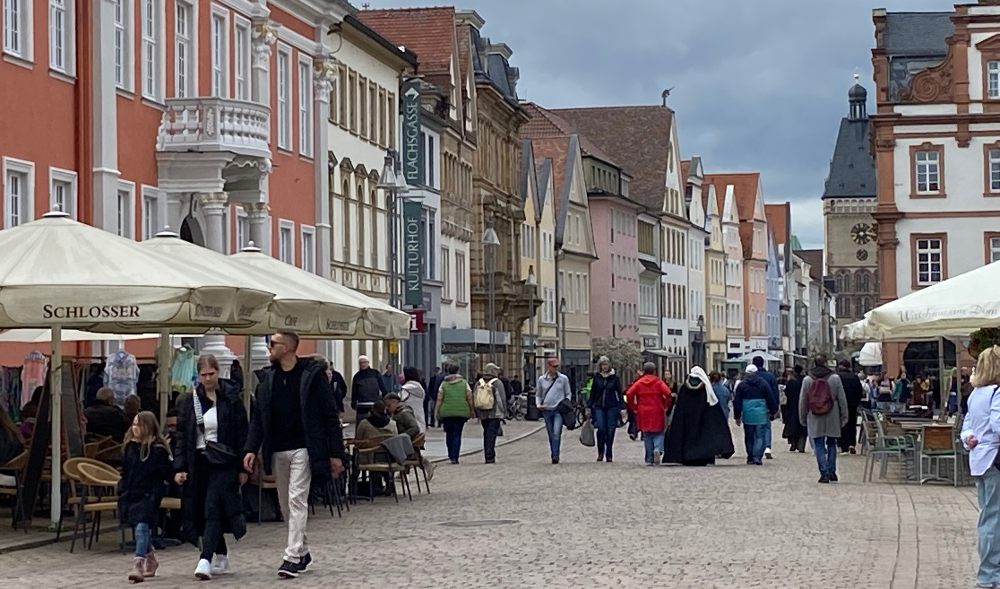
This is a vacation cruise for a boatload of tourists. What’s important is what can be seen in the cities (Cologne and Strasbourg with their big famous cathedrals) and five smaller towns with interesting but smaller churches. Walking these places (all of them) two things stand out. One, the people on the streets and in the squares are all ages from infants in strollers pushed by mom or dad (yeah, mostly moms) to toddlers, some as young as three or four already on their own bikes (no training wheels), teens with skateboards, young adults and everyone else walking or peddling by, along with the elderly using walkers and powered wheelchairs. Strikingly, this diversity of ages is not what we see in Seattle, with the possible growing exception of the waterfront.
The second thing is space. In all the seven stops on the cruise, every one of the cities and towns had at its heart large public spaces, open squares. At the edges of and serving those spaces were always restaurants, coffee shops and bakeries with chairs and tables out front (under awnings in case of rain or sun; the climate’s not that different from Seattle). The rows of seating and restaurant tables are filled with people, not just the one row of tables restaurants can squeeze onto a Seattle sidewalk. These are places where people meet, walk, greet friends and talk or just sit and “people watch.” However defined, these are places that include and create and reinforce a sense community. Really, Seattle has no places like these European public squares. It’s a loss.
Discover more from Post Alley
Subscribe to get the latest posts sent to your email.


What the public squares of Europe provide is a quietness. Think about it. A place that you can talk with friends in the evening, sit at an outdoor cafe for coffee or drinks, or play with kids outdoors is a place where people want to be and families can thrive.
That was my biggest complaint with Bruce Harrell’s Comp Plan. It jam packed all new housing in busy and noisy corridors. It forced people to spend their lives indoors and isolated rather than out and about.
We talk a lot about how Seattle is becoming a city that is expensive and not friendly for families. I’d argue that the best way to make Seattle better for families is to purposely create quiet public spaces. No cars. Away from busy streets. Every Seattle neighborhood deserves its own public gathering space.
We are already seeing how popular a car-free Pike Place market is. The re-imagined Bell Street is another example.
Now let’s lean into those successes. Close off Pine at Westlake and bring back the public square in Westlake Park. In fact, just make the entire street from Pine to the Market pedestrian with food trucks and kiosks.
Pedestrianize the Ave in the U District. In Ballard, close off Ballard Ave NW to car traffic.
Treat our community centers like a European public square with music and cafes.
We need a real change in mindset from designing cities for cars to one where we design cities for people.
Dick, did you see any homeless encampments, people using drugs or sleeping in doorways, etc?
In the 70s or 80s the Westlake block was cleared and there was pressure from architects and others to turn it into the large public square Seattle has always lacked. However, as usual the city opted for quick financial returns over long term public benefit, and turned most of the site over to an out-of-town developer to build a second-rate retail/office project. The same thing has been going on for years with the block across from city hall.