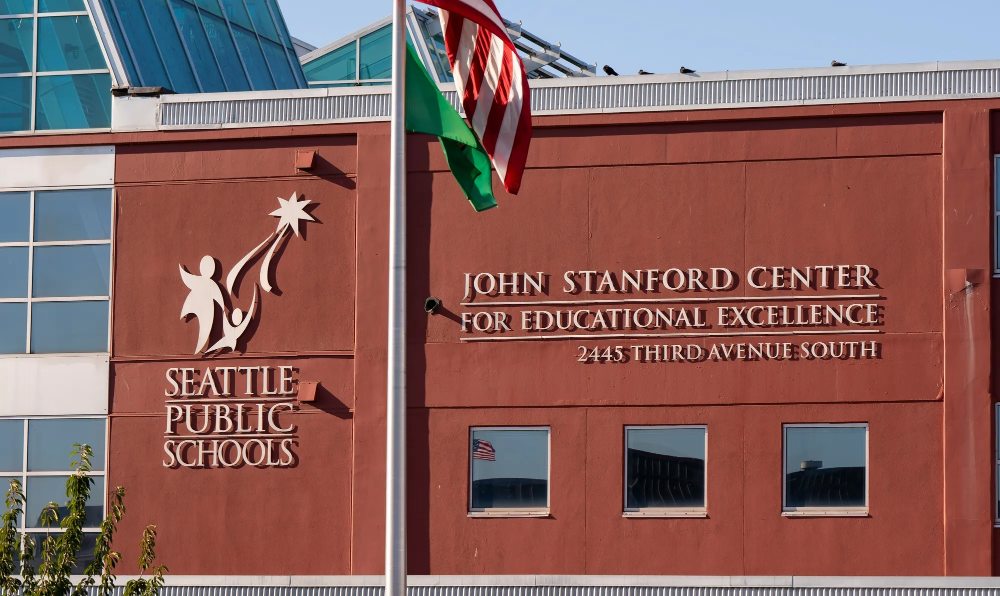

My suggestion for new Seattle Mayor Katie Wilson is to shift her priorities to actually reforming schools. I fear her ambitious affordability agenda will run into funding problems, particularly now that the city and Seattle Schools are deep in debt. Her civic agenda could be a formula for a slow erosion of her popularity. As it happens, there is a strong agenda for change in a key aspect of Wilsonian equality — improving Seattle public schools, starting with school boards. She could be the education mayor.
The way to start is to improve dramatically the Seattle School Board, from which reform will flow. Making its slow way in the Legislature is a package that would do that. It’s been cooked up by a group of educational reformers (including some previous reformist board members). Soon, these ideas will surface in the Legislature, and they need a boost from the new mayor.
There are three elements to this package.
- First, pay board members much more, such as $40-50,000 a year for part-time work. (The current rate is $50 a day, capped at $4,800 for a year, which discourages good candidates and encourages sorehead candidates.)
- Second, set aside serious money for professional development. I would add: Give each board member the funds to have a research assistant, crucial to standing up against the dominating administration, which badly outguns the board.
- Third, allow the Seattle Mayor (with some guidance respecting experience, or picking from qualified candidates) to appoint 2-3 of the seven-member board. This key (and controversial) reform would encourage qualified people to accept appointment, avoiding having to run for election, which is mostly determined by the funding by the Teachers Union.
For myself, I would also change the way Seattle elects its board members. Currently each candidate must live in one of seven districts, and that district’s voters alone get a say in the primary, with the top two candidates facing each other, city-wide, for the general election. This system encourages a narrow agenda, pitting local schools against other districts’, rather than a system-wide approach. This current system locks in candidates who “deliver” for a district or for specialized interests.
The besetting problem for Seattle Schools has been rapid turnover of the superintendents, as well as board members. True reform requires the board support of a superintendent who can stay for at least five years. The revolving door of Seattle School superintendents precludes the staying power of real reform. Brent Jones, who recently quit, served three years (2021-24), Denise Juneau held the top spot from 2018 to 2021, and Larry Nyland served 2014-2018. Three-years-and-out is no way to run a school system and build support for serious reform.
The new superintendent, Ben Shuldiner, arrives from a much smaller school district (Lansing, Michigan, with 10,700 students or one-fifth the Seattle district). He taught in New York City schools and is a Harvard graduate. The Seattle Schools’ hot seat is now mostly of interest to rising stars eager to leave, not proven big-city leaders.
Prior to that, the Municipal League endorsements of board members (now defunct) were based on experience and competence (outweighing special interests). The respected board attracted leading citizens and always included a Boeing executive on loan, such as Phil Swain.
These days, the unpopular Liza Rankin (from north Seattle) is serving a second term and dominates the board. Many board members get elected and quickly depart or withdraw; or they get tossed aside by the forces for status quo when running for re-election. The shaky reform caucus (Gina Topp, Vivian Song, Joe Mizrahi) badly needs a leader and a fourth vote.
The other main problem for Seattle Schools is the high percentage of capable students who leave for private schools or the suburbs. About 20-25% of school-age students now are enrolled in private schools (including lower-cost parochial schools), putting Seattle second in the nation among major cities for this defection. Motivated students are the key to classroom esprit, as I well remember from my daughters going to Garfield High School. K-12 is the crucible for kids; college is too late and too fraught.
The last mayor who really cared about Seattle Schools was Norm Rice, who served from 1990-98 and who instituted a levy to butress non-educational aspects of student support. Since that time, improving Seattle Schools has slipped from the public agenda, and the Alliance for Education shifted from being a force for reform to supporting diversity programs in our schools. We need the new mayor to lead the charge, creating a reform coalition and broadening her appeal to voters.
Discover more from Post Alley
Subscribe to get the latest posts sent to your email.


These are modest but thoughtful structural suggestions. But there is an underlying almost epistemological problem that needs to be addressed first before any educational reforms can be fully successful. Better techniques can only work if the foundation is sound. And the foundation beneath American education has long been crumbling.
Simply put, American public education is the process by which the older members of a democratic society seek to impart collective knowledge and wisdom to its upcoming younger members. But this can only function smoothly if there is some social consensus about what the underlying trove contains. Our current problem, in a nutshell, is that we have become overwhelmed by a deluge of largely unfiltered information and almost violently disagree about which among competing responsive human behaviors are wise. So our educational institutions have ducked the big conceptual questions, slowly and largely unconsciously drifting toward an emphasis on the minutiae of vocational and technical training and their associated research enterprises. The grand pursuit of wisdom — once celebrated as a liberal education — has largely been abandoned.
Our education system, reflecting the society in which it is embedded, has gotten away with its lazy and opportunistic evasion of grappling with how to impart collective wisdom for quite awhile. But now its favorite tricks are no longer working so well. Increasingly, our younger folk are looking for meaning, and when we fail to offer it to them, they are checking out — sometimes creatively, sometimes not.
It’s a tough nut to crack. Through neglect the process of national dysfunction has progressed beyond the point where merely tweaking the system will suffice to fix the worst problems. But the tweaking mindset, alas, is where we are still mired. Proposed solutions to our profound problems still mainly consist of earnest attempts to dust off and polish various forms of conventional wisdom and offer them up (again) as satisfactory panaceas for all our challenges. It isn’t working.
If there is a silver lining to the vulgar and nihilistic onslaught of the Age of Trump it is probably this: he has ripped the mask off the vacuously smiling countenance of conventional wisdom and exposed the emptiness lying beneath. Yes, Trump is offering us a painful moment of self-awareness, but it is an experience we desperately need to embrace. There is nothing to be gained by further delaying it.
You’re overthinking this. Students have always and continue to need to know how to read, organize and express their thoughts, do math, and understand basic scientific constants (biology, chemistry and physics). There will always be room to discuss how we approach history and politics, and it’s ok if we’re not all doing it the same way. There is more agreement in education than disagreement.
My second child will graduate from SPS this year and although I’ve had my frustrations over the years, there are many great programs and teachers. Leadership has been shaky. Absolutely there is room for improvement, the nihilism around having an imperfect education system isn’t helpful.
100% in favor of points 1 and 2. Very skeptical of 3. If it really is true that unions have outsized influence on school board elections, they’ll also insert themselves in mayoral races, and school board appointments could see a lot of churn every four years when a new administration comes in. Is there any evidence that mayoral control over a school board improves district outcomes?
None, Sadie. None whatever.
The cities most often cited where mayoral involvement (not control) has helped: Chicago, Boston, and New York City. Helpful to break up political knots. AI says:
Key outcomes and considerations regarding mayoral control:
Improved Performance: Districts like New York, Chicago, and Boston saw gains in proficiency and graduation rates, particularly among underserved student populations.
Greater Accountability: It aligns school governance with city services, making the mayor directly answerable for school performance, often reducing political infighting found in elected boards.
Efficiency & Funding: Mayoral control often streamlines management and helps secure better funding, as the executive branch directly manages the budget.
Drawbacks: Critics argue this model sidelines parents and teachers, reduces democratic checks and balances, and does not guarantee success in every district.
Context Dependency: While effective in some urban settings, it is not a universal solution; its success depends heavily on the specific implementation, political environment, and the leadership involved.
In essence, mayoral control is a powerful tool to break political gridlock, but it often operates at the expense of local, democratic oversight.
“In essence, mayoral control is a powerful tool to break political gridlock, but it often operates at the expense of local, democratic oversight.”
—
David, if you imagine that Seattle voters and public school parents will accept any erosion of local democratic oversight just to satisfy the conservatives’ wet dream of mayoral control of public schools, I have an Alpine ski lodge in Death Valley to sell you.
I have been reading about the success in Mississippi in raising the reading scores for black and low income students. For these demographics, Mississippi is now #1 in the country. Students are retained in grade if they can’t read. Teachers are closely mentored. Among other things. But Mississippi certainly isn’t spending more per student than Seattle. Why can’t we achieve the same success as Mississippi?
If a child doesn’t learn to read competently, education becomes frustrating and limited. Let’s fix this.