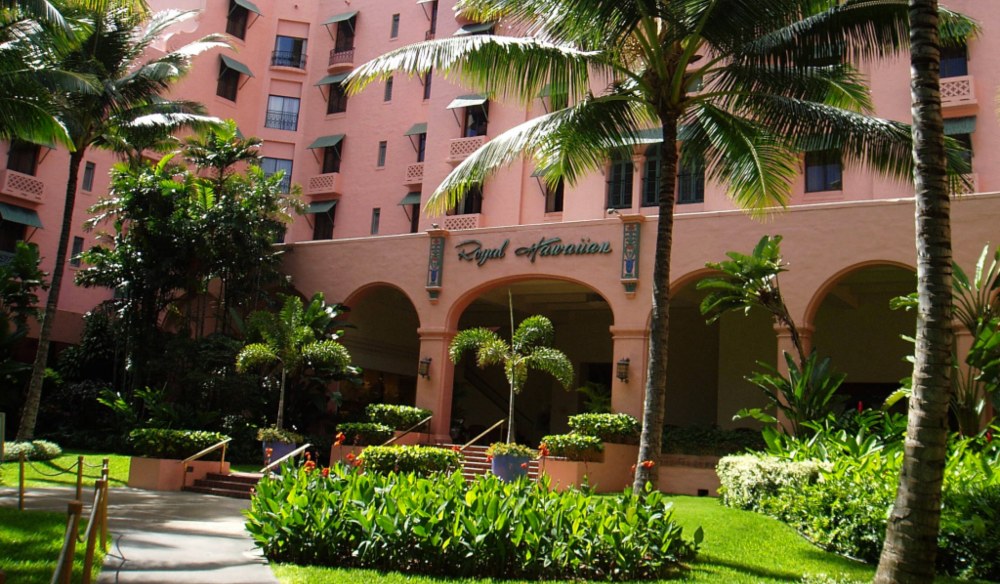


I am sitting by the small round pool at the Royal Hawaiian Hotel in Honolulu reading Joan Didion’s The White Album. I have read this slight paperback, published in 1979 at a cost of $4.95, six, perhaps seven times before, straight through. It is her best, I believe, for she was at the top of her game, the pinnacle of her vast powers. Then, aren’t we all, really, in our thirties and forties?
The book is ruptured with age, its cover badly torn. Many of the 221 pages have come unglued and fall out in hunks. I hurriedly reposition those page-hunks to avoid wondering stares from my bearded seatmate on Alaska Airlines Flight 465, which, after an hour delay on the tarmac, left on its 6-hour-and-43-minute journey from Seattle to Honolulu on Thursday morning, January 6.
Time is cruel to old paperbacks – and even more, yes, to old people.
Joan Didion is dead. You know this. She died in her Manhattan apartment, at age 87, two days before Christmas. Odd, too that her husband and daughter also died during the holiday season.
This dispatch is a tribute to her.
It is my modest — for humble is not the word — way of thanking Joan Didion for her sagacious interrogation and evaluation, and often, enumeration of where American culture stood then and now, and how she, the master of inductive irony, steered us ancient ones through “the paranoia of the time.”
That may be the cardinal reason I am here at the Royal Hawaiian Hotel in Honolulu, though I cannot be certain.
I chose the Royal Hawaiian because Joan Didion often chose the so-called Pink Palace, during her many sojourns to Hawaii. (“I spent what seemed to many people I knew an eccentric amount of time in Honolulu …”) Here, with orchids garnishing her veranda, she watched Robert Kennedy’s funeral. She saw the first reports from My Lai, and reread all of George Orwell on the Royal Hawaiian Beach.
“And I also read, in the papers that came one day late from the mainland,” writes Joan Didion in her glorious White Album, “the story of Betty Lansdown Fouquet, a 26-year-old woman with faded blond hair who put her five-year-old daughter out to die on the center divider of Interstate 5 some miles south of the last Bakersfield exit.”
What I do know, though, is that the proper pronunciation of Hawaii’s only city is “Hooon-a-lulu,” not Honolulu.
I also know that white guilt is quite pervasive here. One must appreciate, the white-guilt set argue, the sensibilities of the “Host Culture,” which means visitors – “flown not grown” – are only passing through, whereas true Native Hawaiians – “grown not flown” – who represent just 8.03 percent of Oahu’s 898,121 residents are considered, well, precious.
“Keep the Country Country” signs, a popular anti-development slogan, has taken root in recent months along the roadways in and around Oahu’s North Shore.
Unlike every state in our vast fruited plain, Hawaii is the only one where it is taboo to call yourself a Hawaiian, unless of course, you are a Hawaiian. No madam, you are a resident of Hawaii. Go back to where came from if you want to be called a Californian, Oregonian or Washingtonian.
And too, I know that Honolulu is not an attractive city. It often glistens, when the morning rains turn it clean as silver, like viewing San Francisco from the Golden Gate. Up close, though, it is 1960s: square boxes, steel and glass.
Yet, like John McPhee observed of Anchorage in his Alaska primer, Coming Into the Country – “Anchorage is the northern rim of Trenton, the center of Oxnard, the ocean-blind precincts of Daytona Beach. It is condensed, instant Albuquerque” – but what a breathtaking out of town it has.
Same with Hooonolulu
. . .

Picture Joan Didion: 1969. She is 34 years old, thin is a reed, sitting in a high-ceilinged room in the Royal Hawaiian Hotel watching long translucent curtains billowing in the trade wind. She is here on this island in the middle of the Pacific in lieu of filing for divorce.
Didion writes: “We spend, my husband and I and the baby, a restorative week in paradise. We are each the other’s model of consideration, tact, restraint at the very edge of the precipice. He refrains from noticing when I am staring at nothing, and in turn I refrain from dwelling at length upon a newspaper story about a couple who apparently threw their infant and then themselves into the boiling crater of a live volcano on Maui.
“We also refrain from mentioning any kicked-down doors, hospitalized psychotics, any chronic anxieties or packed suitcases.”
Unwavering eyes, like a microscope, Joan Didion, the quintessential observer, grabs you by the lapels and gives you a good hard shake. Reading her is like having a candle lit inside you. What ruthless talent, and contentedly neurotic as the ninety-year-old woman Leslie Jamison wrote about in The Recovering, the one who kept a scrapbook full of death announcements pasted next to the marriage announcements – for the same people – that she’d pasted in fifty years later.
Sara Davidson wrote in Literary Hub several months before Didion’s death, in an article titled “Hanging Out with Joan Didion: What I Learned About Writing From an American Master,” that Didion is “probably the most imitated writer since Hemingway, and her voice like his, is catchy, but can’t be imitated without the attempt being obvious.”
Years ago, Didion took Sara Davidson under her fragile wings and advised her to write scenes, interviews or events she’d seen on index cards. “Then spread them on the floor,” Davidson recounts, “and see how you fit them together with space breaks in between. Like arranging a patchwork quilt.” It seems to me it was, and remains, good advice.
. . .
It is January of 2022, a Monday afternoon, just after noon. To be precise, it is January 10.
At lunch on the terrace, the blue skies are bright enough to make your eyeballs ache. A skinny woman, lovely in her mauve bikini, is reading The Disappearing Act. Her handsome husband, with only the slightest paunch protruding from a well-tanned torso, seems content with The Hearts of Men. I toy with the mahi-mahi rice bowl and watch jumbo liner after jumbo liner crawl across cloud-streaked skies.
I find myself thinking of what long-distance swimmer Diane Nyad, who is 72, volunteered to a reporter at The New Yorker about physical decline: “You don’t know this yet, because you’re so young.” But time “actually speeds up exponentially every month, every day, every hour.” I read that on the flight over several days before.
I think of the faded photographs that still line the hotel walls, mostly of happy mothers and fathers, summering or wintering. They scoop up giddy young daughters on the warm white sand, raked smooth by Royal Hawaiian Hotel workers just minutes before.
How perfectly Didion puts it: “Nor did the turning of the Sixties effect much change at the Royal. What the place reflected in the Thirties it reflects still, in less flamboyant mutations; a kind of life lived always on the streets where the oldest trees grow. It is a life so secure in its traditional concerns that the cataclysms of the larger society disturb it only as surface storms disturb the sea’s bottom, a long time later and in oblique ways.
Gazing at the lumpy green mountain that rise above the quiescent ocean several miles east, Diamond Head, I summon a perky young waitress to my table. I ask her why it is called this name, when to my eyes I see neither a diamond nor do I see a head. “I don’t know, sir. I just accept it,” she says brightly.
. . .
The sun is hot in paradise – 79 degrees for this Northwesterner is hot – and I wait for the cool trade winds to blow, as I’ve been assured by Patti Epler, my Hawaii guide, a former colleague and good friend from our long-ago days at The Anchorage Times, they frequently do, but they never come. (Patti is the editor of Civil Beat, a prominent online news site in Honolulu.)
The warm tropical air tastes of orange blossoms and I realize how far I am from the torrential rains pounding the Northwest. I think of Joan Baez: “Sometimes I get lonely for a storm.’’ A gaggle of tourists happen by, one of them, his arms, back and legs a blizzard of tattoos, toting a sack filled with sweet-smelling malasadas, a yeasty donut flavored with lemon zest and coated with sugar and cinnamon. It is Honolulu’s equivalent of Voodoo Donuts.
I notice several Covid masks, light-blue ones, floating in the turquoise sea water of Waikiki Beach, which fronts the Royal Hawaiian. The waves are listless and the oily sheen of sunscreen oil coagulates near the shore.
By the pool, a black couple, in their late twenties, are performing a highly-suggestive dance on the steps that lead down into the four-and-a-half-foot depths of the small round pool. The woman’s top comes nearly unhinged and a vague cheer goes up.
I asked for the children’s special on the poolside menu – grilled cheese and fruit – when the cheerful server arrives. I tell her I just turned twelve. She laughs and flashes me a shaka, a gesture of friendly intent – sometimes known as “hang loose” – that is widely associated with Hawaiian culture.
. . .
“1970: To look down upon Honolulu from the high rain forest that divides windward Oahu from the leeward city is to see, in the center of an extinct volcano named Puowaina, a place so still and private that once seen it is forever in the mind.”
This is how Joan Didion begins her take on a place called Punchbowl, the National Memorial of the Pacific.

Patti and I decide to go. I want to see it. Here, up in the sky blue yonder, 13,500 of the dead that lie beneath a stone. They were killed during World War II. Some of the dead are from Korea and Vietnam, but not many.
As Didion wrote more than a half-century ago: “Because the Vietnam dead are shipped first to Travis A.F.B. in California and then to the next of kin, those Mainland families burying their sons or husbands in Honolulu must bring the bodies the bodies back over the Pacific one last time. The superintendent of Punchbowl, Martin T. Corley, refers to such burials as his ‘ship-in Vietnams.’”
“The quiet is eerie. The city below might be a few miles away, or perhaps, a few thousand. There are no gravediggers, for there is no one to bury. Stone-faced groundskeepers in golf cars whizz by us. We say nothing. There is nothing to say.
Writes Didion: “I walked away from the grave then, down to my car, and waited for Mr. Corley to tell the father that if and his wife wanted to come back before their plane left, the grave would be covered by four o’clock. ‘Sometimes it makes them feel better to see it,’ Mr. Corley said when he caught up with me. ‘Sometimes they get on the plane and they worry, you know, it didn’t get covered.
“His voice trailed off. ‘We cover within thirty minutes,’ he said finally. ‘Fill, cover, get the marker on.’ We stood there a moment in the warm wind, then said goodbye, The pallbearers filed onto the Air Force bus. The bugler walked past, whistling ‘Raindrops Keep Fallin’ on My Head.’”
Patti and I look down from high green slopes, a good deal of it colored in mauve jacaranda. “That is a banyan tree,” Patti tells me. There are hundreds of bayan trees and monkey pod trees in the crater.
2022: Five days have gone by. Back at Royal Hawaiian Hotel, I swim one last time in the small round pool. Tomorrow, Tuesday, January 11, I will fly back to Seattle. It will be nice to feel cold and stand in the rain.

I only recently began reading the works of Joan Dideon (Ed: make that Didion) and they have offered one revelation after another. I have been missing so much. Yours is a fitting tribute.
Thank you for this, Ellis and for including your wish to feel again the seasonal cold and rain. You’ve done Dideon (Ed.: it’s Didion) proud.
Starting about 1966, Joan Dideon moved her Hawaiian headquarters from the Royal to the Kahala Hilton, on the other side of Diamond Head. It’s not surprising, since by then Matson Lines had sold the Royal Hawaiian, the Moana-Surfrider, and the Princess Kaiulani to Sheraton. Most of the Royal Hawaiian’s lush gardens were converted to boutique shops, and the astonishingly ugly 38-story Sheraton Waikiki was built next door on the edge of Gray’s beach. Dideon must have found the Kahala much more serene. And her fellow guests on her first visit were the Rolling Stones. I wonder if she was impressed.
On December 7, 1941, my mother emerged from the old St. Augustine’s Sunday mass in time to watch the bombing of Pearl Harbor. The Moana and the Royal were the only large buildings on Waikiki, and the smoke and planes were clearly visible. My father’s submarine, the Argonaut, was on patrol, and returned to Pearl Harbor the next month. By January, I was safe in my mother’s womb, but sadly, I never met my father. The Argonaut was depth-charged off New Britain a year later. The entire crew was lost.
By 1964, while still in college and through a very strange set of circumstances (another story) I found myself writing hotel dedication speeches for Conrad Hilton. I was flown to Honolulu for an orientation while the Kahala Hilton was still under construction. Conrad Hilton would never have allowed anyone to stay at a Sheraton hotel. I was fortunate to room at the original Halekulani, which remains my favorite hotel on Waikiki. They have the best Mai Tais.
Sympathy and respect to your father, and to you; and I wonder if you did any of the background work on Conrad Hilton in “Mad Men”?
Thanks, Ellis. Very much in the style and voice of Ms. Didion. Appropriate.
Sorry for the typo. Didion, not Dideon.
Ellis Conklin writing about Joan Didion and in her style is fantastic, in my book. Full disclosure: I’ve been a big fan of Conklin and Didion for many years. Jean Godden, Leslie Helm and Jack D Bernard put it so well in earlier comments, Ellis done Didion proud. I also echo Jean’s endorsement of Ellis’ endorsement of our wonderful winter weather.
I need to remember it’s Joan D-i-d-i-o-n. Several of us need to pay attention to our spelling (Miss Phillips would give us an automatic F.) I treasure Didion’s writing, particularly her “Year of Magical Thinking.” After the death of a beloved of mine, her shared thoughts were so healing.
I was introduced to Joan Didion’s work as a junior at UW in Don Pember’s course on “The New Journalism” in 1976, which included study of her “Slouching Toward Bethlehem.” Hooked for life and read everything she ever wrote. RIP❤️
Please hire a copy editor. Or at least a proofreader.