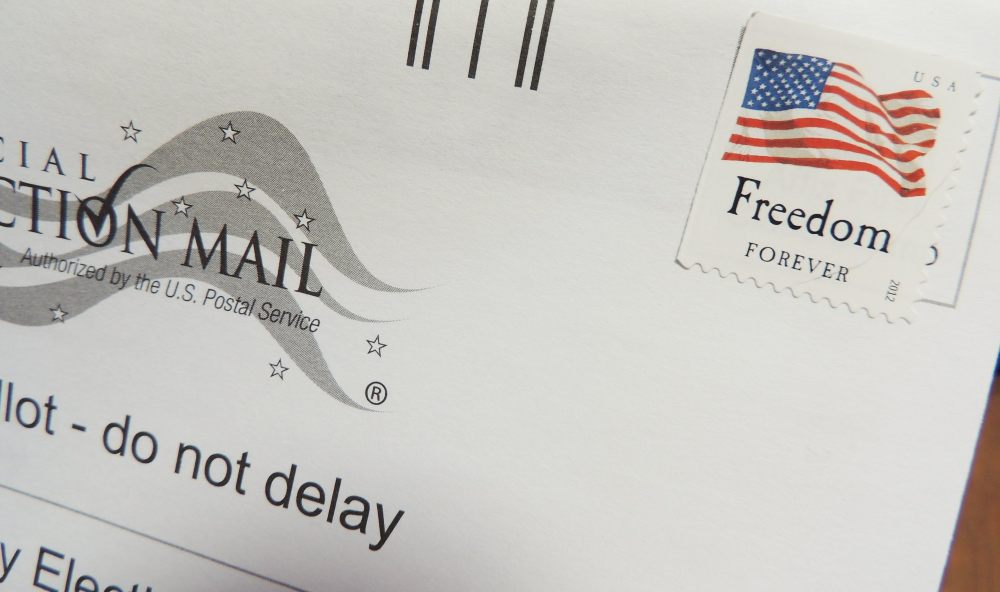

Well, it looks as if we’ll all get our midterm ballots in the mail next month after all.
The Supreme Court has rejected the Trump Administration’s appeal of a District Court injunction that blocked the U.S Postal Service from carrying out or enforcing Donald Trump’s March Executive Order that would have severely restricted the used of mailed ballots. Trump hasn’t stopped trying to jigger this year’s election process in ways that favor Republicans, but mailed ballots are finally off the table – at least for this fall’s election.
Ever since Donald Trump lost the election in 2020, he has claimed – against all evidence – that the contest was rigged, and ever since he won in 2024, he has been trying to rig the next one. How else can anyone interpret his using this year’s State of the Union address as a commercial for his SAVE Act, bluntly pressing legislators to pass a bill that would require proof of citizenship at the polls in order to vote?
And how else can anyone interpret Trump’s March Executive Order designed to limit mail-in and collection-box voting? This is the way it would have worked: DHS sends each state a list of residents it thinks are citizens. The state gives USPS a list of eligible mail-in voters. USPS drafts a list of eligible mail-in and absentee voters. If you’re not on it, you’re SOL: USPS can’t deliver your ballot. Ditto if a ballot envelope doesn’t carry the prescribed bar code.
This would have had to be done across 50 states plus the District of Columbia by the time ballots were mailed out – a process that Washington will start next month. Trump has been trying to get voter lists. This would be another way to do it – as well as limiting or precluding the vote in states that may not favor Republicans. Is this really about election integrity or public confidence? Like other forms of fiction, those assertions require a “suspension of disbelief.”
There have always been stories and suspiscions, both true and false, about specific incidents of election chicanery. There is a longstanding belief – apparently false – that John Kennedy won Illinois and hence the White House because he got overwhelming support from the deceased citizens of Cook County.
If public fears about election integrity have become more widespread, though, they have flourished because Trump himself has energetically stoked them. “[T]he cheating is rampant in our elections. It’s rampant,” he told a national audience in this year’s State of the Union address. The Supreme Court majority seemed to take administration claims about preserving public faith in elections at face value. When SCOTUS lifted a lower court injunction against carrying out Trump’s executive order, Chief Justice John Roberts, writing for the majority – possibly with a straight face – began by saying, “[a]bout five months ago, President Trump issued an Executive Order designed to maintain public confidence in federal elections.” Sure it was.
After Trump made a televised July speech about election integrity, CBS News reported that Trump had “raised new allegations regarding China’s access to U.S. voter data. He revisited accusations about voter registration fraud in the U.S., exaggerated claims about dead and noncitizen voting and claimed voting machines are ‘easily compromised.’ And he made other pronouncements about the state of voting in America.”
As for mail-In voting, Trump said that “[m]ail-in ballots are inherently corrupt. So, . . . these reforms are urgently needed to stop the vulnerabilities that I’ve mentioned.”
CBS fact checkers found “no evidence of widespread mail-in ballot fraud or corruption in states where no-excuse absentee or universal vote-by-mail is offered. Multiple studies have shown that instances of voter fraud are very rare and not significant enough to impact the result of an election. The Brookings Institute found an ‘average total mail voting fraud percentage across the 2016, 2018, 2020, and 2022 general elections of only 0.000043%, or about four cases of mail voting fraud out of every 10 million mail votes.’”
In that same speech, Amy Davidson Sorkin has written in The New Yorker, “he complained that there were ‘tens of millions of ballots floating aimlessly through the mail,’ as if the U.S. Postal Service were a road to nowhere.”
Mail-in is terrible except, you know, when he and his relatives do it. “Trump has long sought to limit mail voting, even though he himself often uses that method to cast his own ballot,” The Guardian has reported. “He has falsely blamed mail balloting for his 2020 election loss, spreading baseless claims of fraud, but has so far been unable to change the longstanding voting procedure.”
He certainly gave it a try, but his Executive Order was “an absolute mess,” Amy Davidson Sorkin has written. “If it were ever fully put into effect, it would not only disenfranchise many eligible citizens but break the mail-in voting system and possibly the Postal Service.”
It also looks unconstitutional. The Constitution gives a President zero power to shape the mechanics of federal elections. That power rests with the states, though Congress – not the Prez – can intervene.
“The Times, Places and Manner of holding Elections for Senators and Representatives,” the Framers wrote, “shall be prescribed in each State by the Legislature thereof; but the Congress may at any time by Law make or alter such Regulations, except as to the Places of ch[oo]sing Senators.”
Washington Attorney General Nick Brown and other Democratic state attorneys general have fought Trump’s order from the start. “The Constitution is clear: states control elections—not the president,” Brown has said. “The U.S. Postal Service doesn’t have the authority to deny Washingtonians the ability to vote. We will protect the rule of law.”
Brown and the AGs of 22 other states and the District of Columbia – in parallel with the League of Women Voters and other good government groups — persuaded a U.S District judge in Massachusetts, Indira Talwani, to enjoin the Postal Service from carrying out the order.
Trump appealed to the Supreme Court. Which quickly stayed Talwani’s injunction.
The Court majority – the usual six – basically said no harm no foul. No final action had been taken, so no plaintiff had been harmed. It was premature for the courts to act. Trump’s order merely “directs [USPS] to issue a notice of proposed rulemaking. According to the States, this internal directive demands that they overhaul their existing election procedures. It does not.”
Instead, it merely “orders the Postal Service to initiate the process of proposing a rule that might bind the States in the future. It is not a proposed rule, let alone a final rule. And it imposes no legal requirements on the States.” Right. The Court issued its order on a Monday. The Postal Service had issued a final order the previous Friday. Oops. This was starting to look like farce.
With that final order in place, the attorneys general went right back to court. Talwani issued another injunction. Trump made another “emergency” appeal to the Supremes. That meant another significant case would be decided on the Shadow Docket.”
While the clock kept ticking.
“[S]tates are consumed with the task of registering voters, maintaining voter lists, conducting early voting, processing vote-by-mail applications, mailing ballots to voters, preparing voter lists, appointing poll workers, and tabulating votes,” Talwani noted. “Voter registration alone is an unwieldy task, where, in many States, voters can register as late as election day. Accordingly, the onus of the [Postal Service’s] Final Rule’s requirements falls on State and local election official officials to somehow find the time and resources to comply with the Final Rule in the middle of election season.
“On the record before this court,” she wrote, “the myriad aforementioned obstacles and negligible amount of time for officials to familiarize themselves with new processes (let alone successfully implement the new requirements) will make compliance by State and local officials with the Final Rule ‘virtually impossible’ for the November 3, 2026 midterm elections. And because the USPS has conditioned sending mail ballots on compliance, disenfranchisement of Plaintiff Organizations’ members is unavoidable, rather than hypothetical for the upcoming elections.”
There was a lot at stake. The big picture was sobering. “In the run-up to the election, the federal government is exerting unprecedented pressure on American democracy,” NYU’s Brennan Cener for Constitutional Rights proclaims on its website. One could argue that the Capitol riot of January 6, 2021 – coupled with Trump’s pardoning of and attempt to enrich convicted rioters – put a fair bit of pressure on American democracy, too.
But it’s just as likely a mere unwillingness It would be nice to see the SCOTUS decision as a ringing defense of the Constitution and a rejection of Executive over-reach. But it’s at least as likely to be a mere rejection of the electoral dysfunction that trying to comply with the order would have caused. The underlying issues haven’t been addressed.
Because this is the Shadow docket, we don’t know how or why individual justices voted as they did. We know that Alito and Thomas dissented. We know that Kavanaugh concurred in the result – trying to carry out the order before the election was obvioiusly nuts – but figured that USPS had a good chance of prevailing on the issues. That may be a majority view.
Trump appealed to the 1st Circuit, as well as the Supremes. The 1st Circuit denied the appeal, noting that the administration had failed to disprove or even seriously challenge the lower court finding that the final rule would cause “chaos and widespread voter disenfranchisement.”
Right. No one wanted that. Well, no one except the Trump Administration, which was evidently willing and even eager to see it happen. Does anyone think that has changed? There’s still more than enough time between now and Election Day, not to mention the seating of a new Congress, for chaos; and disenfranchisement to have their moment.