

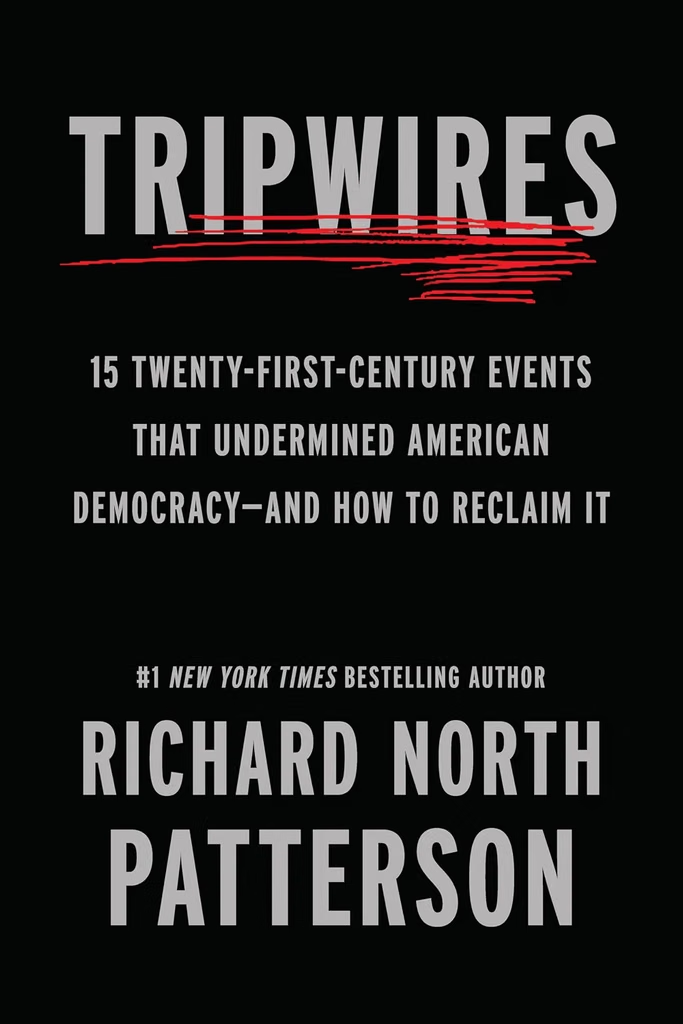
If you have the sense that America is still fighting the 2000 election, then Richard North Patterson’s new book Tripwires will help you understand why you feel that way. Revisiting 15 seminal events since 2000, starting with the Supreme Court’s hijacking of the 2000 election in Bush v. Gore, through Hillary Clinton’s “fateful missteps” in 2016, Mitch McConnell “flinching” from convicting Trump, Biden’s decision to seek re-election and various Supreme Court decisions along the way, Patterson traces “a series of self-inflicted wounds and destabilizing societal trends.”
Our national politics since 2000 have been marked by close elections, a closely divided Congress, bitter partisan battles, with neither party able to gain a sustainable majority of public support.
Washington state voters have reflected this long, slow burn even as state election outcomes mask the underlying churn. Washington politics altered course in 2000 as indicated by three trends.
First, voter optimism cratered. The Elway Poll’s quarterly Voter Outlook Index – a combined measure of voters’ outlook for “the next year or so” for: 1) the country, 2) the state, 3) “your community” and 4) “your household” – hit its all-time high in January of 2000. The trajectory has been generally downward ever since, with a brief rally during the Obama years. The Index hit its all-time low in July, 2022 and was in negative territory in 4 of 6 readings from 2022 to July 2025, when the Elway Poll ceased.
Second, the souring public mood has been reflected in Washington voters’ feeing about their representation in state government. From 1985 through 2002, most voters felt well-represented in state government. The average proportion of Elway Poll respondents who said they were “very well” or “somewhat well” represented in state government over that 17-year span was 63%. By 2025, the average had dropped to 44%.
The performance ratings of the Democratic governors (The only kind Washington has had since 1984) also echoes this trend. The Elway Poll measured Governor’s performance every six months. From 1996 to 2025, there were 50 readings. All the readings through January 2001 (Gary Locke) were net positive (more positive than negative). After that, 36 of 42 readings were net negative. Locke’s ratings were all net negative from the start of his second term. Christine Gregoire had a year and half of slightly positive ratings (2007-08) out of eight years. Jay Inslee had a net positive rating once and a net neutral rating once in 12 years. In the lone measure of Bob Ferguson’s job performance, now more than a year old, he got the lowest ratings got a governor in 34 years.
The third trend, as I noted earlier in these pages, is that party identification began to shift in 2000. The proportions of Washington voters who identified as Democrats and Republicans were basically equal throughout the 90s. Twenty-five years later, Democrats had opened up an 18-point advantage. As a result, Democrats have had control of both houses of the legislature and the governor’s office for 20 of the last 25 years and are on the verge this year of super majorities in the state legislature.
These numbers drive Republicans crazy. How can voters who feel less and less represented in state government and keep electing more and more Democrats to state office?
Part of the answer is due to a reversal of Tip O’Neil’s old chestnut that “all politics is local.” Diminished news coverage of state government – made worse by the recent McClatchy layoffs – plus a President who never topped 39% of the vote in Washington demanding all the attention all the time, makes it more accurate today to say that “all politics is national.”
Add to that the takeover of the state GOP by the most conservative elements of the party and even moderate Republican candidates can’t get out from Trump’s shadow.
Read the comments below news stories in the local papers about state politics. Almost inevitably, some commentor will bring up Dan Evans, who left office 50 years ago, as the kind of leader we need. When commentors, or focus group participants, talk about Republican candidates, they don’t talk about Rob McKenna or Bill Bryant. They bring up Ellen Craswell and Loren Culp.
As we head into this election, we don’t have a recent measure of voter outlook or the governors’ job performance rating, or voters sense of representation. But we do still have President Trump, among the highest inflation and gas prices in the country, and state budget deficits. It is hard to imagine that voters’ mood has improved much in the last year.
Both parties have on-going internal ideological struggles as they anticipate a post-Trump world. Democrats anticipate taking over the US Congress and are daring to hope about the Senate. If Democrats do win a majority in Congress, it will be with a party divided on philosophical and generational lines. Meanwhile many Republicans will be trying find a way to distance themselves from Trump, while continuing to paint the Democrats as Godless Communists.
Here at home, Republicans are not going to take over the state house or senate. Republicans are hoping to keep the Democratic majorities under “super-majority” status that would give them unbridled legislative power. But we have former Democratic Governors (Locke and Gregoire) chastising the Democratic-controlled state government for spending too much.
We will remain a politically divided nation however the 2026 vote turns out. By mid-November, the curtain will rise on the 2028 main event, as we continue to resolve the election that took place 26 years ago.
Discover more from Post Alley
Subscribe to get the latest posts sent to your email.