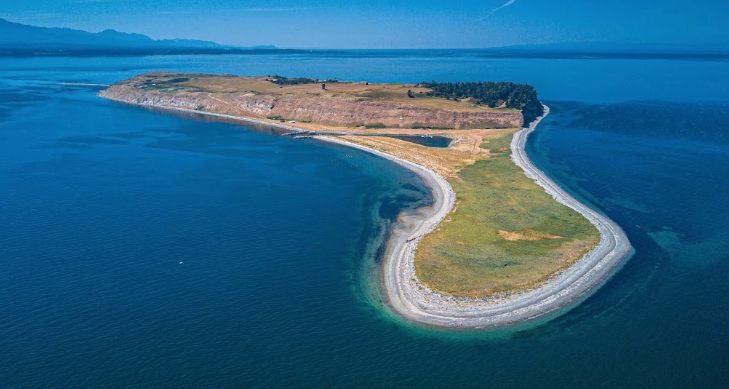

In a surprising move Monday at a meeting of the Jefferson County Board of County Commissioners, Jamestown S’Klallam Chairman and CEO Ron Allen said that a number of tribes in the Salish Sea and coastal waters seek to transfer ownership of National Wildlife Refuges (NWR) and incorporate them into tribal reservations.
This requested transfer of public lands to private entities like the tribes, is unusual and raises questions about the process of transfer of public lands out of public hands.
Chairman Allen came to the meeting to discuss the proposed “Land Transfer of Dungeness Spit and Protection Island”, and was commenting on this transfer to the three County Commissioners (and public in attendance) when he mentioned that this land transfer is only part of a larger effort by the tribes to take back public lands that are National Wildlife Refuges. He said that the Makah tribe was seeking land transfers of three properties off the coast, the Nisqually were looking to transfer one adjacent to theirs, and the Lummi Nation or Swinomish (he wasn’t sure which) were looking to transfer the San Juan Islands Wildlife Refuge.
“…Because we know (the) Makah’s going to go after the three (refuges) on the coast. And we’re pretty certain that (the) Lummi or “Swin” (Swinomish) will go after the San Juan (reserve)… We know that that once we get this done they’re gonna go after the other three or four.” Allen said.
He went on about the Nisqually Tribe: “…There’s other tribes doing exactly the same thing just like this…. They’re (The Nisqually Tribe) are always pursuing the refuge in their Nisqually Valley area.” It is likely that what Chairman Allen was referring to was the current Nisqually Clear Creek Land Transfer Act of 2026 which is sponsored by Representative Marilyn Strickland and Senators Cantwell and Murray. The tribe is in the process of having U.S. Fish and Wildlife transfer buildings at the hatchery which sits on tribal land to the tribe. It is not seeking to transfer the Billie Frank National Wildlife Refuge to them at this point, but Allen’s comments raise questions about the future of the refuge.
There are six National Wildlife Refuges in Washington State managed by the US Fish and Wildlife Service. They are considered the Washington Maritime National Wildlife Refuge Complex:
They include:
- Flattery Rocks National Wildlife Refuge
- Quillayute Needles National Wildlife Refuge
- Copalis National Wildlife Refuge
- Dungeness National Wildlife Refuge
- Protection Island National Wildlife Refuge
- San Juan Islands National Wildlife Refuge
The Jamestown S’Klallam currently have been in a co-management agreement with Fish and Wildlife, and are being paid approximately $800,000 for their work on Protection Island and Dungeness Spit. It is unclear if the Trump administration would be in favor of granting these annual funds if the properties were no longer owned by the Federal Government. It is agreed by all parties that they have been doing exemplary work for the government, and their ability is not being questioned. There have been no calls from the Trump Administration, the Federal government nor the State government to transfer these two particular lands. The request has come only from the Tribe and not from the public. Many public comments ask that nothing change in the relationship.
Washington U.S. Representative Emily Randall (D) has been in talks with the tribe for months if not years, and has openly acknowledged her support of the goal of a land transfer of Dungeness Spit and Protection Island to the Tribe. At a recent public meeting Representative Randall seemed taken aback at the level of public concern over the transfer. The public has only been aware of this land transfer since April. The Jefferson County Board of County Commissioners and Clallam County Commissioners meetings have been the only local way for the public to comment in person. The Clallam County County Commissioners meetings have been very contentious. The lack of federal sponsored meetings is unusual, given the outpouring of negative comments at both counties meetings.
The Trump Administration has been giving up public lands like these refuges as part of their announced Project 2025, which calls for government to get out of the vaguely-worded business of “conservation”. In Texas, the administration is in the process of giving away part of the Lower Rio Grande Valley National Wildlife Refuge in south Texas to SpaceX in exchange for other properties owned by SpaceX. A lawsuit was filed on June 10th to stop this transfer.
Chairman Allen said that the tribe took out a big ad in the Peninsula Daily News and Port Townsend Leader because they wanted to be as transparent as they possibly could be …but he added, “Congresswoman Randall asked us to kind of back off on it and we said, okay, that’s fine.” This raises the question of whether Congresswoman Randall asked the Tribe to not advertise its intentions to the public.
Washington Senator Maria Cantwell has also been in discussion with the Tribe, but has not yet fully committed to the transfer and would like to see more public input, according to a person who discussed it with her staff. However she has not held any public meetings on this. There has been no mention of the Governor being involved in the discussions.
This reporter has seen the draft bill that has been written by tribal lawyers that might be submitted to the U.S. Congress. The draft bill does not contain any legally binding language that would protect the island or spit from the tribe using it for commercial aquaculture. The concern by the environmental community is that the rare protected species on the island feed off the marine flora and fauna of the waters and beaches around the island. Creating a monoculture “farm” could impact the amount of food available for the birds.
The current tribal council and Chairman Allen claim they have no plans for commercial activity. But it is easy to petition the Washington State Department of Natural Resources to open privately held shoreline to commercial use. DNR has a long history of supporting aquaculture, and the State of Washington legally views aquaculture as a desired commercial priority. Once it becomes part of tribal lands, it would also be exempt from state or federal oversight as negotiations would be nation to nation based on treaty law.
The Protection Island National Wildlife Reserve was created in 1982 after almost 20 years of work by bird lovers Zella Schultz, Eleanor Stopps and the coordination with Seattle Audubon Society. It is the breeding ground of most of Puget Sound’s glaucous wing gulls as well as rare Tufted Puffins and Rhinoceros auklets. Its creation was supported by virtually all the Washington State federal and state senators and representatives at the time, including Senators Warren Magnuson, Henry Jackson and Slade Gorton and Republican governor John Spellman.
The tribe has admitted that they look forward to writing their own rules for use of the island. In an interview in the local Port Townsend Leader Tribal Vice Chair Loni Greninger stated, “If we’re able to have that fuller ownership instead of co-management, then I don’t have to rely on any other government and their rules and regulations. I can take my deeper regulations from an ancestral standpoint and be able to infuse that and implement it.”
This article first ran in the Olympic Peninsula environmental News
Discover more from Post Alley
Subscribe to get the latest posts sent to your email.


Native American tribes aren’t “private entities.” They are federally recognized governments that pre-exist Washington State and the United States.
I don’t understand your point. Tribes are not just tribes they are also corporations. Jamestown S’Klallam are a corporation that involves many businesses including their casino their aquaculture industry their nursing homes their golf courses. The Leader of the Jamestown S’klallam Tribe is Ron Allen whose title is CEO. just to be clear I wrote the article.
Study up on Indian tribes Mr. Bergstein- they have treaties with the United States- agreements between governments. These treaties reserved pre-existing rights over broad land and water areas- including the refuges which are the subject of your article. Tribes have extensive government infrastructure and agencies- courts, police, social services– and fisheries, wildlife and environmental protection staff. Yes, tribes also operate commercial businesses to raise revenues for their people and governments. That fact shouldn’t lead to knee jerk reactions to reasonable land return proposals.
Jim I have studied Treaty law in my limited way, and I understand they *may* reserve pre-existing rights. Do you know for certain that the 1855 Point No Point treaty does guarantee those, and if so, what is the wording?
But the central concern is not the identity of the proposed owner, but the risk of incompatible land and shoreline use. Where a prospective landholder is engaged in commercial monoculture aquaculture, there is a legitimate reason to ask whether its economic interests could conflict with the conservation mission of these protected areas. Monoculture aquaculture can bring intensified human activity, vessel traffic, predator disturbance, noise, habitat alteration, waste, disease transmission, and pressure for shoreline or nearshore modifications. In a highly sensitive ecosystem, even relatively limited commercial use can produce outsized consequences..
Opposition to it is also justified on a public-trust and precedent basis. Lands protected for wildlife serve a broader public purpose that extends beyond any one administration or ownership model. Transferring such lands without airtight conservation covenants could set a damaging precedent: that protected habitat may be reassigned even where the new holder has active commercial interests that may not align with the site’s ecological purpose. Once transferred, restoring prior protections could be legally and politically difficult.
Appreciate the response and I understand the concern over transferring important refuge lands. A fair evaluation of the proposal should take into account the fact that Indian tribes have been leaders in habitat protection and restoration. They have also been involved in economic development to support their communities which is challenging given the immense reductions in their land base. Despite these challenges, the Lower Elwha Klallam Tribe was a leader in the successful effort to restore the Elwha River to free flowing status- and Jamestown S’Kallams are restoring Jimmycomelately Creek and estuary – Tribes on the other side of north Puget Sound have led efforts to restore habitat and estuaries in the Nooksack, Skagit, Stillaguamish, Snohomish and Nisqually basins- areas named for the tribes that live there. A transfer of conservation lands to tribal management can be beneficial to the values of these lands for everyone. Agreements and deed provisions can be worked out to ensure mutual values of refuge lands are identified and preserved.
Tim I’ve lived over here on the Peninsula for many years, I’ve worked for the Jamestown S’klallam in the past. I’ve been on the Jefferson County marine resources committee as it’s chair. I know very well the accomplishments of the tribe. No need to educate me on them. I stand by what I posted above. reread it please.
Even worse.
Why transfer land to another government?
The real reason is White Guilt.
(But thank you, Al, for yet another disturbing read.)
thanks Tim hoping that people will least send emails to their US representative and our state senators stating their opposition to this bad idea.
Transfer to Tribes: Terrible policy.
Co-management fine, and may work on a case-by-case basis..
That Tribes want them, understandable.
But this is a sovereignty issue with no assurance they will be well managed and, indeed, could be operated for commercial purposes inconsistent with conservation.