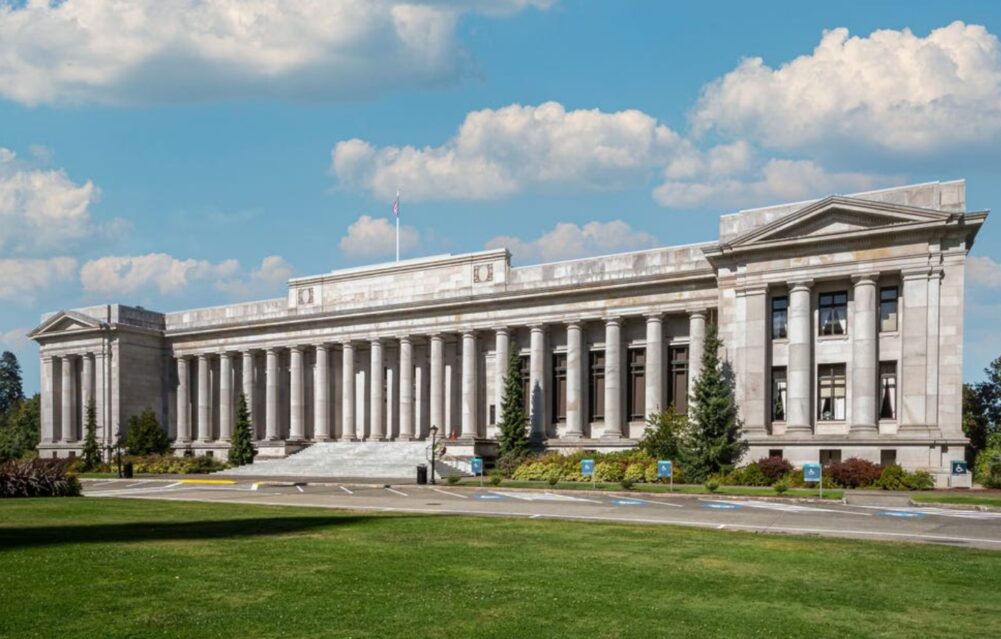

When the Let’s Go Washington initiative factory announced a sprint to a November challenge of the millionaire’s tax, there was heartburn among some right-leaning political strategists, and not just because Tim Eyman, of all people, laid out its long-shot odds. There is more interest from at least some of that crowd in tackling a related but different electoral goal: shifting the Supremes to the right.
If you’re a close political reader, that might cause some cognitive whiplash. Polling suggests a blue wave election will crest in November, with Democrats seeing a 4- or 5-point bump. And Washington Supreme Court races are pretty low-information affairs in which voters often go with the home team, and in WA, that’s mostly the leftier candidate.
But here’s some of the thinking why the smart business money might go big on the Supremes: This is a King Tide year – two wide-open seats, which is very rare, and the new-car-smell is still on two Gov. Bob Ferguson appointees who’ve never run before. The court’s leftward drift has produced opinions that read as political, including the Blake decision that effectively legalized drug possession; consistently swatting down initiatives from the right; some racial justice rulings and rules considered on the far left. There is a general mood of distrust of judicial impartiality that flows from the U.S. Supreme Court but attaches to the state Supreme Court, where a majority — and a vast majority of Superior Court judges — were first appointed by Democratic governors. The races, of course, are technically nonpartisan, but there’s a ton of partisan coding via endorsements and donations.
Which gets us to the money. In general, judicial races are low-dollar affairs. Business and right-leaning money haven’t spent heavily on Supreme Court races since 2016, when almost $2.8M was spent for and against a slate of GOP-backed candidates (including now-retired district court judge Dave Larson, who is running this year) in the wake of the court’s education-funding McCleary decision. That was almost triple the normal spending in any election cycle since then. If the thesis of this story holds, we’ll see the 2016 number get blown away, to the tune of $5M or more spent on Supremes races.
The thinking also goes that candidates running to the center or right aren’t as hopeless as recent elections suggest. In 2024, the last election for an open Supreme seat, Sal Mungia, the left-coded former president of the trial lawyers association, outspent ($567K) Larson ($190K) nearly three to one, yet Larson came within 20K votes, or about a half a percentage point. But there were also more than 675,000 undervotes, meaning almost one in five voters skipped the race. Message: A relatively small amount could go a long way if you’re pissed off about the direction of the court.
There’s enough angst about the Supreme Court’s leftward tilt that a 501(c)(4) nonprofit called Full Court spun up in 2024 to recruit and train candidates how to run for judicial offices. With former AG Rob McKenna and GOP Congressman Baumgartner on its board, the group has a somewhat of a Heritage Foundation vibe. They haven’t released the list of candidates they’ve worked with, but it’s clearly a stronger infrastructure for “Bringing Balance to the Bench,” as their motto says. Three judicial candidates spoke at last weekend’s Mainstream Republicans conference.
They’re not crazy about that “balance” part, at least according to an interesting but largely ignored 2024 analysis of the Supreme Court’s rulings by Ballotpedia, a nonpartisan nonprofit encyclopedia of American elections. Looking at political campaigns and more than 1,700 cases from 2013-22, the analysis found that more than 99% of big donations to winning campaigns were from progressive sources. That speaks to both the leftward tilt of winning campaigns and the futility of spending money to elect more conservative justices.
And the court rulings bore that out per the analysis. Three out of four rulings favored parties (both litigants and amici, or interested bystanders) that Ballotpedia labeled as progressive. Among the most consistent winners were tribes, LGBTQ groups and trial lawyers. Rulings regarding business matters, religion, child welfare, politics (such as redistricting) overwhelmingly sided with the legal arguments from progressives; 100% of the gun cases heard by the court went against conservative positions.
So, how will this play out this year? Every Supreme seat on the November ballot, including Chief Justice Debra Stephen’s, has a right-coded challenger. But if “Bringing Balance” crowd goes big, the money will most likely flow to King County Superior Court Judge Sean O’Donnell, who is running in one of those open seats vs state Court of Appeals judge Ian Birk, and Larson, who came close in 2024. We talked with both of them, and they reject the “conservative” label. O’Donnell in particular says he wasn’t recruited or trained by Full Court Press, and asked to have his name struck when they listed him a while ago as a judge to watch, and touts endorsements by Gov. Chris Gregoire, U.S. Rep. Adam Smith and other center-lane Dems. Larson is endorsed by the state GOP and has spoken at their state convention, but also points to an endorsement by Andrew Yang’s Forward party, and is running as a judicial reformer.
Where these races will get really interesting is when Full Court Press sharpens public messaging about the huge structural advantage for Supreme Court candidates who align with Democrats’ power base – especially the powerful Washington Association for Justice (the trial lawyers) and Big Labor, who, per the Ballotpedia analysis, have been lavishly rewarded with favorable Supreme Court rulings.
In the case of O’Donnell’s opponent, Ian Birk, “align” also means “donor.” He’s a whale of a donor, almost entirely to Democrats or left-leaning groups. As a top plaintiffs’ lawyer at a white shoe law firm, Birk donated $191K to federal candidates since 2006, and $65K to state candidates. He spent almost $13,000 on Jay Inslee’s state and federal campaigns before Inslee appointed him to the court of appeals. Other Supreme Court candidates this cycle have their own donation histories, but the scale of Birk’s is on a whole different level.
The fundraising totals thus far for O’Donnell ($162K) and Birk ($269K) and Larson ($136K) and his two opponents, Ferguson appointee Theo Angelis ($143K) and Thurston County Superior Court judge Sharonda Amamilo ($16K, but with big labor endorsements), are mostly bigger than normal for May, although eye-popping yet. But given the state limitations on direct contributions and a prohibition from judicial candidates directly soliciting cash, the real money would come later in the form of IE groups.
Because here’s the thing. The candidates are limited by lawyerly codes of ethics from actually campaigning on how they might rule on, for example, the constitutionality of an income tax. Independent campaigns can say whatever they damn well please.
This report ran previously ran in The Washington Observer, an independent newsletter on politics, government, and the influence thereof. It’s made possible by our paid subscribers.
Discover more from Post Alley
Subscribe to get the latest posts sent to your email.

