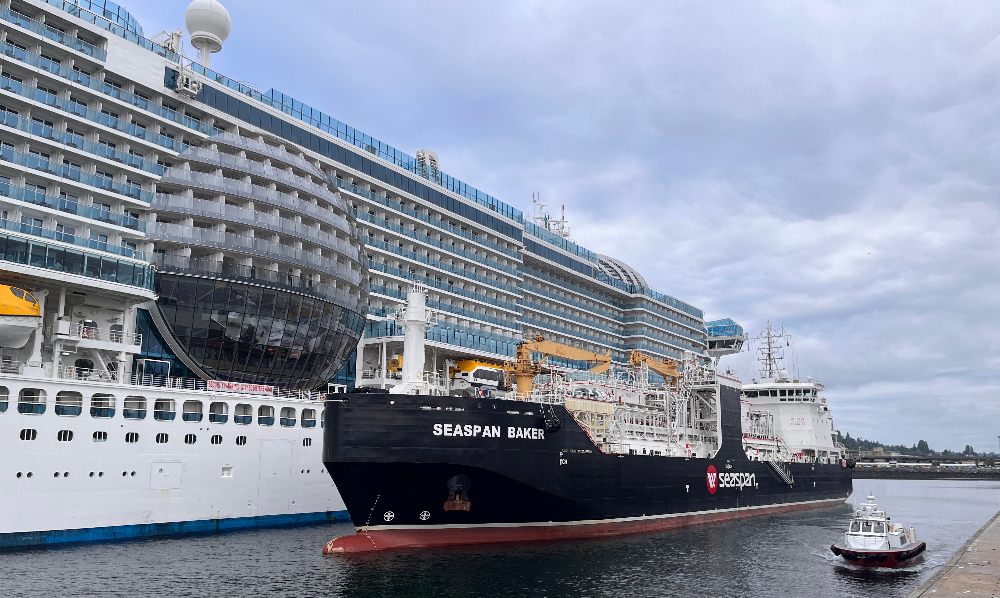

Early this month, a mobile floating gas station of sorts pulled up alongside the towering cruise ship Star Princess at Seattle’s Pier 91 terminal. For the next eight hours the refueling crew made news by pumping a large volume of super-cooled natural gas into the bowels of the cruise liner.
The newest cruise ship operated by Princess Cruises is the first oceangoing vessel to be refueled in Seattle with liquefied natural gas (LNG). It could be the start of a new way of fueling the Alaska cruise ships that operate out of Seattle all summer.
“I’m just delighted to see there’s no smoke coming out of the cruise ship. We’re plugged in. We’re burning the cleanest gas you can right now,” Port of Seattle Commissioner Fred Felleman said while observing from an adjacent pier. “Right now, this is about as good as it gets in the industry.”
The steadily-growing fleet of mammoth cruise ships that ply the Inside Passage have a sizable carbon footprint – ship fuel being the biggest single component. Cruise line executives acknowledge that they need to do their part to soften the environmental impact. The major cruise lines in the Alaska market, through their trade association, have committed to net zero greenhouse gas emissions from ship operations by 2050. The challenge until now has been finding an alternative fuel that is cost-competitive and available at scale locally.
Felleman said the Port of Seattle is striving to be the “greenest” cruise homeport. The gleaming floating palace over his shoulder demonstrated a fuel technology that the maritime industry appears to be coalescing around to improve air quality in port communities such as Seattle, Tacoma and Vancouver. But the lengthy transition is accompanied by some sniping and griping.

The super-chilled natural gas arrives on a specialized small-scale tanker ship from British Columbia in a multiday journey that underscores the novelty of the alternative marine fuel. Vancouver-based Seaspan Energy acquired three refueling tankers (commonly called bunkering vessels) from a Chinese shipyard to offer ship-to-ship LNG refueling along the West Coast.
“We’ve been held to a very high standard, not only in the construction of these vessels, not only in the crewing and the credentials of the people operating on these vessels, but in the actual play-by-play operations,” said Seaspan Energy President Harly Penner during an online roundtable hosted by the Port of Seattle. “We’re going to make sure it’s done safely.”
Penner appeared to anticipate LNG’s detractors who portray the fuel as acutely risky if spilled, due to its very low temperature. Critics also worry about the wide, devastating impact if an LNG cargo ignited, which Penner said has never happened during ship-to-ship refueling elsewhere in the world.
The U.S. Coast Guard and Seattle Fire Department reviewed and were satisfied with Seaspan’s LNG bunkering plans. A Star Princess passenger posted the safety instructions applicable to passengers on board. The cruise line handout told people assigned to staterooms overlooking the Seaspan tanker to stay off their balconies during the refueling operation and that smoking in the Star Bar would be forbidden while fueling was underway. A Port of Seattle police boat also kept watch a couple hundred yards off the stern of the cruise ship, which has a 4,300-passenger capacity.
Overall, Port of Seattle officials appear to be giving a tempered welcome to LNG as they celebrate what is anticipated to be the busiest Alaska cruise season in port history. Maritime Division Managing Director Stephanie Jones Stebbins said the port is interested because of the “tremendous” reduction in air pollutants, such as diesel particulates and harmful sulfur and nitrogen oxides. But port staff pointedly avoided claiming a global warming mitigation benefit and also told elected commissioners that there are no plans to invest in local infrastructure to supply LNG from shore.
“We know LNG is ultimately a fossil fuel. We view it as a transition fuel,” Jones Stebbins said. “We are looking beyond that to renewable fuels – options like green methanol, renewable natural gas, ammonia, drop-in synthetic fuels, electrification.”
Shipping line TOTE Maritime converted two large cargo ships on the Tacoma-Anchorage circuit to LNG propulsion in 2022. The ships refuel from an adjacent Puget Sound Energy liquefaction and LNG storage facility that remains controversial in Tacoma and has so far failed to attract other marine users.
Climate protection campaigners and some political conservatives take issue with the maritime industry’s fuel transition, but for very different reasons.
The environmental group Seattle Cruise Control urged the Port of Seattle to reject LNG-powered ships. The group labels LNG as a “false promise” because activists calculate the carbon footprint of natural gas from “well to wake” to be as bad or worse for the climate than traditional marine fuels. (The math varies in the industry, and some like Penner claim a positive greenhouse gas benefit.)
“The use of LNG will continue harming the climate, lock in obsolete technology, and delay the necessary transition to zero-emissions fuels,” Seattle Cruise Control co-founder Elizabeth Burton said in an email.
Conservative voices meanwhile, including at the highest levels of the Trump administration, are pushing back on maritime decarbonization because of the potential pass-through costs to consumers.
“Popular fuel alternatives, such as liquefied natural gas and hydrogen, require double to more than triple the tank size of oil. In an industry that monetizes every square foot of space, it’s a costly gamble for regulation that may not come to pass,” wrote opinion columnist Kate Farmer in the Wall Street Journal last month.
Princess Cruises spokesperson Negin Kamali described LNG as “the best readily available fuel that significantly reduces direct greenhouse gas and other emissions and particulate matter now.” Notably, the cruise line barely mentions the dual-fuel capability of its newest vessel in marketing and advertising. The Love Boat’s other amenities get all the love – such as the restaurants, stage shows and luxury staterooms.
This summer, Star Princess is scheduled to refuel with LNG in Seattle every other weekend. Kamali said that should be sufficient to operate the big ship on LNG throughout the season. When LNG is unavailable, Star Princess’ engines burn traditional marine gas oil.
Star Princess was mistakenly credited by a port and a chamber of commerce in southeast Alaska as the first LNG-powered cruise ship to visit the Last Frontier. That title actually belongs to Silver Nova, which was refueled by Seaspan with LNG in Vancouver before an Alaska sailing last year in May. The dual-fuel luxury liner is being relocated to the Mediterranean for this summer by its operator, Silversea Cruises.
A demonstration last summer in Seattle involving another cruise line, Holland America, showed the multiple challenges and cost barriers involved with decarbonizing large ship operations. For this project, Holland America and the port teamed up to refuel the cruise liner Eurodam with renewable diesel made from vegetable oil.
A port memo described the three refuelings as a bit cumbersome, but ultimately successful from an operational point of view. However, the biofuel netted out to triple the cost of conventional low-sulfur marine fuel. So, the bottom line was that the experiment would not be repeated until biofuel costs come down and availability improves.
Bud Darr, CEO of the trade group Cruise Lines International Association, said it takes “an awful lot of courage” for ship owners to spend as much as $2 billion on new dual-fuel cruise ships designed to burn various kinds of climate-friendly fuel that cannot be procured today.
Darr said there is not much uptake on methanol because the industry is still waiting for bio- or synthetic forms of the fuel to become available at scale. Darr said “the safety case” for carbon-free ammonia is not strong enough to work as cruise ship fuel because of the high toxicity of the gas were it to leak.
That basically leaves LNG as the preferred alternative marine fuel, Darr said during the Port of Seattle’s industry roundtable in April. He said no ship owners had told him that the fossil fuel LNG was their final answer.
“Really, we’re looking to progress from the fossil form of LNG,” Darr said, “on to a renewable version of that.”

Commissioner Felleman is also zeroing in on renewable natural gas as the way to have a thriving cruise industry and protect the climate. Renewable natural gas – aka RNG or bio-LNG – is most commonly derived around here from the breakdown of landfill waste, municipal sewage or feedlot cow manure. Felleman said he is encouraged that the steep price premium for RNG is slowly coming down. Other branches of government are trying to spur greater supply with carbon credits.
“The fastest way to make progress with the existing and growing fleet of vessels is to incentivize the use of alternative fuels,” Fellman said.
Discover more from Post Alley
Subscribe to get the latest posts sent to your email.


Shore power is great, BUT….sad to see Fellman so pumped up for fracked gas to LNG, at the expense of the planet & human safety.
Someone should check his PDC disclosures. Always follow the money…
Interesting that this story mostly ignores PSE’s costly LNG refinery, built upon the Puyallup Reservation, against the Puyallups strong opposition.
PSE managed to force rate payers cover nearly half of that private, foreign-owned, for profit frackedgas-methane-LNG refinery, that’s well over $150 million – taken from local resident’s pockets – to feed Australian millionaires and Canadian pensions.
Felleman came to Tacoma to personally, and strongly voiced his and port of Seattle’s support for Tacoma LNG – for Seattle uses. When I asked him why not build an LNG refinery in Seattle then, he starred at me incredulously and said” Have you ever looked at Seattle? We’d never build an LNG refinery”. Now they are importing all that toxic fuel from B.C.
In 2021, Puget LNG and GAC Bunker Fuels signed a memorandum of understanding to build a cryogenic barge for Tacoma – to fuel Seattle cruise-ships, just as demanded by Felleman. That got abandoned. Now we are stuck with a costly, massively overbuilt refinery that only has one customer.
LNG is not a green nor a clean solution – that’s pure greenwash. RNG is and will be so minuscule – the only use for it is for politicians and commissioners to claim its renewable – like 0.02% of all that methane gas.