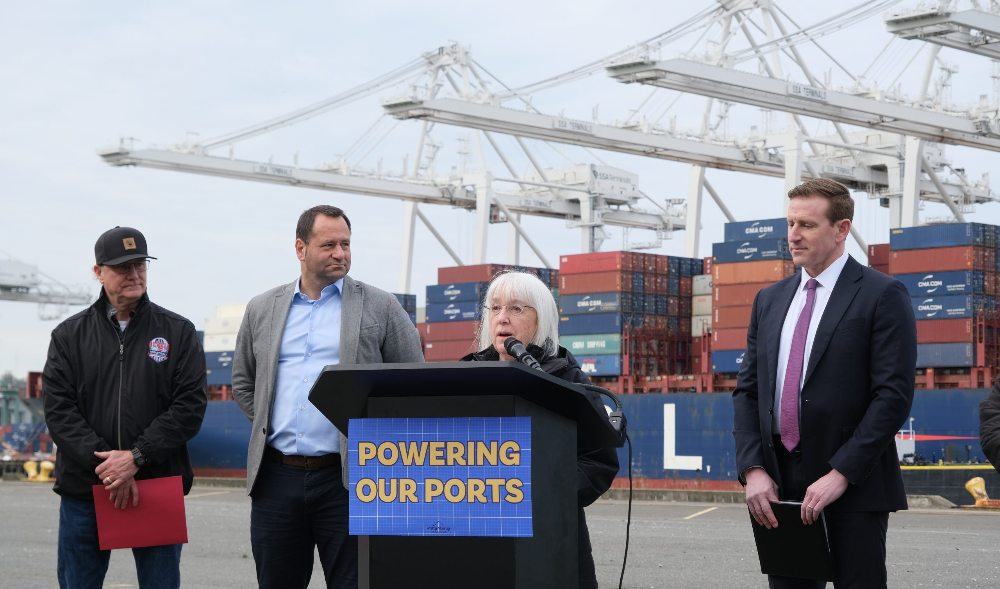

This is a response to Rod Stevens’ February 2026 piece in Post Alley advocating commercial development on the Seattle waterfront. ILWU Local 19 (International Longshore and Warehouse Union) believes it is important for the community to be aware of a critical need to protect maritime industrial employment lands along Seattle’s waterfront and to understand their unique role in supporting Washington’s economy.
As you drive through Seattle along the Puget Sound, you’ll see cranes buttress the waterfront on one side and skyscrapers looming overhead on the other. Where the water meets the shore in Seattle’s unique, deep-water port, business and industry work hand-in-hand to create opportunities for all of Washington state. But we can’t take our economic fundamentals for granted – and will need support from elected leaders to protect the marine cargo operations that are at the center of our local economy.
The maritime industry is a cornerstone of Washington’s economy – and the demand for container cargo traffic is projected to grow substantially through 2050. Work on the waterfront usually ebbs and flows with the cycles of the national economy, but a promising uptick in cargo traffic in 2024 was flatlined by haphazard tariff policies imposed from the other Washington. Through unilateral action, the Trump Administration has left our local maritime industry hanging in the balance, and with it, the people who rely on that work.
In Seattle alone, over 8,000 jobs and $745 million in annual wages stem from marine cargo terminals operating at capacity. Perhaps unsurprisingly, the past year has been drastically different for ILWU members looking for steady work, as the effects of federal policy changes started to sink in. Our dispatchers have reported as few as 70 jobs available on a shift for over 600 workers looking for a shift as international trade uncertainty strains the local economy.
Despite the impact from seesawing tariffs, the Port of Seattle continues to export thousands of Washington-made or grown commodities a year, from produce to aircraft parts. Recent downturns in container traffic should stimulate a more focused local conversation with elected leaders to focus on what can be done to protect our working waterfront over the long haul.
Land zoned for maritime industrial use along Seattle’s waterfront serves a unique and crucial purpose. These spaces are job sites that connect our state to the rest of the world while employing thousands of Washingtonians. Unfortunately, industrial land is also prized by housing developers and out-of-state land prospectors, who see opportunities to convert relatively cheap waterfront property into condos and coffee shops. This would be a bad trade for Seattle – exchanging a durable foundation of the economy that provides family wage jobs for waterfront condos and retail would erode important, accessible career pathways for families weathering high costs in an already expensive city.
Further, Seattle Waterfront’s tenant market reports an almost 30% vacancy rate, compared to just under 10% for maritime-adjacent industrial spaces. Before we take a wrecking ball to irreplaceable deep-water port-dependent industries, we should figure out what to do with the surplus of empty housing units and office spaces that are already available in other parts of the city.
Local collaboration between maritime organizations and the government can protect our working waterfront. The Coast Guard plans to modernize and renovate its footprint on T46 with an additional 6.6 acres of setback to support anti-terrorism and force protection operations, a right-sizing adjustment that will keep the nearby marine cargo berths viable for long-term commercial operation.
A 2025 Letter of Intent from the Northwest Seaport Alliance detailed a potential collaborative venture with the Brookfield Infrastructure Group to assess future marine cargo use opportunities to operate Terminal 46 as a 2-berth container terminal. Local efforts like the City of Seattle’s Comprehensive Plan, led by newly elected Council President Joy Hollingsworth, has already created a policy foundation that avoids encroachment on maritime and industrial employment lands and prioritized the protection of freight corridors. Jobs advocates, industry leaders, and government officials all see the critical utility of maritime industrial land to our city and state moving forward.
Protecting our working waterfront is critical to the health of Washington’s economy and workers. Bolstering our vibrant trade-dependent economy despite national uncertainty means protecting maritime industrial spaces and collaborating with local elected leaders to create new opportunities that will support the next generation of Seattleites.
Discover more from Post Alley
Subscribe to get the latest posts sent to your email.