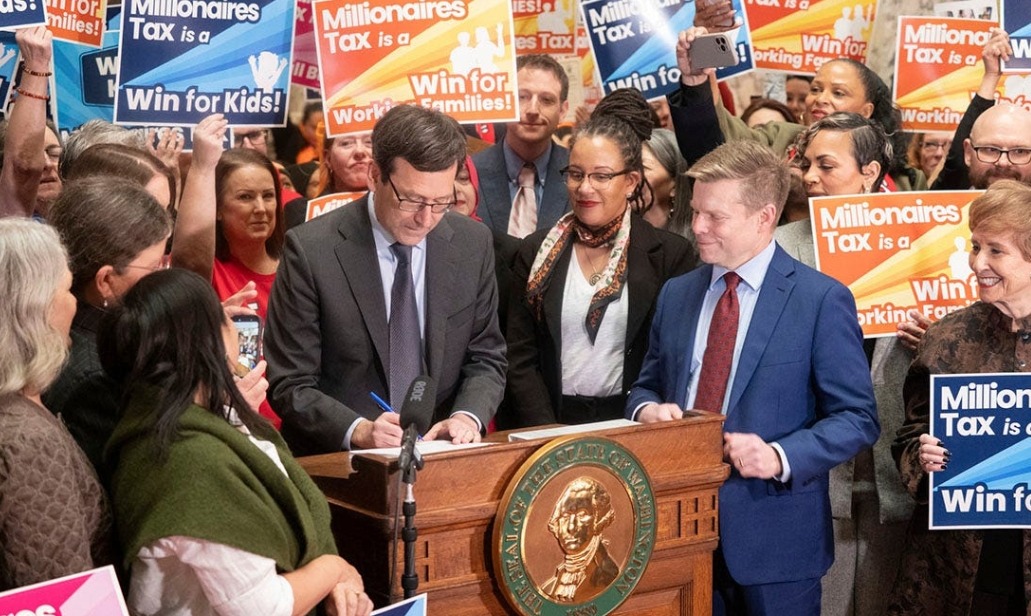

As he signed Washington’s first income tax law in nearly 100 years, Gov. Bob Ferguson took great pains to remind everyone that the “millionaires’ tax” as written doesn’t apply to anyone who isn’t pulling down seven figures a year.
But the bill’s sponsor, Senate Majority Leader Jamie Pedersen, who was the biggest winner of the year in this year’s legislative session, embraced the moment as the beginning of a sea change in Washington politics, the opening of a political and legal battle to remake the state’s tax structure overall. That battle figures to be a doozy on at least three fronts.
Front One: The courts
At the heart of this fight is a challenge to the 1933 Washington Supreme Court case known as Culliton v. Chase, which found that your income is your property and therefore subject to the state constitution’s limitations on property taxation. The opponents of the tax, led by former Attorney General Rob McKenna, will hit the courthouse in a matter of days. It’s vanishingly unlikely that the current version of the Supremes will weigh in on the issue this year. Even so, opposition lawyers will want to get a case in play to tee it up for a decision sometime next year.
The pace of appellate jurisprudence is leisurely at best. The last time this issue was before the Supremes, after the Legislature approved the capital gains tax in 2021, the folks in the black robes took nearly two years to issue a ruling, and they ducked a chance to toss Culliton and adopted the Legislature’s rhetorical fig leaf that it the new tax was an excise tax.
If things play out similarly this time around, opponents will seek a favorable ruling in a friendly courthouse in rural Washington and then the case will skip the Court of Appeals and head straight to the Supremes. Last time around, the capital-gains tax landed in their black-robed laps in an election year, so expect this case to move faster next year.
Front Two: A ballot measure
While there’s a strategic argument to wait for the court and a more favorable odd-year election in 2027, the conservative ballot-measure machine called Let’s Go Washington (LGW) is spoiling for a fight and announced a repeal effort shortly after Ferguson’s signing ceremony. Oddly, LGW filed a referendum on Monday rather than an initiative to repeal the law. Ordinarily, laws passed by the Legislature are subject to referendum challenges for 90 days after lawmakers adjourn for the year.
However, Pedersen’s bill includes a “necessity clause” that generally exempts referendum challenges to budget bills and tax increases. LGW and other critics argue that ploy is improper and illegal because the budgets that will spend any future revenue from the tax haven’t been written yet. Challenging that clause is a longshot move that requires the cooperation of Secretary of State Steve Hobbs and probably the courts.
If it works, the payoff could be huge. A referendum would require half as many signatures as a ballot initiative, around 154,000 signers versus about 309,000, and it would require voters to vote “yes” to uphold the tax, while it’s generally considered easier to get voters to vote “no” than to vote “yes.”
Also, a referendum wouldn’t be subject to a recent law that requires ballot initiatives to carry a warning about any hit to state spending, which helped doom most of LGW’s anti-tax slate in 2024. We’re told LGW might swiftly pivot to a repeal-initiative if this tactic fails or stalls. The deadline to submit signatures to put an initiative on the November ballot is July 2.
This faster timetable arguably plays into the hands of the tax’s supporters. There may never be a better year for income-tax proponents to win this fight with the voters. The second Trump midterm election figures to pull pro-tax progressives to the polls in droves, while an unpopular war, divisive immigration enforcement tactics, and various other weirdness might cause some conservative voters to check out.
Still, waiting for the legal process to play out went poorly on the capital-gains tax. Not only did the court decline to overturn the tax, and the voters did so in the 2024 election, more than three years after the Legislature approved the tax. Voters have spurned an income tax many times in the past, most recently in 2010, when Initiative 1098 went down in flames.
It’s worth looking back at that initiative and that campaign. First of all, the tax in question was on incomes of more than $200,000, not $1 million, which even then would have pulled in far more people, including many rank-and-file employees of high-paying tech companies.
Both sides spent about $6 million, which seems quaint by contemporary standards. The “yes” side was mostly the same public-sector labor unions that dominate progressive politics today, with a handful of wealthy progressives sprinkled in, most notably the late Bill Gates Sr. The “no” side, however, bristled with six-figure checks from name-brand billionaires, including then-Microsoft CEO Steve Ballmer, once-Amazon CEO Jeff Bezos, Microsoft co-founder and then-Seattle Seahawks owner Paul Allen, as well as smaller corporate checks from Microsoft, Boeing, and a variety of other prominent homegrown companies that objected to what amounted to a tax on their executives.
But much has changed since that vote. Ballmer has retired from Microsoft and is now among the state’s preeminent philanthropists; he just pledged to give the state $170 million per year to help pay for its planned child-care expansion. Bezos has left Washington for the tax-friendly Florida. Allen died in 2018. The corporate opponents of income tax, meanwhile, would face a substantially dicier politics next year. It’s one thing to snuff out an aspirational project of the activist left, but it’s another to overrule the Legislature and the sitting governor.
Front Three: electing a new batch of Supremes
For both sides of this fight, this year features an almost unprecedented set of risks/opportunities, since five of the nine seats on the Supreme Court will be on the ballot this fall, with only one true incumbent.
Justices Charles Johnson and Raquel Montoya-Lewis opted out of gifting Gov. Bob Ferguson the opportunity to appoint their replacements, unlike Mary Yu and Barbara Madsen. That means Johnson’s seat #4 and Montoya-Lewis’s seat #3 are open races.
As the Observer has noted, replacement justices (for Yu’s seat, Colleen Melody, and for Madsen’s seat, Theo Angelis) run with the advantage of quasi-incumbency, and it’s been 14 years since any kind of incumbent justice lost. True, we don’t know how they’d rule on an income tax. As now-sitting justices, they are bound by the judicial code of conduct to deflect any such questions. It’s a safe bet that Ferguson wouldn’t appoint an anti-tax hardliner with one of the biggest cases in a generation looming. Neither Justice Melody nor Justice Angelis face candidates with significant fundraising thus far.
The race for Charles Johnson’s seat is shaping up to be a barnburner. State Appeals Court judge Ian Birk and King County Superior Court judge Sean O’Donnell have reported raising a combined $240,000 so far (winning campaigns generally need $500,000), and each is hoovering up big endorsements from Democrats. Birk has more left-lane endorsements — including backing from Yu and four other current justices and former Gov. Jay Inslee. Sean O’Donnell’s list includes Justice Helen Whitener and former Gov. Christine Gregoire, and some center-lane political and legal types and even a Republican. Retired district court judge Dave Larson, a perennial right-lane Supreme Court candidate, reports some fundraising but appears to be getting eclipsed.
Seat 3 is less dramatic, with federal district court judge Michael Diaz building a strong campaign of Democratic endorsements (including AG Nick Brown), albeit with less fundraising. We’ll be watching for a viable challenger.
The endorsements matter because judicial races tend to be dry and high-minded, with lots of read-between-the-lines messaging. We’ll be watching for campaign ads and candidate forums that, say, detail a candidate’s definition of personal property.
One possible wild card is Full Court Press, a new organization that shares some DNA and former AG McKenna with opponents to the income tax. While candidates to be Supremes are effectively muzzled, there’s not much to stop outside political groups from advocating for would-be justices as more or less likely to rule one way or another. (Jonathan Martin also contributed to this story.)
This story first appeared in the authors’ Washington Observer.


I’m really thinking that this bill could have been framed much better by the sponsors.
It sounds like this is a tax the rich idea, rather than an attempt to even out the tax burden.
It makes it seem like Democrats are anti-business, when if this was presented right, we could say, “why do the hard workers of this state have to shoulder the burdon?”
Zoom out! Most states have an income tax. Washingtonians are tired of being a tax haven that generates all sorts of wealth inequality/affordability problems and then sticks the working class — people who earn less than $100k — with the bill of funding state services. I would have liked to see more tax relief for the working class, but this is a good start.
While progressives celebrate this as a victory, there will be negative repercussions. While the idiom “Who will we tax – millionaires! And how will we tax we tax – 10%!” may contain the requisite buzzwords to satisfy progressives’ ideological bloodlust, it’s not exactly sound fiscal policy. And to demonstrate their delusional thinking, the state legislature “compensated” by lowering the maximum estate tax rate to 20% – still highest in the nation even AFTER the reduction. So, our fiscal policy rests on Washington’s ~ 21,000 millionaires remaining sedentary.
To those who naively suggest that there’s no escape for millionaires because most states have income taxes, guess again. FL, TX, NV have no income tax. States with maximum tax rates below 6% include AZ, CO, UT, IL, KS, MI, OH, MO, PA, MD, NC and VA. Plenty of places to move where high earners can give themselves a pay raise in the process.
A more responsible way to implement a state income tax would have been to lower the income threshold and the tax rates. Using 2022 IRS return data, multiplying millionaires’ Washington-based income by 9.9% raises ~ $3.3 billion. Alternatively, consider an income tax with a $200k exemption and a tax on only the three highest income brackets – $200k – $500k, $500k – $1mm, and $1mm+. Tax rates of 2.25%, 3.25%, and 4.25%, respectively, would raise ~$4.3 billion – an additional $1billion, and increase the tax base from 21,000 to over 400,000 taxpayers. The $200k exemption would have provided tax relief for the families and would still be very favorable relative to almost every other state. The maximum tax rate of 4.25% would be lower than almost every other state with an income tax. No need for millionaires (and their businesses/jobs) to move. The additional revenue of ~ $1 billion would certainly have helped fund critical areas as you described in an earlier article – Medicare reimbursement, childcare assistance and K-12 education.
I’d call the above tax policy a win-win. Of course, selling this to the public would require mature political leadership and guts. Why do that when “progressives” can play the class warfare card and vilify high earners – all while singing the siren song of equity and fairness? And if the millionaires’ tax doesn’t raise the anticipated revenue? Washington State will simply hit them even harder. Millionaires know this, and they’ve been given a two-year head start to plan their exit strategy. I can hardly wait to see what progressive’s plan B is. Most likely they don’t have one.