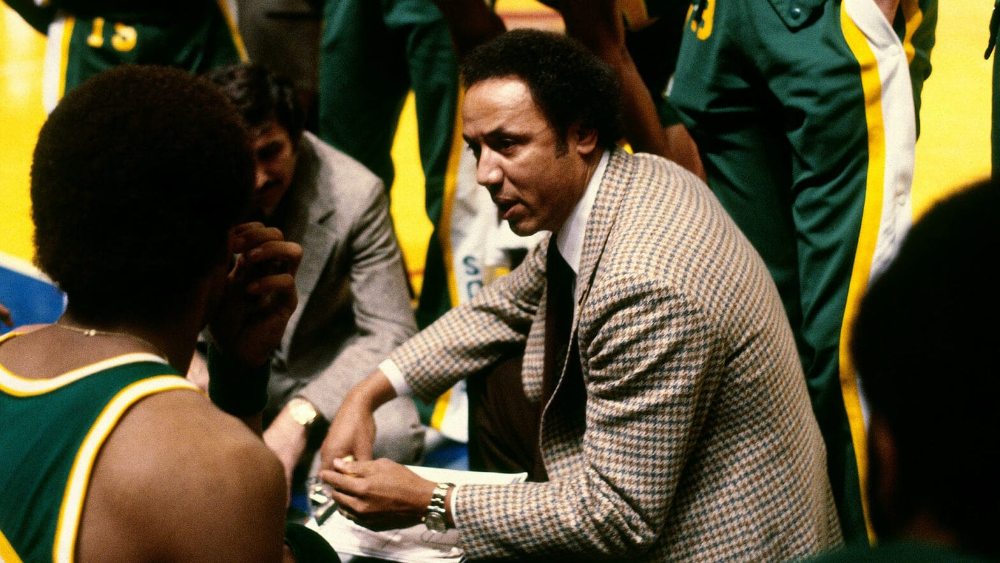

For a sports town that savors its demonstrative sports bosses such as Lou Piniella and Pete Carroll, Lenny Wilkens could not have been more different.
“When we’d get together for reunions,” said Jack Sikma Monday, “we’d joke that doctors had to search for his blood pressure. Just needle him a bit.
“He’d purse his lips, and barely smile.”

That image resonates with those of us privileged to have been around in the Seattle heydays of all three men. Wilkens’ time in charge of the Seattle SuperSonics was so long ago that a younger crowd could have no way of knowing how unsettling it was to see Wilkens in a full grin. Like, was a trap door about to open under the feet of sportswriters kibitzing in front of him?
When last I saw him in July, at the Climate Pledge Arena unveiling of a bronze statue of his likeness as a player, he was, of course, all smiles. That’s when family, friends and fans gathered to celebrate the most enduringly impactful figure in Seattle’s modern sports and civic history. The pressure of sports competition was long over, so Wilkens’ grin lit up a community that needed to say a final thanks, and a willingness from him to accept it.
His death at 88 over the weekend evoked from longtimers a marveling at the length, depth and breadth of his influence. Sikma, the unheralded farm kid from Illinois Wesleyan who was the center on the improbable 1978-1979 NBA champions, was among Wilkens’ most ardent admirers.
“Lenny kept going and going and going,” he said in a phone call from Hawaii, where he was visiting family. “His makeup was such that few could keep up.”
The legendary stoicism and even-handedness may have been the keys to prevailing in the intense tumult of the NBA for so long, where he won 1,332 games with six teams — the Sonics (twice; he was player-coach from 1969-72), Trail Blazers, Cavaliers, Hawks, Raptors and Knicks). The total was the most in NBA history until surpassed by Gregg Popovich and Don Nelson.
A nine-time All-Star in a 15-year career as a defense-first guard, Wilkens had an uncanny calm and authenticity when it came to human relations. Sikma was certain the style would still work in today’s NBA.
“Lenny would be a really great coach these days,” he said. “He understood who he was, learned who players were, and never created issues. He managed people really well.”
Sikma was an eyewitness to Wilkens’ impact in 1977 when, as Sonics personnel boss, he fired Bob Hopkins after a 5-17 start and installed himself as head coach. He asked leading scorer Fred Brown to become sixth man while pairing Gus Williams with Dennis Johnson, creating one of the NBA’s best backcourts. He also demoted the team’s most popular player, Slick Watts, then traded him.
The Sonics began to take off.

“Lenny was willing to go with my learning curve,” Sikma said of his rookie year. “He’d pull me out to sit on the bench and learn. He always told us we had the right parts to win, and had confidence in me. He rearranged our roles, which was not easy, but he never panicked.
“He mixed the young guys with the veterans — the perfect guy at the right time. A lot of people in the league were rooting for us, telling us how they liked how we came together.”
They went 42-18 under Wilkens, finishing 47-35 to reach the playoffs. They beat in the first round the Los Angeles Lakers, led by Kareem Abdul-Jabbar. They beat defending NBA champion Portland in the second round, then beat the Denver Nuggets in the Western Conference finals. In the NBA Finals, they drew the Washington Bullets, featuring All-Star bruisers Elvin Hayes and Wes Unseld. The series went the full seven games, when the Bullets crushed Seattle hearts in the Coliseum, 105-99.
Next season the Sonics, armed with young power forward Lonnie Shelton — the player received in return for the loss in free agency of center Marvin Webster to the New York Knicks — Wilkens moved Sikma to center and savvy vet Paul Silas to the bench. Again, success. The Sonics went 52-30, beat LA 4-1 in the first round, then survived a harrowing Western Conference final series 4-3 over the Phoenix Suns before drawing the Bullets in a Finals rematch. The Sonics lost the first game but won the next four, including Game 5,97-93, at the Capital Centre In Landover, Md.
That was the first, last and only NBA title for Seattle, now 17 years without a franchise. Hoops fans hoped that Wilkens would be around for the NBA’s return. but expansion is being slow-walked, likely because the NBA lusts to expand its reach to Europe, not domestically.
The 1979 title may be all that will be. Even the vibe from that championship lasted quick.
Two seasons later, the Sonics finished 34-48, the steepest fall by a champion in NBA history at that time. By 1985, the Sonics were 31-51 and Wilkens was moved to the front office, replaced as coach by Bernie Bickerstaff.
Many factors contributed, chief among them Wilkens’ intractable relationship with Johnson. No amount of leash granted by Wilkens was enough for the moody guard from Pepperdine, whose stellar defense was enough to earn the Finals MVP award. His legendary patience worn thin, Wilkens made a move. On June 3, 1980, Johnson was traded to Phoenix straight up for All-Star guard Paul Westphal. Most Sonics fans were outraged, because little of the conflict had gone public. The shock factor was similar to the 1999 trade of Ken Griffey Jr. by the Mariners and the 2022 trade of Russell Wilson of the Seahawks.
At the time, I was the beat reporter covering the Sonics for the Seattle Post-Intelligencer. I called Wilkens, expecting to be brushed off. Instead, he talked about Westphal, then was honest about Johnson: “If you have a cancer, you have to cut it out.”
The A-1 story quickly went national. Wilkens denied the cancer analogy, but I knew what I heard. We stood by our positions over an awkward summer. By fall, the shock had ebbed. The NBA was in rapture over the rookie seasons of Larry Bird and Magic Johnson, figures who helped transform the NBA from a second-tier operation.
Years later, when Johnson starred with Bird and the Celtics, he told Sports Illustrated, “Sure, Lenny and I got into some heated arguments. Maybe I missed a couple of people, or took some shots I shouldn’t have. That’s all it ever was. I certainly never heard Lenny call me a cancer.”
I did. To Wilkens’ credit, he never let the episode compromise our professional relationship. Westphal played only 36 games for Seattle because of a foot injury. Johnson played 10 more seasons that included two championships with the Celtics.
“DJ’s trade had a lot of complicating factors,” Sikma said. “Future contracts were involved, Lenny wore two hats (also general manager). It was not a positive environment. A decision had to be made, and he made it. Westphal’s injury couldn’t be helped, and Gus Williams sat out a season (1980-81, in a contract dispute).
“It didn’t work out well for Seattle. But my experience in coaching is you have to put on your big-boy pants and live with it.”
Those pants were among many worthy things in Wilkens’ closet, including Pro Basketball Hall of Fame honors as a player and a coach, an Olympic gold medal as coach of the 1996 champions, as well as accolades for his fundraising efforts on behalf of the Lenny Wilkens Foundation and the Odessa Brown Children’s Clinic.
Impact need not include histrionics. A calm demeanor and deep insight into human nature work too.
Discover more from Post Alley
Subscribe to get the latest posts sent to your email.


I had the privilege of meeting Mr. Wilkins in the early 80s. I was a bus boy for Seattle Center catering and my boss escorted me to the owners suite so I could change out a bus tub of beverages. My boss Joe said Mr. Wilkins I would like you to meet one of our employees and not only did he stop and look me in the eye and give me a proper greeting and handshake. He then turned and introduced me to his wife. I was a 16-year-old kid changing out a bus tub of ice and cold beverages and he treated me like an equal. I have always remembered that exchange. He was a true gentleman.
Many people in Seattle and elsewhere have experienced the Wilkens trademark.
I have no doubt, I think as kids we all had fairly sensitive BS detectors when it came to adults.
Great article, the Sonics were, as I remember, a new team full of unknowns, until Wilkens came aboard, already one of the league’s premier players.
I sincerely believe that in his playing days, he ushered Seattle sports into a new era.
Our first pro sports superstar as a player, then became a coaching legend.
Art. Enjoyed your journalistic reflections. Lenny was a class act on and off the court. Is it possible you misheard “cancer?”
My dad became an usher at the Coliseum during the Sonics expansion year. He was excited about the NBA coming to Seattle and wanted to be a part of the city’s first professional sports team since the NHL Metropolitans folded in 1924. I got to see many Sonics and WHL Totems games growing up. Including seeing Lenny and Spencer Haywood fly up and down the court the way Gary Payton and Shawn Kemp would do 25 years later.
Like many Sonics fans I had my doubts about trading DJ but in Lenny’s coaching career he has his way of doing things and if you can’t conform to it you’ll be elsewhere. You can’t deny his success.
I’m disappointed that he wasn’t able to see the Sonics return but at least he got to see a statue honoring him set outside the very arena his Seattle career started. I’m hoping one of Spencer Haywood will be done as well. Both of their careers are intertwined and both were Seattle’s first real professional sports stars.
Our family moved to Seattle from small-town Michigan in the summer of 1978, and my new “hometown” team became the exciting Cinderella Sonics instead of the middling Detroit Pistons. The Sonics won the 1979 title the same night as our last Cub Scout troop meeting, and parents brought portable TVs so everyone could watch the final quarter. For a grade-school kid, that was the ultimate thrill.
On reflection, it’s remarkable that the right person to lead such an exciting team leading the city to its biggest (pro) sports celebration until 1995 and Super Bowl 48 was someone nobody ever heard with his voice raised. Even in the newspaper photograph of the championship moment, with DJ, Freddie Brown and an assistant coach celebrating, Wilkens was just standing there with a neutral expression.
That’s a difficult word to misunderstand, Dorothy. He was under duress to publicly justify a controversial move. It was one of the few mistakes made in a remarkable career.
Thank you, Art. I had been hoping you would weigh in on Lenny in the same way you wrote about the Ms during the playoffs. You remain a reporter at your heart. Just one story: I watched the 1977 NBA championship’s seventh game at a subterranean Walla Walla bar called The Faucet. At games end I was devastated and told the man sitting next to me that this was so. Says he, I’m doing just fine. I got paroled from the pen(itentary) today and watched as a free man. I bought him a beer.