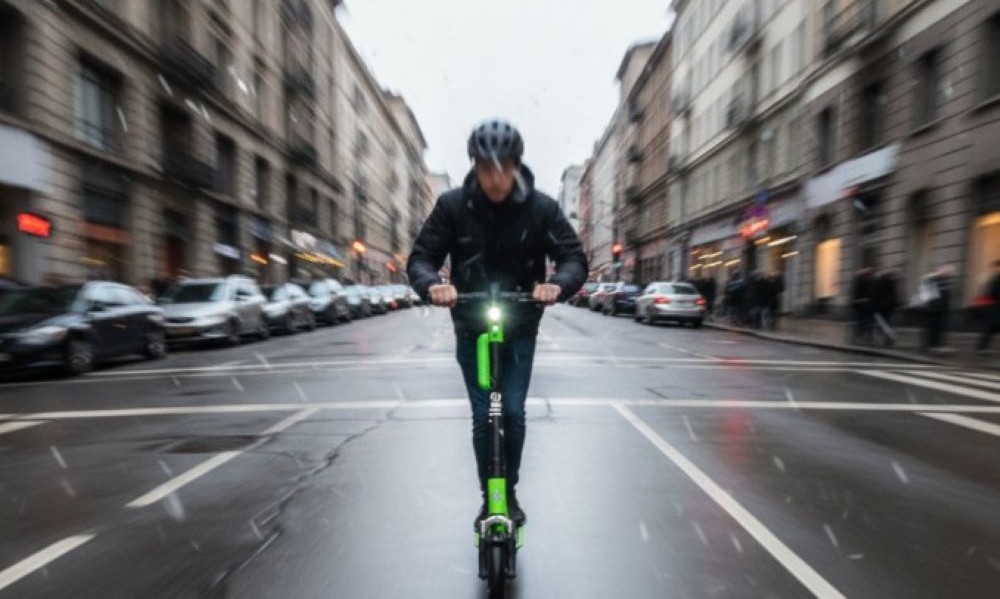

It’s a common sight in Seattle: 40-pound electric bikes and scooters tossed into bushes, blocking sidewalks and access ramps, and barreling down the sidewalk at unsuspecting pedestrians.
Lime, the micromobility private company that operates 14,000 electric bikes and scooters in the Seattle area, has long been the target of criticism from city residents. The vehicles block bike lanes, sidewalks and, in some cases, both simultaneously. Citizens with mobility issues continually complain of Lime vehicles making sidewalk curb cuts and ADA ramps unusable. Severe injuries have befallen both riders and walkers.
Pedestrians of all shapes, sizes, ages, and abilities have continually raised the alarm about riders on these hefty, fast-moving vehicles disregarding sidewalk motor laws, putting walkers, pets, and strollers in danger. According to the University of Washington, 84.9 percent of these accidents take place between dusk and dawn, and alcohol use is
a factor in 64 percent of accidents.
On Tuesday, December 2, six community councils from Seattle neighborhoods came together for a community forum to hear Lime discuss the company’s plan to address these issues. Parker Dawson, Lime’s senior regional lead for government relations — who joined the company earlier this year — spoke for Lime as he addressed the full room at Plymouth Congregational Church.
The presentation touched on Seattle usership statistics, safety-messaging initiatives, and
technological innovations promised to arrive in Seattle by June of 2026. However, much of the planned changes were met with skepticism from the attendees, since Lime already promised and failed to deliver many of their promised solutions in 2022, and this time they say they need to use even more public resources to do so.
Lime is “a success” in the Seattle area, but for whom? More people ride Lime in the Seattle area per day than enter Westlake Station, and ridership has increased from six million trips annually in the Seattle area in 2024 to nine million in 2025. Lime also claims that it has “displaced 7.2 million car trips in Seattle,” though that number was not explained. Most forum attendees were more focused on Lime’s safety messaging and promised tech innovations.
Dawson claimed that “Lime puts on over 40 public events a year” aimed to promote rider safety, some of which include talks on proper helmet usage, and that Lime is undertaking an advertising campaign to dissuade users from sidewalk riding. Lime has also “provided the Seattle Department of Transportation (SDOT) with rider safety flyers in seven languages.” The technological innovations that Dawson promised “will be rolled out to Lime devices in the Seattle area by June of 2026,” but that prediction roused skepticism.
Proprietary technologies Captur and LimeVision 2 (both developed on Seattle streets) promise to solve parking and sidewalk problems with AI-powered, real-time feedback with cameras on bikes and scooters. An innovation called Lime Location Engine will pin-point the location of a Lime device within four feet of error to more accurately track vehicles and identify riders who ride outside of the street.
These innovations also sounded great in April 2022 when Lime promised all of them in its initial scooter-sharing permit filed with the city. Now Lime appears to be kicking the can on pedestrian safety to another future deadline.
In its 2022 permit application, Lime said it would implement LimeVision, camera technology meant to detect sidewalk riding, parking violations, and pedestrian conflicts, similar to what is promised for the June 2026 rollout. Years ago, Lime promised “industry-leading geofence technology […] accurate to within less than a foot and activating within less than one second.” Lime also promised in 2022 to “address improperly parked devices within 15 minutes.” At the recent forum, however, the best Dawson could do was encourage residents to “use Find It, Fix It” to report improperly parked Lime vehicles, which would be addressed by Lime within “a few hours.”
Another problem that skeptical attendees pointed out was the unclear messaging surrounding SDOT and Lime’s detailed relationship. Dawson stated that to solve parking issues, Lime and SDOT need to work together to build 800 corrals with designated space for 10 parked scooters in each corral. Dawson seemed to imply that if Lime gets to further expand its infrastructure, then it will be able to reduce sidewalk blocking problems.
This “Mandatory Parking Zone” system is already used in some sections of Alki Beach, the waterfront, and elsewhere, but it is inadequate as a solution. Riders can still walk away from their ride without ending it. After all, according to Dawson, the vehicle only counts 15 minutes of inactivity before ending the ride. At $0.50 a minute, that’s a price tag of $7.50 for rider convenience and pedestrian impediment. Dawson also implied that Lime does not want to immediately fine riders who engage in this behavior for fear of reducing its customer base.
When asked about the possibility of a per-incident fine system, he responded that “Lime has a progressive disciplinary policy that starts at warnings and that moves up to fines, then suspension,” and that no plans are in place to immediately fine riders, even if the technology can accurately determine that the rider broke Lime’s terms of service.
Lime’s presentation was illustrated with renderings of what the new parking corrals could look like. The renderings proposed using space in the parking lane near intersections to
hold multiple scooters. This sparked important questions around sections of public thoroughfares being used and operated by private entities — Lime is owned by Neutron Holdings, a private company founded by venture capitalists.
Seattle tackled a related scenario in the late 2010s with car sharing company Car2Go. But Car2Go’s physical infrastructure was limited to privately owned lots and non-roadway parking spots purchased by the company. Car2Go’s free-floating model brought its own share of parking challenges, but Car2Go did not obtain permanent parking rights from SDOT on public roadways. The daylighting area parking corrals that Lime is pushing for are in the public right-of-way.
One common refrain in the community forum was Lime’s assertion that it sees itself as critically important for Seattleites. When Dawson was asked if the company had considered suspending service until safety issues can be addressed, he said “no, because we help a lot of people get to where they’re going.” Lime’s mission states that it is “building a future where transportation is shared, affordable, and carbon-free.”
Lime operates using city permits but is not a public utility. Many Seattleites completing 2025’s nine million trips on Lime have come to rely on the availability of the service for their commutes and errands. So do the public transit riders who completed 151 million trips in 2023 on Seattle’s bus and light rail services. Privately-owned micromobility rideshare companies deliver less than 6 percent of transit ridership.
Forum attendees also wondered, why June of 2026? Lime has Lime has been making similar, unfulfilled promises as far back as 2022. For all of Lime’s claims about helping Seattleites get around, Dawson was unable to provide concrete numbers on how many people using Lime in Seattle are actually Seattleites and how many are tourists who are unfamiliar with the street network and may be more likely to engage in unsafe behaviors like riding on the sidewalks.
Many cities such as Paris have banned Lime scooters. When Dawson was asked about the earlier pledges from Lime, he had to admit he didn’t know about them. At the Plymouth Forum, Lime ended up getting squeezed.
Discover more from Post Alley
Subscribe to get the latest posts sent to your email.


Seems like there is also room for improvement here from riders themselves, let’s work from that angle too. If riding a bike on a sidewalk is illegal, ticket violators; if leaving a bike on a pedestrian path is illegal, ticket violators; if recklessly operating a bike is illegal, ticket violators. We must create a culture of doing the right thing again, and both individuals and rideshare companies have a role in this.
No, riding a regular bike on sidewalks is not illegal, but cyclists should yield to pedestrians. The dockless e-devices are not supposed to be ridden sidewalks. So, it is odd and probably counter productive for SDOT to provide sickle device corrals on our sidewalks. The e-device clutter obstructing sidewalks, curb ramps, and bus stops is a major issue.
How about the use of lime scooters and bikes in criminal activities. Is Lime helping to solve crime and ban riders who use their scooters and bikes for criminal activity? Porch pirates, store break ins, drug trafficking, etc.
I support the Paris solution. Personally, I have had Lime riders almost knock me down riding on the sidewalk multiple times as I walked from Horizon House to Skyline to visit a friend in skilled nursing there. As for immediately ticketing a violator, who is going to be on the scene with the authority to do that?
Same goes for car traffic violations where there’s not always enforcement on the scene — you roll out a campaign to follow the new law, publicize some enforcement, and let the threat of a ticket take care of the rest. Perhaps there is a role for collaboration between Lime and the enforcement. Perhaps like cars, each bike needs a unique ID (license plate) to report bad behavior.
Lime has a record of every user, every trip–it would be possible, technically, to identify the rider who left a bike in an inappropriate location. Not sure if there would be privacy rights issues.
The scooters are frequently operated by out-of-town visitors who not only are ignorant of local rules, are quite comfortable flouting community standards in a community they are not part of. I’ve had a pair of tourists menace me after I commented aloud about riding fast on t sidewalk immediately adjacent to a bike lane in the same direction of travel. They really don’t give a rip and the rental scooters give license to doing so at speed.
Car2go did use public parking spaces. Drivers could park them in public spaces free. As a lime use I find many of these claims to be exaggerated. Some do get poorly parked but people do that in cars all the time. Should we ban cars too? People also get injured in vehicles and by vehicles but no one’s calling for a ban on vehicles.same goes for crimes most often criminals get away in a vehicle but no one’s going after Ford or GM for that fact.
To be precise, I don’t think the call here is to ban scooters, either, it’s to ban Lime rentals (including presumably any similar operation.) That’s a vehicle that runs at fairly high speed, requiring no license or experience of any kind, more or less guaranteed to be used without proper safety gear like a helmet, and – I think maybe really the key point – the street infrastructure isn’t made for it. Roads are not reliably in adequate shape for it; sidewalks are technically forbidden; bike lanes are scarce; parking isn’t really available where it’s needed. It’s a scandal that this is going on.
The analogy to cars isn’t exactly perfect.
As someone who does both walking and using Lime’s scooters, I can say for a fact, I have seen more people who ride on the sidewalks and 100% ignore the laws and agreements they said they would follow before getting on a scooter. I have almost been hit by those heavy rides. I have also witnessed a scooter rider not paying attention and hitting the back of a car, but the car did stop suddenly. It was just strange. Too often I see them riding on sidewalks.
Good article, Gabriel. Does anyone know if Lime pays any fees for Seattle bike paths (e.g. taxes from rentals, fee with City of Seattle licensing, etc.)? Lime bikes and scooters are high utilizers on separated paths such as Seattle Waterfront, Fourth Ave, and Dexter Ave. While we citizens support paths with our taxes, I’d think Lime should also chip in somehow, if they’re not already.
Thank you for an excellent article. The presentation was a one-sided one from Lime. There was no opportunity to counter the corporate point of view with that of Seattle Residents.
The DOT has NEVER considered safety. There is NO safety plan. Police cannot enforce the laws, and have not been trained on the laws. SDOT’s “count” of accidents is 5% of the number who. have been admitted to just one of the Emergency Rooms. They have not done their mandated report to the city in five years. Thousands of electric scooters/bikes now operate without any need for safety.
Scooter blocking your wheelchair? Open Findit Fixit and Lime will be out the next day to clear your path. We have to trust Lime that they will let the rider know about the problem, even though they refuse to keep track of riders. We should feel secure that they ensure riders are over 18–by making them click a checkbox stating they have read all the terms and conditions (which state they must be over 18).
Lime talks about their GoSlow and NoGo technology with geofencing. After six visits to protect the terrified seniors at Pride Place, they gave up.
The head of the micromobility team at SDOT sits on an industry council. How can she represent the city AND Lime?
A little digging shows that Lime has been given carte blanche to make millions each year with no one monitoring them. Parker Dawson used to work for City Council. There has been ZERO concern with safety of either pedestrians or riders.
SDOT is now working on a program for driverless taxis. Let’s hope the new SDOT leader cleans house and investigates how the team leader has a conflict of interest and how NO one is looking out for Safety.
Yet another post, heavily commented upon, on SDOT’s roque policy for saturating Seattle with e-scooters and e-bikes for rent. No transparency, let alone accountability, for hundreds and hundreds of injuries treated at Harborview. For turning everyday sidewalks into “hostile infrastructure” for defenseless pedestrians, the elderly and disabled especially, as scooters illegally ride and “park” on sidewalks and curb ramps. For inexplicable illegal riding by kids and couples. For a toothless “fines” policy for Lime’s endemic permit non-compliance. For how much in total this intrusion on sanity costs the public. For how little Lime pays Seattle for the hugely profitable privilege granted by SDOT to take over the public streets and sidewalks.
The only question now, before SDOT quietly renews in March Lime’s permit for Lord-knows how many devices: Will the City Council ask for any accountability from SDOT for the actual outcomes and bokken promises of this program? After five years of Council ostrich-head-in-the-sand utter neglect, could we dare to hope for a serious, informed, public discussion and deliberation whether to actually fix this mess, or end it?