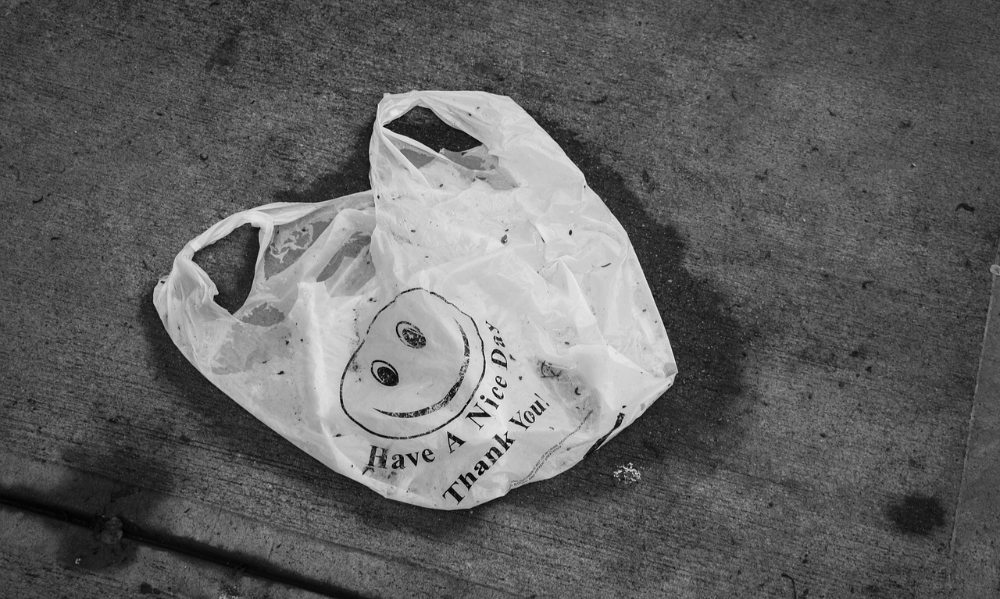

California has decided to ban all plastic bags at retail stores, effective January 1. The same idea is bound to pop up here, and we ought to think about it first.
The campaign against plastic bags has been going on for most of this century. It began with a report about a swirl of plastic in the Pacific Ocean discovered by a yachtsman in 1997. People called it the Great Plastic Garbage Patch. It was a vortex of bits, bottle caps, chunks of Styrofoam, and parts of fishing nets.
This was terrible: the tiny bits of plastic were a digestive threat to seabirds and nets were an entanglement threat to seals. Beyond that, the Garbage Patch was disgusting. It was humanity’s detritus of a civilization that didn’t give a damn.
I’ve seen something a bit like that Garbage Patch while hiking in the Olympic National Park. In the midst of the most fabulous wild coastline in America, plastic junk had washed ashore. Most of it was colored rope, white floats and dark fishing nets from boats that had lost their gear. Water bottles and detergent bottles, many with Japanese labels, were lodged in the boulders and kelp. I don’t recall plastic bags or any hikers’ stuff, so I assumed that the bottles were from sailors dumping their garbage before entering U.S. waters.
Accounts of the Garbage Patch said that 80 percent of the junk in the ocean was from people on land. An actual investigation found that most of the Patch is made up of fishing gear and that 20 percent of it is stuff from the tsunami that hit Japan in 2011. Of the garbage with labels that could still be read, most of them were either Japanese or Chinese.
In other words, it’s not ours. The stuff on the beaches south of Cape Flattery wasn’t, either. We’re careful here; Seattle sends its trash by train to Arlington, Oregon, where it’s buried in the ground. Other communities do other things, but none of them dump their garbage into the sea. But when activists asserted a connection between plastic in the ocean and plastic shopping bags, people felt obligated to talk as if it was our trash and our waters.
I quote the Seattle Times editorial board, which on September 11, 2013 said, arguing for a ban on plastic bags: “Harm by plastic bags to the environment, particularly to Puget Sound marine life, outweighs consumer taste and convenience.” That editorial was in support of a ban on plastic bags in Issaquah. I very much doubt that town’s bags were floating in Lake Sammamish, down the river to Lake Washington, through the Ballard Locks and into Puget Sound. But Seattle had banned thin plastic bags, and it was time for Issaquah to do it.
Now California is banning all such bags. When the Washington Post argued against California’s ban, readers took it to task. No debate necessary! This was for “the environment,” and they were for it.
People need to think about this logic. Rhetorically, “the environment” is a vague and spacious box that contains things that are hugely important, plus things of everyday importance and things mostly banned for looks. By boxing them together, you can avoid having to justify each one. But each proposal does need to be justified.
In Washington, the statewide ban on plastic bags at retail stores began in 2021. The ban applied to the thin, 0.5-mil, bags then being offered to customers for free. (A mil is a thousandth of an inch.) Since then, the law has allowed 2.25-mil bags, as long as stores charge at least 8 cents for a bag. They can charge more, and I’ve paid 25 cents.
The law declared the old bags “single-use” and the new ones “reusable.” The old bags were, in fact, reusable; I used mine for kitchen garbage. It occurs to me that because I used the old bags twice, that with the new ones, in order to get the same number of uses per pound of plastic I would have to use each bag nine times.
In 2028, our state law is set to replace today’s bags with 4-mil bags eight times as thick as the ones banned in 2021. Because I used the original bags two times, I’ll have to use the third-generation bags sixteen times in order to begin doing environmental good. Are people going to do that? If the aim is to reduce the amount of plastic in the wild, does it make sense to replace thin bags with thicker ones?
Our law also requires further that our thicker bags have 40 percent recycled content — not from bags, which are not allowed in our recycling bins, but from other plastic. Plastic can be recycled for use in bags, but it produces a more expensive bag. And it’s still not a biodegradable bag. That it contains recycled plastic would make no difference to a fish. When we call such a bag “sustainable,” does that mean anything?
In short, our state’s policies are in need of review. To that end, our Department of Commerce recently published a study, “Evaluating Washington State’s Retail Carryout Bag Policy.” Its authors, Eric Jessup and Jake Wagner of the School of Economic Sciences at Washington State University, concluded that mandating thick bags has reduced the number of bags but has put “more plastic volume in the environment.” The same thing happened in California.
WSU’s Jessup and Wagner say that the problem of plastic in the environment will be worse with the 4-mil bags planned for 2028. They conclude that the least-harmful bags are the thin ones, which appear not to cause “sufficient damage to warrant a ban.” The WSU economists would allow stores to offer whatever bags they chose, but would keep the mandatory charge per bag as an incentive for people to bring their own bags.
The economists’ study was not welcomed in Olympia. In a cover memo, the departments of Commerce and Ecology say Jessup and Wagner “fail to consider larger social, economic, and environmental implications.” It goes on to say, “Commerce and Ecology remain open to a statewide ban on all plastic carryout bags, as this would be an effective policy to reduce plastic in the environment,” the memo declares. “However, this policy raises potential equity and environmental-justice impacts.”
Commenting on this response, Todd Myers of the Washington Policy Center, a free-market think tank, writes, “How will the agencies measure equity and environmental- justice impacts against the data showing environmental harm? They can’t. They are just vague slogans that can be used to come to any conclusion agency staff prefer.”
If there really is substantial harm from plastic bags — our plastic bags, not bags from China and Japan — maybe we should ban them, as California is doing. But the advocates need to make their case a lot better than they have.
A final thought. The thin bags, which are the most convenient for kitchen garbage, have not been banned outright. If you want some for your kitchen garbage, you can go on Amazon and buy a box of 1,000 “T-shirt bags” for less than 3 cents a bag. Fred Meyer can’t use them, but you can. For how long, I don’t know, but you can do it now.
Discover more from Post Alley
Subscribe to get the latest posts sent to your email.


Another couple of wonderful words the State uses: “….. this policy raises potential equity and environmental-justice impacts.”
Now those are fighting words!
Don’t want that policy!!!
Oops, my knee just jerked to tell me not to challenge anything that violates those policies.”
I apologize!
Excellent observations. In my household we were in the habit of using the thin bags over and over and over again, and then when they got ragged, using each of them one last time for something messy that had to be conveyed to the non-recycling bin. I still think that was a good compromise overall. Now we have an abundance of shopping bags of random descriptions in the back seat of our car, some of which are not all that well designed.
Plastic used and discarded (and all of the gasoline and oil used for transportation and energy generation) is decayed living tissue.
Yes, plastic on the ocean beaches is mostly not ours, but the rest of the state is littered with OUR plastic, especially thin bags that blow in the wind. I use cloth bags for shopping and wash and reuse ziplocks and, like you, use the few thin ones I end up with for trash. Short of banning all plastic bags, making them expensive would reduce the problem.
PS: I am put off by your “promotion” of Amazon’s thin plastic bags.
Clearly some updates in plastic bag use are appropriate. But this piece is off the mark in key areas. Standard plastic bags from stores should never be used for kitchen food waste going into household Green Food and Yard Waste containers for pickup. Those bags are not compostable and pollute the composting process. Compostable bags intended for this purpose are readily available and reasonably priced. In addition, regulations concerning use of plastic bags should focus on encouraging customers to bring their own reusable bags, which many people do. If that isn’t successful, non-compostable plastic bags should probably be banned. After all, microscopic plastic pollution has now invaded every corner of the globe, as well as our human bodies, with unknown long-term consequences.
Just to be clear, we don’t direct anything but approved, biodegradable bags to the compost bins which are picked up weekly (which is mostlytree and shrub pruning as distinct from recyclable materials). The one thing that needs more clarification and better direction from our city is which plastics actually get recycled, and which, alas, got the landfill in any case.
Another point worth mentioning is that the extremely thin (free) produce bags found in virtually every market can be reused many, many times as well.