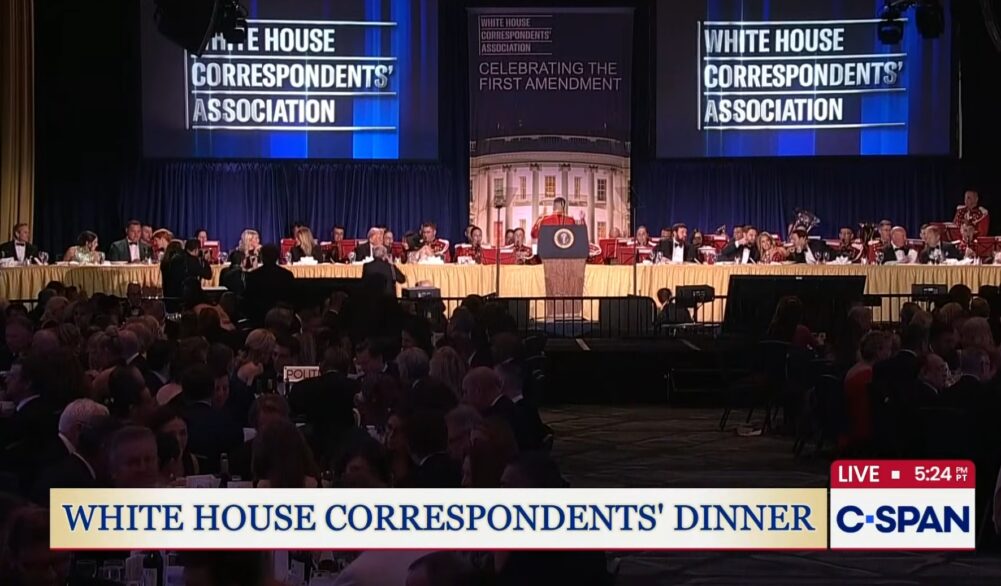

For close to 20 years, I attended the White House Correspondents Ball. It was rarely fun.
What began as a well-intentioned gathering to honor outstanding reporting on the presidency and to give scholarships to promising young journalists evolved into a celeb fest that in many ways highlighted the increasingly troubled and confused ethics of those of us attending.
This past weekend’s shooting outside the jammed Hilton ballroom has caused even more than the usual analyses of what is right and wrong about this annual gala. I am so grateful that it did not become a mass casualty event, and I hope those present can take deep breaths and move forward without too much trauma.
I first attended the White House Correspondents Dinner as one of the stringers Time Inc. invited to fill a few extra seats. This was probably around 1990. Before and after dinner various news organizations hosted receptions in rooms throughout the Hilton. Guests could roam from party to party, and I ran into former colleagues from the Associated Press and other old friends. It was a relatively low-key although dressy affair where reporters and those in the government they covered could mix and mingle and build relationships important to both.
The opportunity to get face time with key officials off the clock was a central attribute of the fete organized by members of the White House Correspondents Association. The WHCA historically played an important role assuring that the press had the access it needed to keep the public informed about each presidential administration. WHCA members were hard working journalists who reported from cramped cubby holes inside the White House. They represented all the major news outlets and, back in the day, the larger regional papers that could afford to have fulltime correspondents in the nation’s capital.
One of the first experiences new reporters in DC encounter is the challenge of getting access. Back when I worked in Salem covering the Oregon government for the Associated Press, I could easily accost any elected official walking through the corridors or in the elevator or cafeteria. It doesn’t work like that in DC where every official has staff serving as gatekeepers to make journalists navigate multiple obstacles to finally get a needed interview.
The White House Correspondents Dinner was a rare opportunity to circumvent all those gatekeepers. Reporters invited members of the Administration, Supreme Court justices, Congressional leaders and other key DC players to be their guests at the dinner. It was a way to build relationships and gain access. After trying for weeks to get through the hurdles to talk with a Cabinet secretary, at the dinner I could walk up to her (or often more importantly her press secretary) – not to interview but to introduce myself in hopes that it would help with future reporting requests.
Over time, the gala became an increasingly coveted ticket. That credit (or discredit) goes to the trend of Hollywood on the Potomac. What started with a few journalists inviting celebrities and headliners to be their guests burgeoned into a fierce competition among many news organizations to bring the biggest names that would generate the most buzz for them.
This did lead to some very cool moments I enjoyed. For example, sitting near Serena Williams with my editor asking her for advice on his grip. Or standing by the elevators with Henry Kissinger while he talked with Padma Lakshmi. He had shrunk by that time and was eye level with her chest.
Working for People magazine and then Glamour, my job involved helping to fuel this celebrity fest. The goal was to invite a mix of powerful political figures like a Cabinet secretary along with top celebrities. Big names went beyond Hollywood to star athletes, singers and ordinary people who had been thrust into the front page headlines. Even those news outlets that purported not to be celeb crazy often brought the biggest names to their tables. What used to be a wall at news organizations between editorial and publishing crumbled more and more as the business side saw the dinner as advantageous to its goals.
At times there were some amusing moments because A-list Hollywood types weren’t used to being crammed in a ballroom full of journalists and bureaucrats who would walk right up to them to get autographs for kids (or like my editor get tennis advice from Serena). At one dinner I was asked by an editor to stand behind the chair of one celeb guest to fend off anyone wanting to meet him. There also were celebrities who hadn’t fully understood that the White House Correspondents Dinner didn’t mean going to 1600 Pennsylvania Avenue. (And the idea now being floated by Trump that the dinner should switch venues to his planned tasteless over-priced new ballroom is a non-starter, or should be a non-starter).
The ball was not an inexpensive evening. News outlets that were starting to struggle financially and laying off staff would spend tens of thousands of dollars on the gala. In addition to tickets (about $3,500 for a table of 10), many paid the air fare and hotels for their celebrity guests and then also coughed up big dollars to host before and after parties.
A one-night party morphed into three to four days of festivities. There were parties starting on Thursday and going through Sunday and each vied to be exclusive and get some of those celeb guests and big pols to pop in.
At the same time, most journalists attending and helping to organize all these events would tell you they fully embraced the old adages of our profession to comfort the afflicted and afflict the comfortable, to speak truth to power, and as Walter Lippmann said: “to tell the truth and to shame the devil.”
Today’s White House Correspondents Dinner has become a travesty of those values. A struggling news industry is spending money on this weekend of partying while reducing the number of journalists actually out there doing the grunt reporting that makes freedom of the press so important. A president who constantly derides the press in general and hurls despicable slurs at individual journalists like the schoolyard bully he is should not be the guest of honor at a dinner ostensibly about celebrating outstanding reporting.
It’s beyond time to call off this annual extravaganza that poses increasing challenges to what we once believed were the core ethics essential to good journalism. It has devolved into a reality TV show at a time when too much of our national government acts like they are part of the desperate housewives franchise.
Discover more from Post Alley
Subscribe to get the latest posts sent to your email.


Enjoyed the insight (and another microcosm of what’s wrong right now).
Yes, so many examples these days of what’s wrong. Still I remain hopeful that change will come.
Good piece. I especially liked this bit:
“A president who constantly derides the press in general and hurls despicable slurs at individual journalists like the schoolyard bully he is should not be the guest of honor at a dinner ostensibly about celebrating outstanding reporting.”
Of course, if American voters keep electing fascists dictator-wannabe people like Trump, we can expect more obsequious praise for future POTUS-es and more direct control by the President’s minions over all such bootlickings.
The cheesey, gold plated ballroom Trump plans is smaller than the Hilton’s, so here’s an idea: Buy the Hilton and turn it into a guesthouse for all the wonderful parties Dear Leader wants to host. That way, you get the biggest ballrooms, the biggest kitchen, lots of bedrooms where the drunks can sleep it off afterwards. In short, if the government buys the place you can have the whole enchilada. Surely El Trumpo, savvy businessman that he is, can see this being a BIGLY WIN for America (maybe the biggest in history!).
Feh, this farce needed to be cancelled before it began. “access journalism” is the problem…don’t get too tough with the questions, or you lost access.
Colbert was right all along.
Of course Trump already tried having his own hotel in DC when he converted the Old Post Office building into a luxe property that opened in time for his first inauguration. Despite sycophants of all kinds staying there to show their loyalty to Trump, the hotel lost $70 million and was sold in 2022. Another of his multitude of failed businesses.
Thanks Linda for the informative inside look at the WHCA dinners. You got around. I hope the association and fellow journalists will continue to celebrate freedom of the press, perhaps in more humble ways and without inviting vicious enemies of press and speech freedom such as the current White House resident. The first rule of facing tyranny: Never capitulate.
In regard to speaking truth to power, the biography of Claud Cockburn, “Believe Nothing Until It Is Officially Denied” by his son Patrick ends with this: “He disbelieved strongly in the axiom about ‘telling truth to power’, knowing that the rulers of the earth have no wish to hear any such thing. Much more effective, he believed, is to tell truth to the powerless so they have a fighting chance in any struggle against the big battalions.”