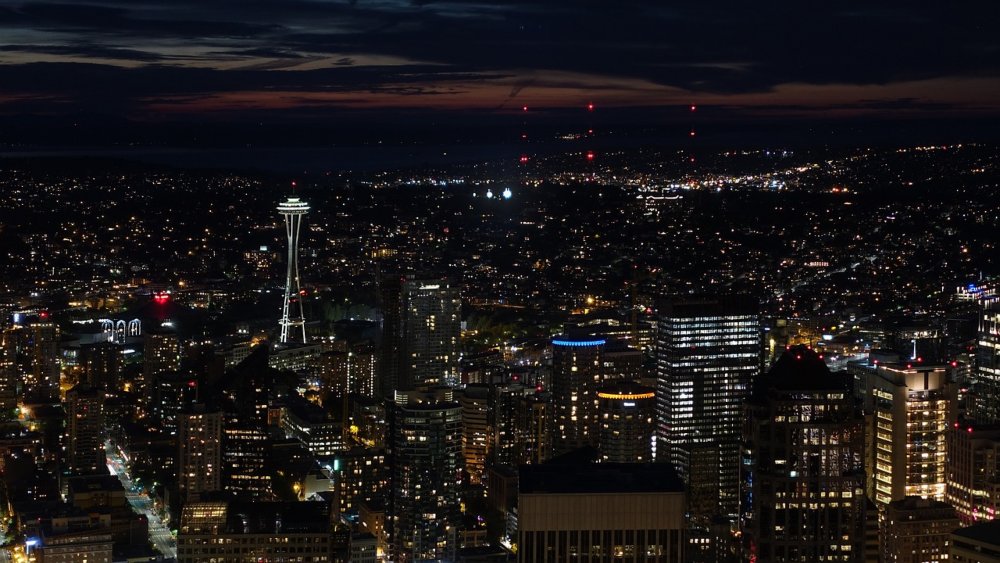

Predictions for Seattle’s future have been ranging from mere pessimism to dour, belt-tightening adversity. But as an eternal optimist I disagree. I’m beginning to see signs of a modest recovery, indications the city is waking from the pandemic nightmare.
Seattle carried on after past disasters including the Panic of 1893, the 1918 Flu epidemic, the Great Depression, and the infamous Boeing Bust. When Boeing cut three-quarters of its work force in 1971, many ignored advice to leave town. They stayed, retooled, and formed new businesses. Their efforts helped fuel a slow but steady recovery, setting the stage for Microsoft, Starbucks, Costco, and Amazon. In consequence, Seattle became one of the fastest-growing cities in America, the city with the most construction cranes and most funky titles like “most livable” and “best city to move to.”
If you’re looking for a symbol of Seattle resiliency, look no further than one of those kids’ toys that pop right back up when knocked down. Among them is the round-bottomed okiagari from the Japanese words oki (to get up) and agari (rise). Here are some of the sectors that will most affect Seattle’s rise:
The Economy
Prophets like PostAlley’s David Brewster and the Seattle Times columnist Jon Talton have been lamenting a stalled economy: Amazon layoffs and exodus, workers opting for on-line work, restaurants closing while Bellevue eats our lunch. Those are valid concerns, but not fatal blows. Although Amazon job losses will hurt, the 18,000 announced layoffs are only a modest reduction of Amazon’s total workforce. Restaurant closings, too, aren’t deal breakers; they’re standard first-of-the-year casualties in an industry that operates on razor slim margins. Seattle still has much potential to attract new enterprises. Biotech is more promising than ever, so are other medical, research and tech-based startups, nurtured by that remarkable economic engine, the University of Washington.
Downtown Doldrums
No one argues that Downtown Seattle hasn’t been badly impacted by street crime, boarded-up buildings, and changing retail behavior. But the city remains the cultural, business, political and transportation center of the region. City Hall is finally paying attention, working to keep streets safer and more alive. Downtown camping is a thing of the past and empty store fronts are reawakening. The recovery is being led by successes like the booming Pike Place Market, reviving arts, surging hotel occupancies, and increasing tourist activity. Seattle’s new waterfront is taking shape, bringing us the overlook walk, the Marion Street Bridge, Park Promenade, reconstructed piers and more. There’s even an honorary name for Alaskan Way: Dzidzilalich (“Little Crossing Over Place.”) Seattle is rediscovering its front door.
City Council Elections
Seattle’s sometimes recalcitrant City Council will look different in January, 2024. This fall voters will elect seven of the nine councilmembers. Already three incumbents – Lisa Herbold in District 1, Alex Pedersen in D-4 and Deborah Juarez in D-5) – have decided not to seek reelection. Kshama Sawant in D-3 also is likely to bow out. The other three up for reelection have poor favorability ratings. An EMC survey taken for a Seattle Housing Levy group showed D-3’s Tammy Morales at minus five; D-6’s Dan Strauss at minus nine, and D-7’s Andrew Lewis at minus 15. Social media is buzzing with names of potential candidates. Those most “mentioned”: Rob Saka, AnnaLisa LaFayette and Preston Anderson in D-1; Tanya Woo, Toshiko Hasegawa, and Dawn Lucas in D-2; Ron Davis and Matthew Mitnick in D-4; Alex Hudson, Joy Hollingsworth and Ry Anderson in D-3; Peter Kithene and Justin Simmons in D-5, and Pete Hanning in D-6. With four open seats and the council’s underwater ratings, the pros expect a couple of dozen more to surface.
Regional Strengths
This region’s political leaders, branded by some as “creaky,” are admittedly getting older. But they are the ones who have the seniority and power to make things happen. Take Sen. Patty Murray, 72, who will ascend to chair of the crucial Appropriations Committee and presides in the Senate when the veep is away. Or Governor Jay Inslee, 71, who steers the state on climate change, gun control, housing and education. To me, it’s better to have a seasoned politico than youthful newcomers like Andrew Grant Houston, the 32-year-old architect who ran for Seattle mayor and harvested more democracy vouchers than votes. Washington now has one of the nation’s strongest congressional delegations, most of them from this region.
Social Justice
In Seattle, homelessness (the nation’s third largest) has long seemed stubbornly intractable. However, there are reasons to expect better times ahead. After the growing pains of trying to integrate city and county programs, King County Regional Homeless Authority is finally in place and starting to unite the region. There are signs the approach of rapid rehousing under CEO Marc Dones is taking hold.
Crime Abating?
The wave of violent crime that so plagued Seattle during the pandemic years seems to be subsiding. Although there is still a troublesome amount of property crime, violent incidents have decreased in recent months. There isn’t any explanation of why there have been fewer incidents of violent crime, but there is a sense that the city is safer today. Credit for that perception may be due to Mayor Bruce Harrell’s crackdown on illegal encampments; or it may belong to Police Chief Adrian Diaz’s efforts to spread his reduced force optimally. Whatever the reason, the reduction in violent incidents is welcome even while greeted with cautious optimism.
Other Bright Spots
Tourism is showing monthly upticks. It’s no surprise that a city with a fairy-tale setting and moderate climate is going to attract visitors. No surprise either that some of those out-of-towners are beguiled enough to want to do more than visit and move here. At the same time, we’re seeing enhancements for locals as well as tourists: an expanded Convention Center, the new Climate Pledge Arena, expanding Aquarium, live music festivals, museums, concerts and theater as well as competitive sports teams, along with both casual and high-end dining and an amazing range of ethnic cuisines.
In short, Seattle’s recovery, like the city’s past renewals, won’t happen overnight but it is on the way.
Discover more from Post Alley
Subscribe to get the latest posts sent to your email.


The city’s sports teams seem to be on the rise as well. Post season for Mariners, Seahawks, Huskies, and Cougs. Kraken in second year, seem to be heading for playoffs.
This piece gave me great encouragement — until you got to your perception that crime is abating. On the contrary, violent crime, gun violence in particular, has not subsided whatsoever, especially in the Central District and South Seattle, where there were numerous incidents in the past week, including a business owner killed in his teriyaki restaurant, 2 people killed in Georgetown, and a barrage of drive-by shootings. The Seattle Times rarely covers crime in South Seattle (the former crime editor responded to my email that was because subscriptions were low in this part of town), but at least a couple of TV news stations do.
Crime stats have shown a modest reduction of Seattle violent crime, peaking last August. This has been confirmed by Seattle’s police chief.
But our perception of violence remains high. That’s partly because of the rule in TV news: If it bleeds, it leads. A good many of the recent crime stories featured incidents that actually occurred in other communities. While no less worrisome and distressing, that should not factor into Seattle statistics.