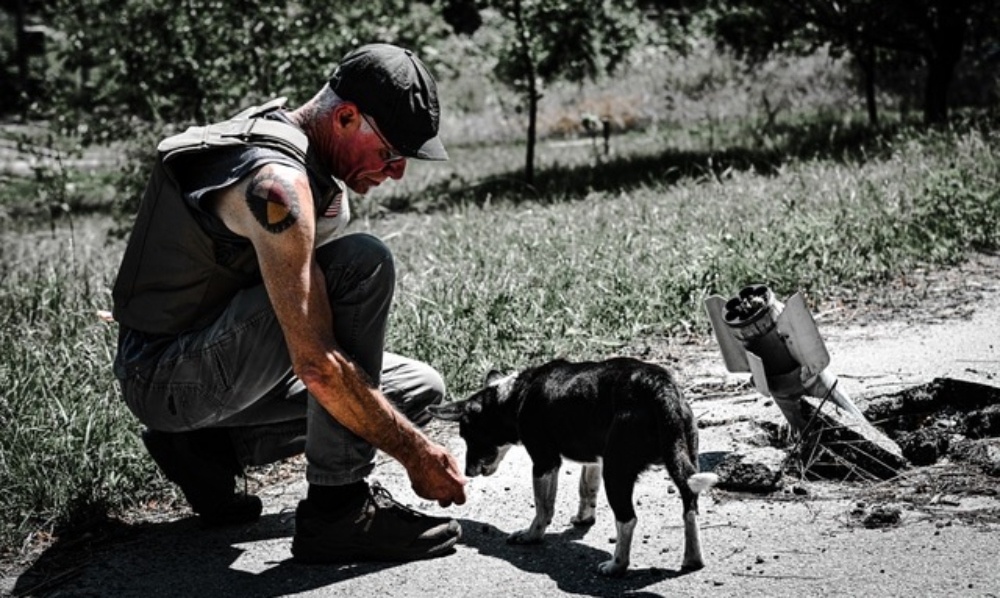


When the first Russian artillery shell hit, Tom Bates realized he’d made a mistake.
“We forgot what we were supposed to do,” he said. “We weren’t hiding the vehicles, we gathered in a group, and that’s what they’re looking for.”
Russian drones will direct fire at anyone who appears to be assisting in Ukraine. “Especially humanitarian aid workers. The Russians want to cause fear and confusion so foreigners will leave and abandon Ukraine.”
Bates was in the demilitarized village of Tsyrkuny, east of Kharkiv and 14 miles south of Belarus. The Ukrainians had recently liberated it after Russian soldiers destroyed and stole everything they could. “What buildings and homes remain don’t have water, gas, or electricity. Yet many villagers chose to stay to take care of their property, their animals, and the animals left behind by the neighbors that fled,” he said.
“After the second artillery shell came in, everybody’s in their vehicles beating out of the place, it looked like Dukes of Hazzard getting out of there. I’ll never forget this one dog wanted to go with us so bad, and we didn’t take him.” Bates has returned to the village repeatedly, delivering aid and looking for the dog. “We can’t find it, we want to bring it out, we’ve got people who said they’d take it, but I don’t know.”
Tom Bates, 68, of Lakebay, Washington, is a retired truck driver who had never been to Europe. He arrived in Przemyśl, Poland, just 30 minutes from the Ukrainian border, March 23 to volunteer for local animal rescue efforts.
Before retiring, his last job was with the Washington State Fair Foundation, working in a program called the traveling farm. “We had a truck that carried the sheep, goats, chickens, ducks, rabbits, pigs, and we’d have some portable pens we’d set up and we’d teach elementary school kids about agriculture,” Bates said. “That was my animal experience.”
He said the stars aligned to send him to Ukraine. “Before the war, I wanted to go on a trip around the Black Sea. I’ve always been fascinated by the history of that area. I’m passionate about animals. They were victims and I just knew I had something to offer, that I could do something about it.”
Gretchen Roosevelt, his wife of 28 years, agreed.
“It makes sense to me,” she said. “We grew up learning about the Soviet Empire and all the history that happened around that. And then this opportunity comes to see that kind of history happen in real time. Of course, he would go.”
Bates planned to come home within three or four weeks. He took a short trip back but spent another five months in Ukraine, returning to the States in September to raise money to continue his work.
In the first months after the Russian invasion of Ukraine on February 24, five million people fled and another eight million were internally displaced. Many who ran tried to take their pets with them, but at least one million animals were abandoned, according to the Humane Society International.
The Ukraine-based animal rights organization UAnimals discovered 485 dogs that had starved to death in locked cages at a deserted animal shelter in Borodyanka in the Bucha region of Kyiv oblast (province), the site of multiple atrocities allegedly committed by Russian soldiers.
One dog saved by the Polish ADA Foundation had been shot eight times and was paralyzed. Other animals — dogs, cats, horses — were missing limbs or were wounded by shrapnel. All were traumatized.
Bates started work with ADA, driving animal food, medicine, and other supplies into Ukraine in a borrowed delivery van, and hauling people and their pets out.
“When I arrived there, the influx of animals coming into Poland was hitting its peak,” he said. “If you were Ukrainian and it was your pet, you could come right in. But sometimes people would try to bring too many animals in, and that ended that.”
The change in border policy changed the mission. Bates started working to get supplies into Ukraine — food, medicine, collars, leashes — to zoos, shelters, and people who could not evacuate their animals.
“This is right in my wheelhouse. I might have apprehension, but I don’t have much fear about what might be coming down the road.”
And everything is on the road.
“People are selling honey, diesel, water on the roadsides; there’s horse-drawn wagons with hay; Russian Ladas pulling trailers piled with stuff on top and four people going about 30 kilometers [per hour] when I’m doing 140.
However, Bates said, “The Ukrainian government is not spending any money on anything but weapons. There’s no humanitarian aid, they don’t buy dog food for their K-9 units, everybody is dependent on international aid.”
He works mostly with women because the men are out fighting the war. “The men are defending Ukraine; the women are saving it,” he said. “They’re making the things happen that need to happen, keeping the wheels on the rails.” He estimated that 90% of his contacts are female.
“I feel like I’m the hub of a wagon wheel. I met people and I started connecting them to other people, but pretty soon people were calling me directly. ‘Tom, when are you coming back? Tom, we need this cat moved.’ ‘Tom, these kids in Italy finally talked Mom into leaving Kharkiv, but she’s not going without her dogs.’ There’s only one way to get her and that’s to send somebody that’s willing to do that. And that would be people like me.”
Bates has covered over 25,000 kilometers (15,500 miles) driving in Ukraine alone. “Everything seems to be seven hours away; Lviv to Kyiv to Kharkiv to Dnipro. My last mission I brought a saker falcon out of Kharkiv to Lviv to a wildlife center, and I just got a message from a lady in Dnipro; they have two eagles they need transported to Kyiv. I go to a shelter, find a room for the night, rinse and repeat, every day.”
And it’s all happening in Ukrainian, through Google Translate.
“Let me tell you it works well; they’re used to using it over there. And they’re always happy to see an American, and that helps me get through a little quicker.”
Bates also works with K9 Rescue International, a nonprofit based in the UK. It helped him buy the van he was renting and coordinates donations from Europe, but he pays out of pocket for fuel, animal food, phone bills, and his own needs.
“What I like about it is we’re direct action,” he said. “Every penny that comes to me goes straight into the fuel tank or into animal food, or a cup of coffee occasionally. I supply shelters, but if that’s all you do you don’t really get to see what’s going on. You go into the villages and apartments, one-on-one, where some person is caring for 30 cats because they’ve been abandoned by everybody who’s fled, and it changes your outlook.”
Between April and August, Bates managed to raise about $9,000 on his own.
“I could exist for months on that,” he said. “It doesn’t take a lot of money to make things happen over there, unless you have huge overhead. People like me, K9 Rescue International, Dan Fine’s organization (Ukraine War Animals Relief Fund in Edmonds), we know how to stretch our money and make it go.”
Bates also works with a number of groups in Kharkiv for a week at a time. “I really look forward to going into the demilitarized villages,” he said. “It’s a little scary, but that’s where I felt like I was helping people that really deserved to be given help. Those can be exhausting, long days. We’ve been there for 12 hours and distributed to 100 or 120 different stops, bringing in clothing and baby food and water. I haul a lot of water.”
A bad day is when you can’t complete the mission, he said.

“You can’t find that dog you were sent to rescue, or you run out of food while people are still waiting. When you have to say ‘No’ or ‘I can’t, I don’t have anymore.’ When you have to say, ‘I’m sorry, I just can’t help you.’ Those are the bad days really.”
Bates said he’s seen firsthand what the Russians are doing to civilians.
“In Kharkiv, you go to bed at night, and you know the air-raid siren is going to come,” he said. “They’ll start over there, and then it’s a little closer, and then you’re wondering is number three coming. Number three always seems to be right outside the window, but it’s not, unless you hear the debris falling. I’ve had that happen, where the explosion went off and then you hear the trickle down of debris in the air. I was there the night they bombed the dormitory [August 17-18; 25 people killed and 44 wounded, including young children]. I’ve never seen such devastation. It was incredible.”
Bates was ready to come home in August, but one-way ticket prices were $2,000. “I can’t afford that. The first day it was $600, I set the date. And now I feel like I need to get back, to keep it going,” he said.
“I know enough about who Tom is, I know why he wants to go back, and it means a lot to the people there, and that means a lot to him,” said his wife, Gretchen. “I’m not worried about him because he really does know what he’s doing and he’s a very handy person. I do wish he would wear his helmet more; he does wear his flak jacket.”
Bates will return to Ukraine in October.
For more information or to donate, go to @TBates8094 for PayPal or K9rescueinternational.org.
Reprinted from Key Peninsula News with permission.
Discover more from Post Alley
Subscribe to get the latest posts sent to your email.