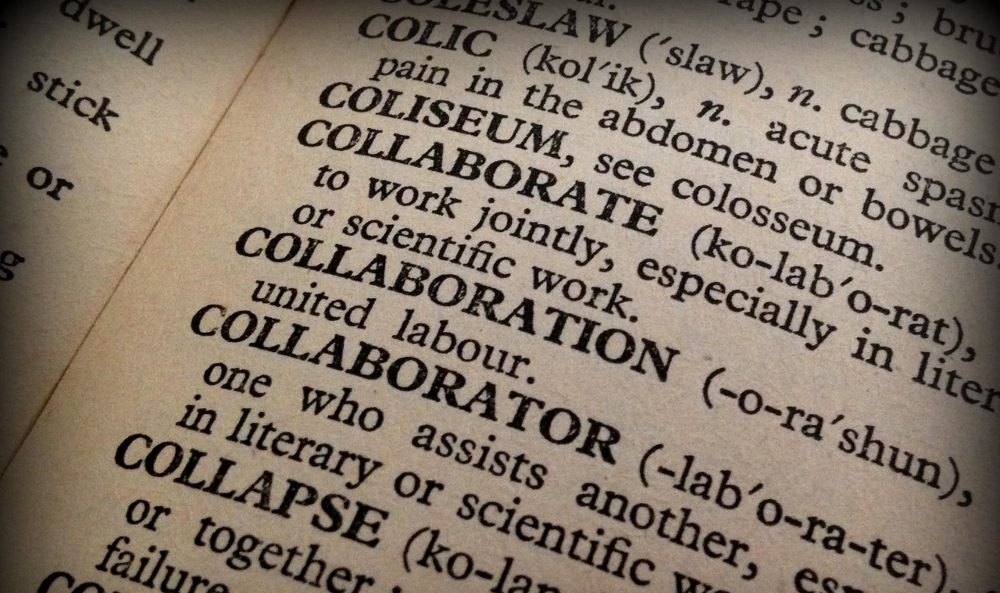

Of all the trite beginnings for essays, the one I hate most is quoting a dictionary definition, but, now, I can’t help myself.
“An army, or a parliament, is a collection of men; a dictionary, or nomenclature, is a collection of words.”
—Isaac Watts, quoted from Samuel Johnson’s definition of “dictionary.”
A parliament of words is an exquisite phrase for a dictionary, but my first dictionary was a Little Golden Picture Dictionary, which didn’t contain the word “parliament.” It must have been the 1953 edition. In 1955 I entered the first grade (no kindergarten in our baby boom-strapped school district) and I remember I had gone on from the dictionary to reading stories. Daffy Duck was my favorite. Dick, Jane, Spot, Puff, Mother, and Father were bland compared to Daffy, Porky, and Elmer.
Through elementary and junior high school, I loved get up and go to the big dictionary on a stand next to the window, stretch my legs, read up on interesting words, and gaze at the weather. A welcome pause during a ho hum class room day.
I still have the Webster’s New World Dictionary my parents gave me as a birthday present in junior high. The spine is reinforced with duct tape, but I don’t consult it much anymore.
Eventually, I ended up in graduate school working on a thesis under Dr. Herrlee Creel. He was an academic who was known for writing history books that became New York Times bestsellers. I admit that his advice on writing stuck with me more than his historical knowledge.
Creel was not vain, but he was no shrinking violet either. “Do you know why my books sell well?” he once said to me. “Because, unlike my learned colleagues, I use the dictionary all the time.” He had a well-worn copy of Webster’s International on a low table in his office at his left hand. Another piece of his writing advice was, “Read Rex Stout and write like him.” I took both bits of writing advice to heart, although I abandoned my thesis soon afterwards.
A great watershed in dictionaries occurred between Webster’s International second and third editions when the editors switched from a “prescriptive” to a “descriptive” policy. Prescriptive dictionaries are judgmental arbiters of proper language; descriptive dictionaries describe language as it is used. I followed Creel’s admonition to read Rex Stout so I know the famous scene in Stout’s novel, Gambit, in which Nero Wolfe burned the New International third edition for conflating “infer” and “imply.” Just to show how dictionary compulsive I am, I checked in the second edition. It suggests infer can be used to mean imply. Wolfe was just showing off, as Archie Goodwin says he was wont.
The prescriptive-descriptive distinction depends mainly on who is doing the describing and prescribing. In practice, I think the distinction is exiguous, a word that Creel once told me was too highfalutin for a reasonable writer to use.
Today, I rely on three on-line dictionaries: Merriam-Webster Unabridged; The Oxford English Dictionary; and Johnson’s Dictionary Online. A paper copy of Webster’s New International, Second Edition sits on a low table at my side, but I mostly look at the drawings and color plates rather than looking anything up.
A thirty-year veteran of the software industry, I have an elaborate two screen computing setup in my home office. The screen directly in front of me is my work screen. It usually has a word processor (Microsoft Word—CoPilot disabled!) on display with whatever I am currently writing. On my left is a smaller screen displaying a network browser. The browser almost always has Merriam-Webster Unabridged displayed, and may have tabs open to Sam Johnson’s dictionary, for which I had great fun helping verify quotations as a volunteer, and for the OED, which I access through a public library.
MW-Unabridged is a workhorse for zeroing in on an exact word; for those times when, as Mark Twain is quoted as saying, “the difference between the almost right word and the right word is really a large matter—’tis the difference between the lightning-bug and the lightning.” MW-Unabridged is worth every penny of the yearly fee.
Johnson’s dictionary was written by one of the greatest prose stylists in the English language. His views on words are always worth reading.
The OED is an infallible source of too much information. According to the OED, “infer” was used with the same meaning as “imply” in the 16th century and continuously since.
Having clearly distinguished between “infer” and “imply,” I think I will take a nap, hoping to dream of my Little Golden Picture Dictionary.
Discover more from Post Alley
Subscribe to get the latest posts sent to your email.


I enjoyed your essay. I will probably read it again. I usually have a dictionary handy. I have 4 or 5. One is at my cabin in the woods. Sometimes a new word, sometimes a different meaning. I am not a writer. I remember a childhood dictionary with one kind of art or pictures. I do not like to misspell and usually know it right away. Gotta look it up. Anyway, thanks. Gordy
A wonderful comment on his belief in the dictionary. A fun read, and would love to see more from this writer on Post Alley.
Thank you! I enjoyed reading this just about as much as I still enjoy reading about words in dictionaries. No place here for the American Heritage Dictionary?
There certainly is a place for The American Heritage Dictionary, although I don’t happen to own a copy. There is an excellent online version. For me, however, the AHD is more of a style guide than a dictionary–an excellent and useful style guide.
Sorry, but I just can’t get over the “infer/imply” hump, 16th century or no.
Well, I agree that the “I infer from what you imply” is a useful distinction that I observe when I am writing, but “infer” has often been historically defined as “to imply.” Sloppy thinking? Maybe. But isn’t it delightful to argue over?
You overlooked the surprising best dictionary of all…the two-volume World Book Dictionary (admittedly, available in print only). It’s a model of clear definitions, straightforward pronunciation cues, illustrative phrases from literature and journalism, and clear typography. And so many words!