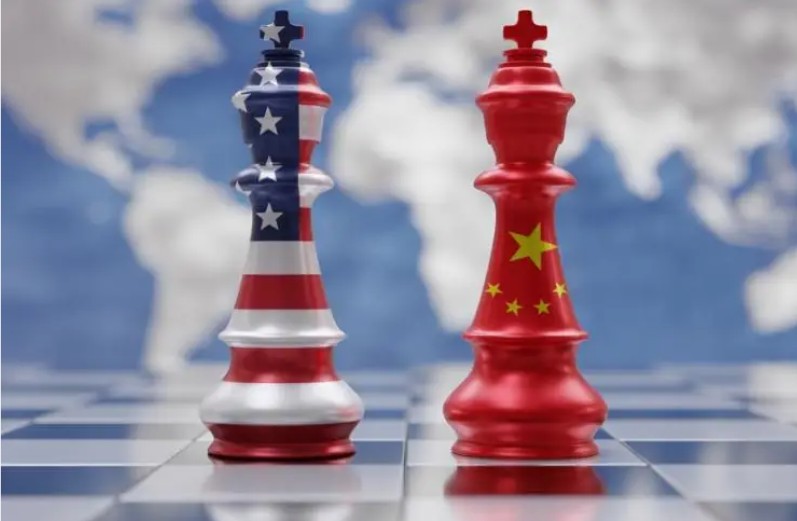

Over the years, China has been called Red China or Communist China. These appended descriptors no longer describe today’s China.
The Chinese Communist Party hasn’t changed its name. Its constitution still declares communism as the ultimate goal. The party, however, has long ago diverted from orthodox Marxism, which in practical terms means the abolition of private property. The CCP now not only allows but encourages diverse ownership in China’s economy. For this compromised and mixed economy, the party calls it “socialism with Chinese characteristics.”
With its unorthodox or creative reforms, the CCP was able to lift 800 million Chinese out of poverty and expand the country’s urban population from19 percent to 67 percent in four decades. It oversees a vast market economy, in which private companies contributed 60 percent of China’s GDP, 70 percent of its technological innovation, 80 percent of its urban jobs, and 90 percent of its total number of business enterprises as of 2025. It has also turned China into a manufacturing powerhouse, a global trade superpower, and a leader in green energy, EVs, humanoid robots, and other high technologies.
Still, as the one party in one-party rule, and with its old habit of censorship and control even over advanced technology, CCP rule is still authoritarianism. It is just not your run-of-the-mill Communist authoritarianism anymore.
Jennifer Lind, an associate professor of the Department of Government at Dartmouth College, calls China’s version “smart authoritarianism.” In an interview about her book Autocracy 2.0: How China’s Rise Reinvented Tyranny, Prof. Lind is quoted as saying, “The question is no longer ‘Can China rise to become a great power?’ but, rather, ‘How did China do it?”’
According to Prof. Lind, the conventional wisdom about developmental authoritarians was that they had two choices: either loosen control to allow more innovation or keep tight control to accept less innovation. China defied that. That wisdom in the U.S. academic and policy community, Lind pointed out, has gotten China wrong at almost every turn. Calling the China model “smart authoritarianism,” she tried to distinguish Chinese government’s ability to encourage innovation while still maintaining significant political control, to move the country not only from poverty to middle income but to go further and cultivate innovation to sustain economic growth, and to adapt to new conditions in the world.
An autocracy evolving into smart authoritarianism is one version, Prof. Lind says. But she notes the possibility of arriving at it from a surprising, different direction: democracy. what does that teach us about our own authoritarian president and Trumpian authoritarianism. Is it “smart autocracy?”
While accepting his Republican Party nomination in 2016, Trump stepped onto the stage of America’s democracy with perhaps the most blatant authoritarian declaration in these United States: “I alone can fix it!” So, what problems has he fixed alone, domestic or international?
The Ukraine war: According to CNN, Trump has said 53 times that he would end the war in Ukraine either within 24 hours of his return to the White House or even sooner than that. Now a year and a half into his second term, the war in Ukraine is still raging, longer now than World War I. Trump’s bromance with Vladimir Putin has resulted in as much success as his love affair with Kim Jong Un.
Tariffs on China: With his Liberation Day reciprocal tariffs on all countries in early 2025, Trump punished China with an eyewatering rate of 145 percent. First, the Supreme Court ruled his tariffs illegal. The U.S. deficit with China did shrink for a while, but the “reduced” deficit, however, simply shifted to Vietnam, Taiwan, Thailand, and India. Now, China’s exports to the U.S. are surging again at pre-“Liberation Day” pace, soaring nearly 35.4 percent in May from a year earlier. Finally, when China retaliated against those tariffs with its powerful choke-hold restrictions on essential rare earth metals, Trump backed down.
Inflation: Trump promised voters that he would end inflation on Day One and slash grocery prices. But he undid his own efforts by launching his Liberation Day tariffs worldwide, making everything more expensive, from groceries to household goods to electronics. Then came his unprovoked war on Iran, which sparked an international crisis, pushing gas prices up in the US to $4.086 on average, and $5.529 for Washingtonians. Gas in downtown Los Angeles this past weekend was going for $8.50 and more
Iran war: Trump won over many Americans with his pledge of no new wars or regime change in foreign countries. But he started a new war in Iran, aiming for regime change. But just as he had not expected China to retaliate against his tariffs with rare earth export controls, Trump the “stable genius” never expected Iran to close the Strait of Hormuz. His criticisms of America’s earlier wars as stupid and a ridiculous waste of blood and treasure can now fully apply to himself.
If Trump must be an authoritarian, would it be better at least to be a smart one? Doubtful we’ll find out.
Discover more from Post Alley
Subscribe to get the latest posts sent to your email.


In the early 1970s, I studied Confucian Classics and came very close to a PhD. in the subject. I observed then that a society based on traditional Chinese culture and thought was more suited to successful private enterprise in a capitalist system than American society. 21st century China has come very close to proving me right.
Authoritarian CCP leaders of the last few decades have modernized China, but traditional Confucian values of support for family and social groups through mutual accommodation has made these authoritarian leaders’ efforts effective. China has always been authoritarian, but Confucian authoritarians foster the success of their subjects and build up institutions of education and research, unlike Trump’s narcissistic self-centered authoritarianism that takes his followers to the cleaners and destroys any enterprise that does not pay him bribes.
Exactly. Insightful comment. I too studied Chinese, Chinese (and Russian) politics, history and language (in the late 60’s), and travelled in China (from Guangdong to Beijing to the Northeast and from Beijing to Wuhan to Chongqing). I was amazed talking to Chinese people (esp. students, who spoke much better English than my Chinese) that they really didn’t care much about, or for or against, the government. And I was amazed at the mercantilism of the society. I also feel that China has maintained its history and culture, and that the government continues to operate on traditional Chinese principles — including Confucian ideas like the Mandate of Heaven. What few people seem to realize is that Marxist Communism is dead, both in China and Russia, replaced by what I call “market socialism”.
Agree. “Market socialism” is an excellent term. I conjecture that a hundred years from now, the CCP regime may be seen as a great traditional dynasty like the Ming or Sung. Its violent Marxist beginnings and current prosperity look to me like an Emperor Wu (War) followed by an Emperor Wen (Culture), the traditional beginning for a great dynasty.
A popular view on the Left and the Right alike, especially among the hate “Trump the Authoritarian” crowd – is that China will surpass the U.S. with continued levels of food production, ship construction, industrial output, technology, and military strength. In this view, China will soon replace America as the world’s predominant power, and become the new version of the post WW2 American powerhouse.
But China is the real autocracy here where one person holds unlimited power. Its efficiency is superficial. China’s technology is derived from the free wide-open atmosphere of the West – the US in particular. There are usually around 300,000 Chinese students here in the US – and they are not history, literature, or art majors, but are sent here to master US scientific expertise and technology and then return home to clone it.
China has around four times the population of the US, but produces only about 60 percent of our total GDP. One US worker accounts for 40 percent more goods and services than four of his Chinese counterparts. And Americans enjoy a per capita GDP (around $95,000) over six times higher than China’s (around $15,000).
The US is now largest oil and gas producer and exporter in history. China imports 11 to 12 million barrels of oil every day. The US is also the greatest food exporter in history; China, for all its miraculous increases in agricultural productivity, still imports 30–40 percent of its food, a number that keeps rising as the Chinese become more affluent and more diverse in their food appetites.
And the first American dictator will likely not be a loud conservative hated by the media and all the institutional powers of the U.S. – including higher education, corporate boardrooms, the media, popular culture and entertainment, and the foundations.
The first strongman will not ram fascism down our throats. Instead, we will go willingly without resistance. We will go happily.
Mr. Big will not be loud and off-putting. He will not be hated by the elite. Our new suave autocrat will be loved by Europeans, the Chinese, minorities, the poor, the press, and the billionaire class – but mostly by the bicoastal enclaves of wealthy white elites. He will promise an everlasting peace. He will promote “equity and diversity and inclusion,” and warn against hate speech, misinformation, propaganda, and disinformation, all in Orwellian fashion.
He will be young, handsome, and suave – a Macron, Obama, or a Trudeau type, not an 80 year old fat guy. Many will swoon over his exciting charisma. His clothes will be very cool yet modestly dressed down, but pricey. He will not look day-glow orange with a thinning blonde comb-over and an obnoxious red tie with a stodgy blue suit. He will modulate his accent to fit the particular audiences he talks to. He will not speak with an annoying Queens accent. He will not use words like Bigly, Yuge, Fake News, or Pocahontas. He will not sound or behave like a Manhattan Uber driver.
He will win over, and mesmerize the powers that be and convince them all to take certain steps to save our precious democracy – to prevent it from dying – by doing things that have never before been seen in the United States.