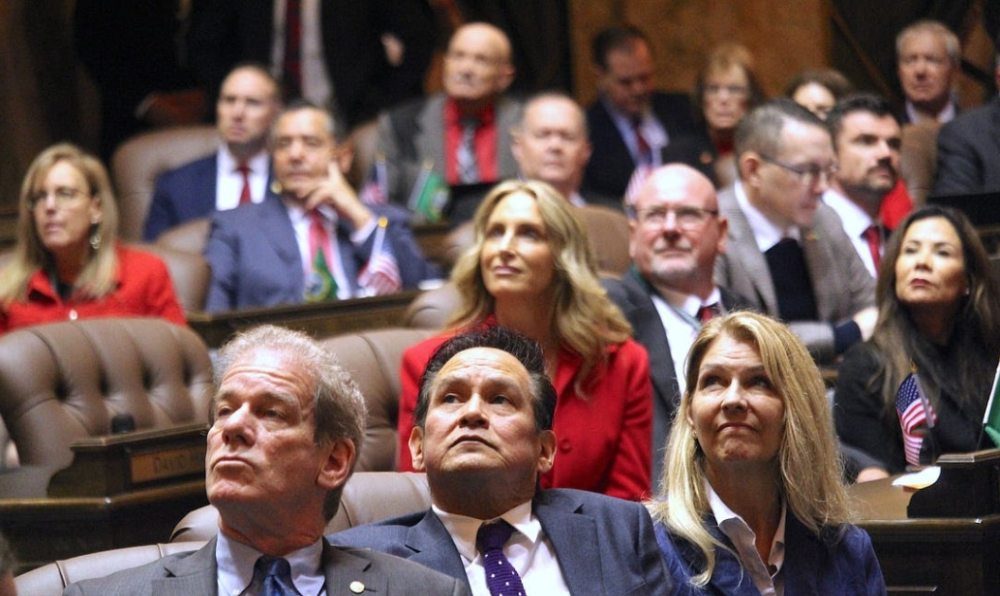

The first legislative cutoffs of the short 2026 session kindled and killed dreams, and simplified the lives of legislative staff, lobbyists and watchers, yours included. Big fiscal decisions remain, including many revenue bills to close the roughly $2.3 billion budget deficit, and some that would make the hole bigger.
As the legislative session nears its third inning, here’s a rundown of the legislative living and deadpool items that raised our eyebrows.
What did survive…
A stealth rollback of last year’s big bump in the estate tax
We’re always on the watch for consequential legislation — AKA things with really big price tags — moving fast and quiet. And so we call your attention to Senate Bill 6347, which has an unusually clear title: “Undoing recent changes to the estate tax.” The measure, sponsored by Sen. Claudia Kauffman, D-Kent, would roll back last year’s big tax increase on very wealthy people who leave this life and pass their stuff on to their heirs.
That measure, signed by Gov. Bob Ferguson with great fanfare last spring, jacked the top rate on the estate tax from 20% — already tied for the highest in the country — to a whopping 35%. It also tossed some tax relief to the merely affluent by increasing the portion of your estate that is exempt from the tax to $3 million.
That change is worth about $200 million per year to the state’s bottom line, at least in theory. It was hailed as one of the only truly progressive elements of the massive tax package lawmakers adopted last year.
Here’s where we get to the fast and quiet part. The new bill was introduced on Feb. 4. A brief public hearing was held on Feb. 6 in the Senate Ways & Means Committee, at which exactly nobody testified pro or con. On Wednesday, it passed out of committee with zero debate on a very unusual bipartisan vote that included all the majority Republicans. Three Democrats, including Vice Chair Noel Frame, D-Seattle, who is generally in charge of tax legislation for the Senate majority, voted no.
So what is going on? Here’s our guess: Remember that early sunset on the B&O tax surcharge on big business that’s part of the income tax proposal? The one we characterized as a bribe aimed at keeping Big Business on the sidelines during the inevitable repeal initiative campaign? This looks a lot like that, only for very rich individuals. Stretch it over five years, and it looks like $1 billion of that. (Paul Queary)
Banning toxic tires.
A bid to kick toxic tires to the curb burned rubber on its way past this week’s fiscal cutoff. The proposal from Rep. Zach Hall, D-Issaquah, would ban a noxious chemical — 6PPD — from all vehicle tires after 2035. 6PPD is an anti-degradant that gives your tires a longer lifespan. It also degrades into a toxin (6PPD-q) which tends to get mixed into runoff and eventually flows into salmon habitats. The stuff is deadly for the fish even in small amounts so it’s not so great for humans either.
House Bill 2421 would levy fines of up to $5,000 for first-time offenses and up to $10,000 for repeat offenses. It includes carveouts for Uncle Sam’s vehicle fleets — e.g. the FAA, Homeland Security, and NASA.
Environmentalists and local governments hailed the bill as a boon for Mother Nature. Folks in the business of making or selling tires framed it as another irksome expense on their respective industries on top of the state’s tire fee hike last year.
Cleaner alternatives to 6PPD have begun to roll onto the market, but most haven’t passed federal review or gained a proven track record in the field. Truckers told the House Appropriations Committee this week that the scenario above will likely see them buy 6PPD tires out of state at greater expense. Hall’s bill is parked in the House Rules Committee where it awaits its next green light. (Tim Gruver)
Protecting lawmakers’ addresses
A well-intended bill by Rep. Liz Berry, D-Seattle, to get ahead of the rising trend of political violence has survived a round of kvetching by archivists, auditors and the press and is sitting in the House Rules committee.
Berry, in response to assassinations on the political left and right last year, and lawmakers’ disturbingly prevalent reports of stalking, would have extended the state’s address confidentiality program to elected officials and law enforcement officials. Her bill would also allow State Patrol security at events. (Jonathan Martin)
And what didn’t survive…
Regulating college protests
Wildcat campout protests on college campuses over the Israel-Hamas war in Gaza inspired a bill from Rep. Mari Leavitt, D-University Place, which would’ve given universities a path to regulate encampments.
The bill died in committee after a series of questions from Democrats about whether the bill would impede protests, skepticism from Republicans about whether it was needed, and testimony from a woman who said she was harassed at Evergreen State College.
Universities already have time/manner/speech regulations that can limit protests, but those often fall into the political quagmire of heated debate. An encampment on the University of Washington’s central Quad grew to more than 100 tents before an agreement was brokered to close it after 18 days. (Jonathan Martin)
Hearings for Supreme Court appointees
A Governor’s power to appoint replacements to the state Supreme Court upon mid-cycle retirements has in effect become the power to stack the court with like-minded justices, because once appointed, the justices almost never lose at the ballot. With Washington’s four-decade streak of Democratic Governors, that power has helped tilt the court further left.
A proposed constitutional amendment by Sen. Chris Gildon, R-Puyallup, would borrow from the U.S. Constitution the Senate’s right to advise and consent the appointment of justices via confirmation hearings. It would give lawmakers a chance to query appointees before they, in effect, become justices for life.
That would be relevant at the moment, as Gov. Bob Ferguson appointed Justice Colleen Melody this winter to replace Mary Yu, and is taking applications to replace Justice Barbara Madsen this spring. That means there will be five seats on the ballot this year, including an open race to replace the retiring Justice Charles Johnson.
Gildon’s gambit, a long-shot good-government notion, died in the cradle, without a hearing. (Jonathan Martin)
A leg-up for public grocers
Food deserts have become a progressive cause as Big Grocery consolidation and the rough economics of a low-margin business have left shelves barren in some neighborhoods, especially in Seattle’s Lake City, home of Democrat Rep. Darya Farivar.
Her bill would have allowed cities to open publicly-owned grocery stores with a combination of tools, including buying or leasing land, tax incentives, and even using eminent domain to take properties. It died without a vote in the House Local Government committee. (Jonathan Martin)
These stories also appear in the authors’ site, the Washington Observer.
Discover more from Post Alley
Subscribe to get the latest posts sent to your email.