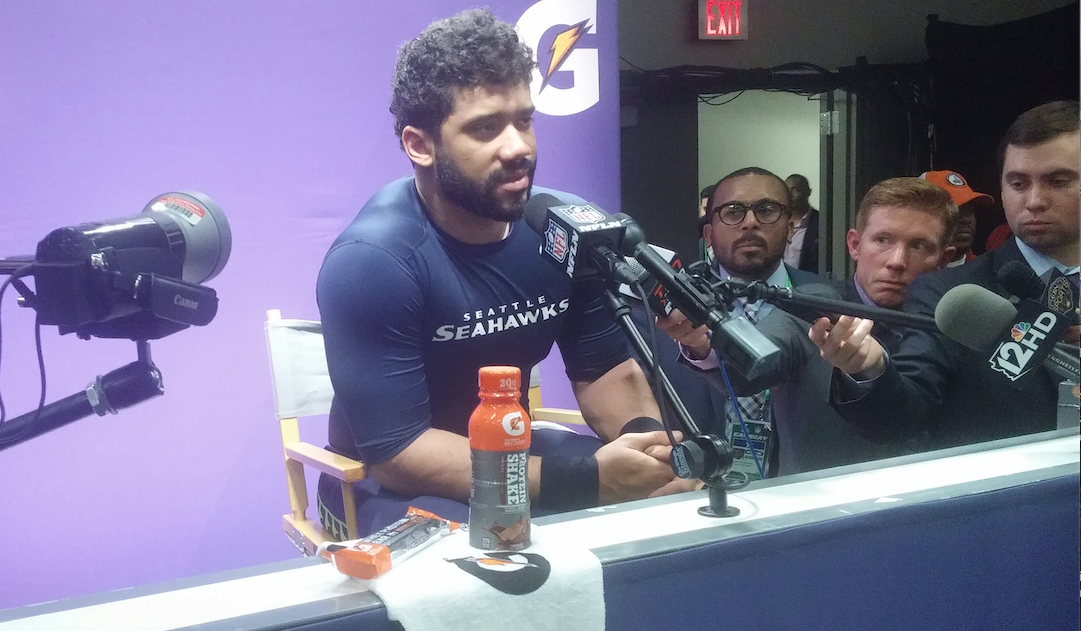

From a Seattle perspective, the Seahawks’ first Super Bowl appearance in 2006 was a disaster. The crowd in Ford Field was anything but neutral, cheering on a favorite Detroit hometown dude, Jerome Bettis, with the Pittsburgh Steelers. Officiating calls were so lopsided that, years later, the lead ref confessed to the errors. Steelers rookie quarterback Ben Roethlisberger finished nine of 21 for 123 yards passing, and two interceptions, yet somehow led his team to a 21-10 triumph. Esthetically, it may have been the dreariest Super Bowl ever.
But the halftime performers were the Rolling Stones. You can’t always get what you want, but if you try sometimes, you get what you need.
The Seahawks’ next title-game appearance in 2014 was a complete reversal — again, from a Seattle perspective. The 43-8 win in New Jersey over the Denver Broncos — who set a record for most points in the regular season — tied for the third-largest Superbowl margin of victory. It was decided as quickly as the game’s first snap, which went over QB Peyton Manning’s considerable head for a safety and a 2-0 lead. Seattle’s 2013 entry may have been the team of the NFL decade.
The next Super Bowl appearance was the following year in Arizona when . . . well, I probably don’t need to remind those of you reading this with one eye, the other having been plucked out with a cocktail fork. No greater wound is upon the Seattle sporting soul than the final-minute, goal-line interception by Malcolm Butler of a Russell Wilson pass that preserved New England’s 28-24 win.
Although it was 11 years ago, the episode has been re-mutilated all week, ahead of the teams’ rematch Sunday in Super Bowl XL in Santa Clara. No malice was intended, but the storyline was the easiest, laziest angle to play so that many media members could get more quickly to the front of the bar lines at the parties.
What interests me is whether these four independent football events constitute a pattern. If so — if not, I’m going with it anyway — it is the Seahawks’ turn to have a splendid Super Bowl outcome. In fact, I think that will happen.
But before I explain why, the mere qualification to play in the planet’s largest annual TV show has elevated the Seahawks to a bit of national eminence rare for Seattle sports. The four SB berths mean only 13 teams have made more trips in the game’s 60 seasons.
The list:
12 — Patriots
8 — Steelers, Broncos, 49ers, Cowboys
7 — Chiefs
5– Commanders, Packers, Dolphins, Giants, Raiders, Rams, Eagles
4 — Bills, Vikings, Colts, Seahawks
If that doesn’t seem like much to you newcomers, consider that from 1989 to 2002, the Seahawks made the postseason only once, losing 20-17 in a 1999 wild-card game to Miami in coach Mike Holmgren’s first season in Seattle. That was so long ago that Dan Marino was still the Dolphins QB.
For most of the 20th century, the Seahawks were breathtakingly mediocre, despite the Kingdome’s audio-riot advantage. Which is why then-newbie owner Paul Allen decided to change things with his billions in the 21st century. Including this season, the Seahawks have reached the playoffs 16 times, and made the Super Bowl in every decade, each time by a different coach. It’s true the NFL keeps swelling the number of playoff berths, but about half the league still finds the climb difficult.
The most significant through-point among the NFL’s lame and halt franchises is bad ownerships. Which is why the reminder that shot through Super Bowl week mayhem in Santa Clara — the Seahawks franchise will be sold by Jody Allen, Paul’s primary heir and chair of his estate’s trust — was noteworthy, if irrelevant to Sunday’s outcome. The sale within 10 years of Paul’s 2018 death is mandated by the trust, as was the dictum that all estate assets be kept in top condition. A Lombardi Trophy would fulfill the latter requirement.
Early in the week, the Wall Street Journal broke a story that the NFL had fined the Seahawks $5 million for waiting so long to sell the franchise. It was denied by Commissioner Roger Goodell. This is a rare occasion when I tend to believe Goodell, if for no other reason that he could have forced the issue every year, but did not.
More likely is the notion that longtime Pats owner Robert Kraft leaked the fine claim to distract the opponent, a sort of dubious gamesmanship for which the Pats have a well-earned reputation. The slow roll to sale is because of an agreement in the lease with the state that 10 percent of a sale’s proceeds would go to the public if the deal took place within 20 years. That expired in 2024, so the time has come. The sale of Allen’s other sports asset, the NBA Portland Trail Blazers, is expected to close next month.
So the Seahawks, already a five-point favorite in the game, have drawn prodigious attention for a team that was identified by former star player Shawn Springs as located in “south Alaska.” The increasingly steady sports spotlight is unprecedented here in Baja Anchorage.
While sports with smaller followings, the Storm (four WNBA titles) and Sounders (two MLS titles) have brought success, the NHL Kraken has done little, the NBA Sonics are 18 years gone after a lone title in 1979, and as Seattle-area grandparents are required to tell their grandchildren, the Mariners in their 49 years have never been to a World Series. The Seahawks lately have become so compelling that they lost their well-regarded offensive coordinator, Klint Kubiak, after a single season. He’ll succeed the fired Pete Carroll as head coach in Las Vegas.
Alas, the attention may be fleeting. The departure of the Allen empire opens the door to ownership randomness. The only other Seahawks sale was in 1988, when the Nordstrom family erred in selling to California real estate developer Ken Behring, which introduced Seattle to the sports idiocracy. Other current NFL members include the Cowboys’ Jerry Jones, the Raiders’ Mark Davis, the Browns’ Haslem family, and the Jets’ Woody Johnson, and until the 2023 sale, the Commanders’ odious Dan Snyder.
So my recommendation: Enjoy the hell out of Sunday.
It should be relatively easy. Drake Maye is going to be a very good QB for a long while, but the Patriots have averaged 18 points in their three playoff games under his second-year command, and he hasn’t seen a defense quite like Seattle’s. Meanwhile, Seahawks QB Sam Darnold has prevailed over his alleged ghosts, and has, in Jaxon Smith-Njigba, the best offensive player in the game with whom to play catch.
Seahawks 27, Patriots 13. Prepare the boulevards for gaiety.
Discover more from Post Alley
Subscribe to get the latest posts sent to your email.


Thinking about playing my Al Hirt 45’s during half time for old times …
Don’t forget your Herb Alpert collection.
Jody Allen has a lot of bucks. She can easily hire lawyers who are smart enough to navigate the legal maze that appears to require both NFL personal ownership of the team and an immediate sale of the Hawks. The solution would probably require her in some technical fashion to “buy” the team and become its sole legal owner, subject to a later disposition harmonious with her late brother’s ultimate intent. It would cost some money to exactly map all this out, but it can be done. If Jody wants to.
The real question is how long does Jody Allen actually want to play Seahawks owner. Right now she certainly looks to be having a little bit of fun.
Since she speaks to few, I have no clue about current intentions. I do know that years ago, she resented Paul’s involvement in sports. Things change.
As owner, Paul Allen deserves all the credit for the stable and successful organization the Seahawks have become. He built the organization his way and based on his principles. One characteristic of effective leaders is they build a foundation equipping their organizations for success even after they’re gone – the Seahawks are certainly the epitome of that.
The team will probably be sold soon; per the trust it has to be sold. So an era has passed. We can only hope new ownership will hold team management accountable, but in the same low-key, behind-the-scenes style that worked so well for Paul Allen. So, no assclowns, no carnival-barkers please. The Woody Johnson, David Tepper, Jimmy Haslem and Jerry Jones of the world need not apply. The grounded folks of the Pacific Northwest prefer their entertainment to come from the field of play, not the owner’s suite.
The current Mariners ownership has been mostly low-profile for 33 years. Must be the leftover Scandanavin Lutheran reticence once popular here. Paul had no use for the daily news talk.
Well said. Nordstroms and especially Paul Allen. Not just for owing the team, also for rescuing the Seahawks from that California real estate cartoon character aka Ken Behring. Let’s hope there are a few “Scandnavian Lutherans” interested this go round.
I’m trying to discern a through-line in the narrative…is it that the Hawks’ early ownership tried tp run things on the cheap, until Paul Allen took over, and now there’s some catch in the NFL laundry lists of rules that makes Jody Allen do something she doesn’t want to do?
Because S Smith’s comment suggests she may want to do an end run around the rulebook and buy the team and run it herself, in order to keep the Seahawks IN SEATTLE. (Which I am all in favor of).
Is that it?
Well, anything is better than ownership by the odious Ken Behring, aka “Jabba the Hutt” as known in certain circles.
I hadn’t heard about a Jody end-around. Seems unlikely. I think it’ll be a staight-forward sale, probably to a financier/oligarch who wants to give his kids a plaything.
The irony is that the sale of the team by the Nordstroms to Behring, created the mayhem that brought in the Allen ownership.
Had the Nordstroms sold to a decent owner, we may still be knocking on the door to the Super Bowl.
It took a lousy owner to bring in a great one.
Seriously, the planet’s largest annual TV show? Wouldn’t that perhaps be the F1 racing finale or the World Cricket Match final? Don’t you watch cricket, Art?
Great prediction, Art!
Thanks for noticing. I always hear when I whiff.