
From time to time, I’m asked by U.S. friends if our Italian village of Santa Vittoria is the one depicted in the 1969 film The Secret of Santa Vittoria. That film, by the director Stanley Kramer, was supposed to be part of his series of “message movies” like Guess Who’s Coming to Dinner and On the Beach, reflecting on prominent social issues of that era. The movie was billed as a “wartime comedy.”
I recall seeing the film in the early 1970s. My recollection is that it was mildly entertaining. It featured several leading stars of that era such as Anthony Quinn and Virna Lisi. A youthful and slim Hardy Krüger seems to have typecast himself as an overbearing and arrogant German army officer — a character he played multiple times.
Unlike other films in the same genre and of that time, such as Dr. Strangelove, Catch-22, and MASH, the Kramer movie got no laughs from this viewer. Nor did it recently when I rewatched it. For one, it’s chockablock with blatant Italian stereotypes. There’s the slovenly mayor who is constantly drunk. There’s the scowling and screeching shrew-like wife. There’s the glamorous and gorgeous countess who jumps into bed with any hunk at her doorway. All classic and clownish characters found in many Hollywood movies about Italy.
The story centers around an odd premise — that Italians crave their home-grown wine so much that they are willing to die for it. The “secret” of the town is that it has concealed more than a million bottles of wine in nearby caverns to keep them from being plundered by the occupying German garrison. Strangely, the film suggests that townspeople were tortured to reveal the secret, and others waited to be shot, while squads of rampaging soldiers tore the town apart in a frantic search.

This time watching the movie, my ears pricked up when someone mentioned the population of the hill town — 1,200. By coincidence, this is the exact population of our town of Santa Vittoria in Matenano, in the Marche region of east-central Italy. (A town near Rome was in fact used as the film location.) Yet, the town in the film is hardly the same. Instead of a serene mountain village, the movie version is as crowded and boisterous as a metropolis.
Crowds fill the streets and squares. There is obligatory dancing in the streets. This scene produced a well-known “still” showing Quinn’s character doing a happy dance with Anna Magnani after the Germans depart, and the wine is saved from their clutches. Only a quick close-up of the dance appears in the film. The rest seems to have been left on the cutting-room floor. Nonetheless, the photograph has been used to symbolize a sort of carefree, happy-go-lucky life, filled with wine and song — another enduring Italian stereotype.
The irony of Kramer’s “message movie” is that the real story is much more gripping than the fictional one. By the fall of 1944, the central portion of the Italian peninsula was consumed by raging battles between Allied and German armies. Italy had formally surrendered to the Allies the year before, which saved most cities from being bombed into heaps of rubble, which was already happening in Germany.
For the next 20 months, there was chaos on the ground. Many Italian soldiers laid down their arms and walked off their posts. Italy’s switching of sides mid-war enraged Nazi German leaders. They managed to rescue the deposed and imprisoned Mussolini and install him as the fascist figurehead of a puppet regime in the northern regions. Many former Italian soldiers or civilians became partisans, sabotaging roads, rails, and bridges. Eventually, slow, painful progress in the so-called “soft underbelly of Europe” was eclipsed by the Normandy landings.
There were several prison camps near our town, which contained both captured Allied prisoners of war as well as Italian Jews and others awaiting shipment by train to death camps in Poland. Of the more than 10,000 prisoners in the region, some managed to escape and find their way to villages like this Santa Vittoria. They were hidden by local families in farm buildings, cellars, and caves concealed by thick vegetation.
Those in hiding were often discovered, and reprisals by the German occupiers included executions of men, women, and children. Between the machine-gun nests perched in the mountainous terrain, artillery fire, land mines, and revenge murders, life in the area was perilous. A large, well-tended memorial in the town attests to the deadly chaos, with lists of names of those who died.
Kramer could have told the real story as his “message movie.” Actual events involved far more sacrifice and sadness than the fictional account. Local people put their lives at risk not to protect bottles of table wine but to save soldiers and strangers. The interactions of combatants and civilians — including fascists and communists — would have made a compelling film, depicting true bravery and tragedy.
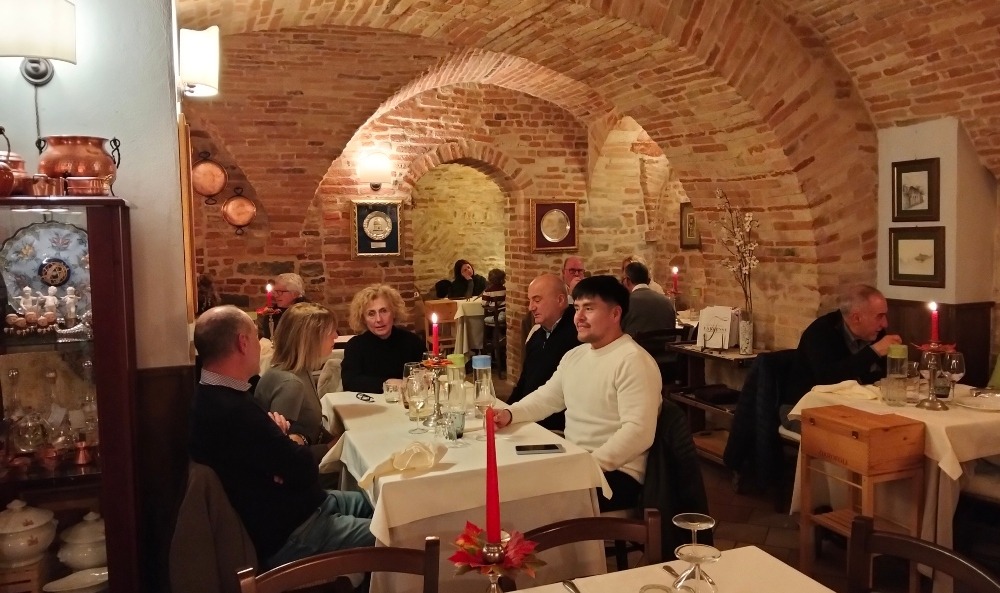
Pivoting wildly to another subject, we recently celebrated Thanksgiving with 50 other people in a local restaurant. Italians and foreigners took part. Curiously, many Italians are fascinated by this American holiday, which they call Ringraziamento. They have likely seen the famous Norman Rockwell painting and countless scenes in movies and TV programs. The restaurant owner invited my wife to be the “visiting chef” to ensure that the meal was authentically prepared and served as it has been on American tables over the decades.
Some readers may be puzzled by this annual holiday meal occurring in Italy. However, I see it not as a celebration of American history but as a way to reinforce the value of community. Whether that comes in the form of a memorial to wartime tragedy or sharing a meal makes little difference.
We are happy to celebrate life in a community of kind and generous people.
Discover more from Post Alley
Subscribe to get the latest posts sent to your email.