
There are tons of great Christmas stories, poems, readings, shows and movies. But let’s pay attention to the Bible’s own Christmas stories. Notice I said stories, plural. There’s more than one. Actually, there are three and they are quite different.
Both Matthew and Luke tell the story of a birth in Bethlehem, but those two aren’t the same at all. The third, so different that we don’t really recognize it as a Christmas story (but it is!), is the first chapter of the Gospel of John.
Let’s begin with Matthew. Matthew’s entire “Christmas story” runs the first two chapters. There’s a genealogy (1: 1 – 17), which looks boring but actually isn’t; then a scene focused on Joseph (1: 18 – 25); followed by the visit of the three kings (chapter 2: 1 – 12); and after that the holy family flees into the night, to Egypt, to escape the hitmen of King Herod who doesn’t much like hearing that the real king has come (2: 13 – 23).
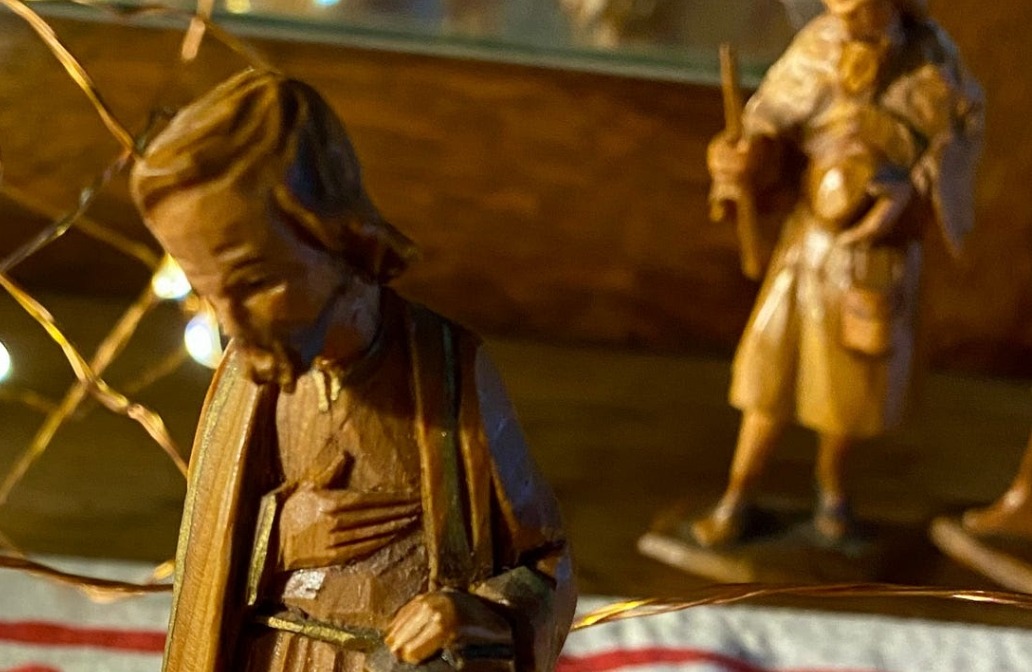
Let’s pay attention to Joseph (the photo above is of the guy from our family creche). It begins in verse 18 with the words, “Now the birth of Jesus the Messiah took place in this way.” Talk about laconic; talk about understated! It’s so easy to glide over this and the six verses that follow without really noticing how epochal the moment is.
Here’s a quick synopsis: Joseph and Mary are “betrothed,” which is like engaged but more serious. They are “husband and wife,” only not yet living together. The marriage is not consummated. But Mary is pregnant. What’s Joseph to do? He’s got a big problem, among other things, an ethical crisis. (The focus shifts to Mary in Luke’s version. She’ll get her due.)
Joseph, we are told, “is a righteous man,” which is to say he is a Jewish man who observes the Mosaic Law faithfully, scrupulously. He’s an upright dude. Mary has, despite being officially his wife, become pregnant with or by someone who isn’t him. What in the world is Joseph to do? Law and custom say a man in such a position should summarily dismiss the woman, end the betrothal, cast Mary out, deliver her to public shame. Even death by stoning was on the table.
Joseph, is not only a righteous man, he is a compassionate one as well. He decides he will dismiss Mary, but quietly to spare her embarrassment. He’s not out for vengeance, but continuing with Mary as his wife? Out of the question.
But there’s a huge divine curveball headed Joseph’s direction. God, who is the prime mover here, intervenes. Joseph sleeps and dreams. Dreams, note, are not something we get, as in acquire or make to happen. Dreams are given, not gotten. In his dream an angel of the Lord speaks to Joseph, telling him first, don’t be afraid. “Don’t be afraid to take Mary as your wife, for this is God’s doing.” Joseph does get the naming rights: he is told to name the child “Jesus,” which means, “God saves.”
On one level it’s a gnarly human dilemma. If ever there was a guy caught between a rock and a hard place, it would be Joseph. But there’s even more at stake. In big theological terms, it’s a Law vs. Gospel showdown.
Law and Gospel are two profoundly different orientations to life, often at war in our society and in our hearts. Law says a person is saved by what they do, by their good, preferably perfect, life and behavior, by being and doing right. The language of Law is “you must,” “you should,” “try harder,” “that’s not good enough.” Moreover, you (not God) are the subject.
Gospel is different, strange, weird, and actually offensive. Gospel says that when it comes to saving souls and putting broken lives back together, God does the work. “Grace” is shorthand for “God is the primary actor in the salvation story.” To move from Law to Gospel is to discover, as my AA friend John daily reminds himself via a sign on his refrigerator, “There is God, John, and it’s not you.”
As C.S. Lewis noted, other religions (including the secular ones) say you must work to earn your salvation, your okay-ness, your acceptability, and a spot in heaven. What someone called “the crucial eccentricity of the Christian faith” — “grace,” says the work is done for us, done for us by Jesus. Coming to him we run up the white flag, surrendering our efforts to do this all by ourselves. We let God be God, which is — back to our story — what Joseph did. “Okay, God, have it your way.”
“When Joseph awoke from sleep, he did as the angel of the Lord, commanded him; he took her as has wife.” (1: 24) Joseph leaves behind a by-the-book, DIY righteousness for the righteousness of faith, in desperation letting God be God for him, and not incidentally joining Mary in shared scandal. What Joseph thought to be a moral outrage turns into a holy disruption, an incursion of God’s grace, which in a way every single birth surely is.
Law, at least as it is often presented, turns God into a scorekeeper, who’s watching to see if we get it right. Part of why we like Law is that it seems to offer a way to control God. “If I do this, then you’ll that — right?” “Deal!” Of course, any God we control is no God at all. Gospel says God is not fair, but God is gracious. So gracious, so merciful, to the point of complete self-giving.
So right here in these seven verses, in this familiar part of the real Christmas story, we see there’s a whole lot going on. The whole drama of life and faith caught like as a prism of light and color in a single, seven verse, raindrop. Merry Christmas!
Discover more from Post Alley
Subscribe to get the latest posts sent to your email.


GREAT stuff Anthony, Thank you!
For Catholics, it is Grace and works in that order. Jesus graces us with heavenly citizenship when we are Baptized and accept it. But he doesn’t pay our taxes! Justice requires responsible citizenship.
Antony, speaking for those of us whose grade of theology is maybe not our strong suit, thanks for dealing out the story cards in this fashion.
Frankly, I always thought Joseph got short shrift; for a guy who should have been a pretty important part of the story, he’s mostly in the shadows (or maybe in his workshop).
Did little Jesus come in and try to play with the saws and chisels like normal kids are won’t to do, and get scolded by Joseph, or was he the strong silent type who just picked up the mischievous little tyke and plopped him down by his mother, with a look that said, “I have more important things to do than baby sit your son”?
For another interesting account with more about Jesus’ family, highly recommend “Lamb: The Gospel According to Biff, Christ’s Childhood Pal”.