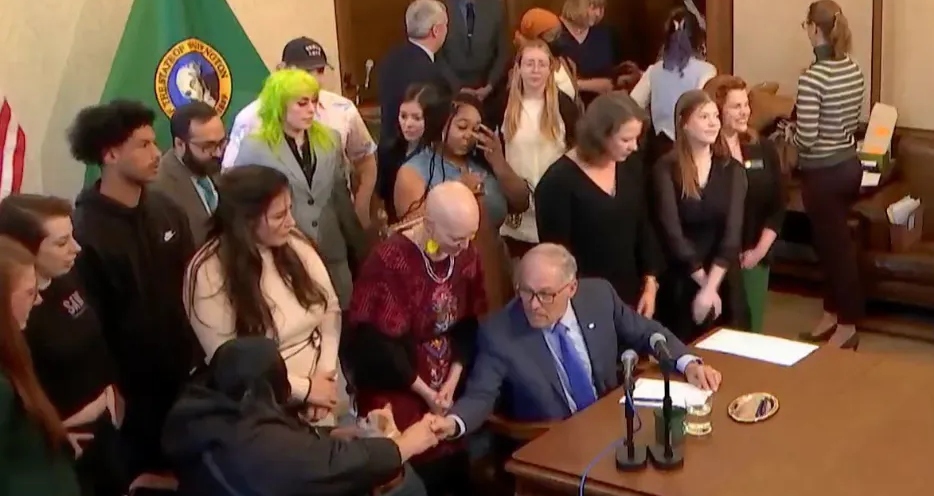

Your local bar might someday feature hot naked people, if we’re reading the fine print properly on the strippers-rights bill signed this week by Gov. Jay Inslee.
One of the original premises of Senate Bill 6105 by Sen. Rebecca Saldaña, D-Seattle, was that Washington should repeal its ban on alcohol in strip clubs because the current booze-free system makes the dancers the main source of profit, thus rendering an already exploitative business even more exploitative. The current law also makes the clubs less profitable, which means there are a relative handful compared to states with looser rules. (We’re looking at you, Oregon.)
The final version of the bill—which is mostly a beefed-up set of workplace protections for dancers—gets at the liquor license problem by requiring the Liquor and Cannabis Board (LCB) to repeal WAC 314-11-050, otherwise known as the “prohibited conduct” or “lewd conduct” rule. That would allow existing strip clubs to seek liquor licenses.
There was broad support for tossing that rule anyway because it was recently used to justify some ill-advised raids of gay bars in Seattle by the LCB and the city’s police, which deeply angered the increasingly powerful LGBTQ caucus in the Legislature. Also, the rule is kinda staid, antiquated, and weird.¹
But here’s the thing: That rule technically bans nudity and stripping in bars, not booze in strip clubs. So repealing it theoretically opens the door for anyone with an existing liquor license to feature some hot naked people.² One Seattle nightclub already announced plans to go there.
Employing actual adult entertainers will trigger an expanded and presumably expensive set of rules from a separate agency, the Department of Labor & Industries. So your local bar probably doesn’t swiftly convert to a strip club. But without the lewd conduct rule, other variations of getting naked won’t endanger your liquor license. So maybe topless barmaids? Bottomless busboys? Getting rid of the rule also wipes out the prohibition on encouraging customers to get naked, which could get interesting.
Eventually, new rules from the LCB and L&I probably will clarify exactly what qualifies as an “adult entertainer” and what’s just an underdressed bartender. Look for some really awkward rule-making hearings.
Another interesting wrinkle: The bill paves over local authority in Seattle—home to most of the state’s strip clubs—and unincorporated King County³ to require a minimum distance between dancers and patrons, provided there’s no actual physical contact. This is in aid of making it easier and presumably more pleasant for patrons to tip dancers. It also allows individualized, up-close dances in public parts of the establishment as opposed to private rooms, which many dancers find creepy and/or dangerous.
That preempts the county’s existing draconian dancer-to-patron spacing rules and its outright ban on the lap dance. The county folks tell us there are currently no “adult entertainment establishments” in the unincorporated areas. Unincorporated King County is home to more than 240,000 people, more than the cities of Spokane or Tacoma. You have to figure some of those folks would enjoy their boozing livened up by nudity. — Paul Queary
Parting shots on gun control
A short session didn’t hinder Democrats from sending a long list of gun control bills to Gov. Jay Inslee’s desk. Some notable ones included House Bill 1903 from Rep. Liz Berry, D-Seattle, which tasks gun owners with reporting lost or stolen firearms in 24 hours flat under penalty of $1,000. The bill includes “good cause” exemptions, such as illness or hospitalization. House Bill 2118 from Rep. Walen, D-Kirkland, holds gun shops to the same standard and would require them to invest in security systems—alarms, cameras, and good storage practices—to ensure firearms are not stolen in the first place. Republicans fought that last one tooth and nail this year, arguing the regulation was so onerous that it would likely put law-abiding dealers out of business.
As for guns purchased by the police or the government through buyback programs, House Bill 2021 from Rep. Tana Senn, D-Mercer Island, sends them straight to the smelter if they’re no longer of any value to a court case or museum.
Lawmakers also set a bipartisan baseline for the right to bear arms this session. Senate Bill 6246 from Senate Law & Justice Chair Manka Dhingra, D-Redmond, bans people experiencing a mental health crisis and those facing involuntary hospitalization from accessing firearms for up to six months. The bill would also ban defendants deemed not guilty of a felony due to mental incompetency from accessing these weapons. Most lawmakers agreed that being of sound mind and body should be required to bear arms, and the bill creates a process for people who lose their gun rights for mental health reasons to petition the court to have their rights reinstated.
Protecting election workers
House Bill 1241 from Rep. Mari Leavitt, D-University Place, aims to protect election workers from harm. The bill makes blatant threats of physical violence, property damage, and harassment of election workers a class C felony.⁴ It also lets election officials knee-deep in nasty voicemails or threatening texts to shield their addresses from the public record.
Protecting abortion care providers
House Bill 2115 from Bellevue Democrat Rep. My-Linh Thai—who graduated medical school with a degree in pharmacology—adds a layer of protection for abortion care providers in Washington. The bill would allow providers and pharmacists to use the clinic’s name in place of their name on abortion medications. Notably, the bill comes the same week that the United States Supreme Court heard a case challenging the availability of mifepristone, a medication used to induce miscarriage.
Fentanyl awareness
House Bill 2393 from Rep. Gina Mosbrucker, R-Goldendale, adds to the flurry of legislation surrounding fentanyl this session. Mosbrucker’s bill creates standards for public outreach campaigns on the risks of fentanyl, establishes standards for decontaminating vehicles where fentanyl was present, and requires jails to provide inmates with information on substance use disorder treatment programs upon release.
Removes fingerprinting delay for child care providers
Senate Bill 5774 from outgoing Senate Majority Leader Andy Billig, D-Spokane, would allow child care providers to work on a provisional basis, while their fingerprinting background check is being processed. Allowing childcare workers who otherwise qualify to get started while fingerprints are being checked removes one bureaucratic roadblock in the painstaking process. —Tim Gruver and Sara Kassabian
Footnotes:
- For example, the bartender isn’t allowed to encourage you to touch your date’s butt.
- In practice, there are a variety of local zoning rules and other restrictions that will likely limit the number of bars that could pull that off.
- Limiting bills to just one city or county is generally against the rules, but they got around that by limiting the carveout to “a city with a population of more than 650,000 or a county with a population of more than 2,000,000.” That leaves local restrictions on strip clubs in place in many other communities around the state.
- A class C felony in Washington is punishable by up to five years in jail and or a fine of up to $10,000.
Portions of this report first appeared in the authors’ website, The Washington Observer.
Discover more from Post Alley
Subscribe to get the latest posts sent to your email.