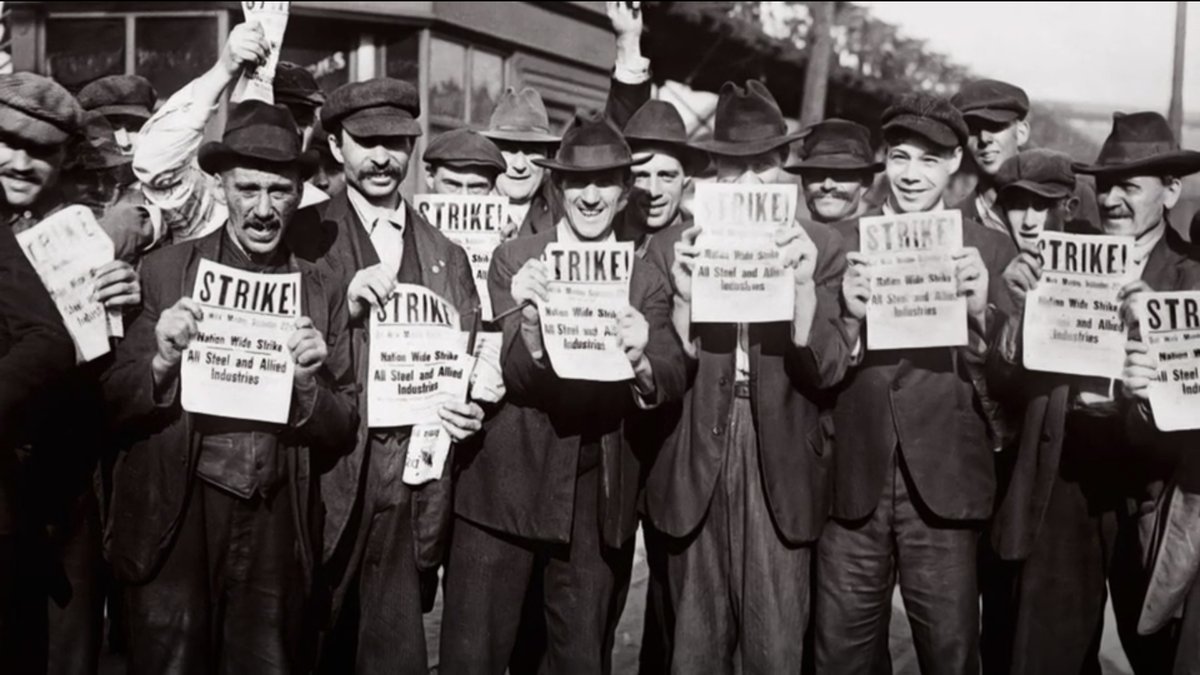

The Washington State Historical Society once mounted an exhibit saluting American labor, with emphasis on the Pacific Northwest. The subject was explored with historical tales, symbols, metaphors, art, and myths. Here’s an update.
We perceive “labor” in many ways. One perspective is Archie Bunker and his gripes. There are also Samuel Gompers with his ever-present cigar and beetle-browed John L. Lewis and the United Mine Workers. The common symbols are “blue collars,” lunch pails, time clocks, and the hammer and sickle.
In my youth, growing up in a pro-labor home, Walter Reuther of the United Auto Workers symbolized the labor movement. Reuther’s gnarled hand – often waived at U.S. Congressional hearings – allegedly represented an injury suffered in a fight with Pinkerton guards at Ford Motor Company. Seattle’s Dave Beck, former Teamster boss, wielded great power on local docks and in warehouses and in Seattle politics and business leaders. Beck also served on the University of Washington Board of Regents and headed a committee to build St. Marks Episcopal Cathedral on Seattle’s Capitol Hill — a sign of his influence with the power elite of Seattle.
The 1880s Industrial Revolution had taken a firm hold on the American economy, and labor shifted from artisans to middle managers, affecting salaries, benefits, relationships with other workers, and the way management controlled workers’ lives. By 1900 the “Laboring Class” was generally proud of its status, expressing that pride through unions, professional associations, political movements, and with badges, stickers, emblems at meeting halls and in parades.
It was inevitable that some elements of labor would want more than pride. The Industrial Workers of the World, or “Wobblies,” epitomized such radicalism. Most radical demands were accepted and lawful during President Franklin D. Roosevelt’s New Deal. The Centralia Massacre in 1919 and the Seattle General Strike the same year were examples of radical Wobbly activity in America and the timberland Northwest.
These violent episodes also fomented an “anti-labor” movement. The Boeing-led effort to break unions through right-to-work legislation was typical of the conservative backlash. When that anti-labor effort failed, it prompted a progressive reaction that is still driving local politics in the deep-blue Northwest.
Today’s high-tech service economy prompted new trends in the labor movement. One outcome has been the effort to organize city councils to pass labor-style reforms in minimum wages and working conditions that apply broadly, not just to labor unions. As for organizing sectors, the new focus for labor has been white-collar professions, public employees, the media, nonprofits, and the arts.
Discover more from Post Alley
Subscribe to get the latest posts sent to your email.