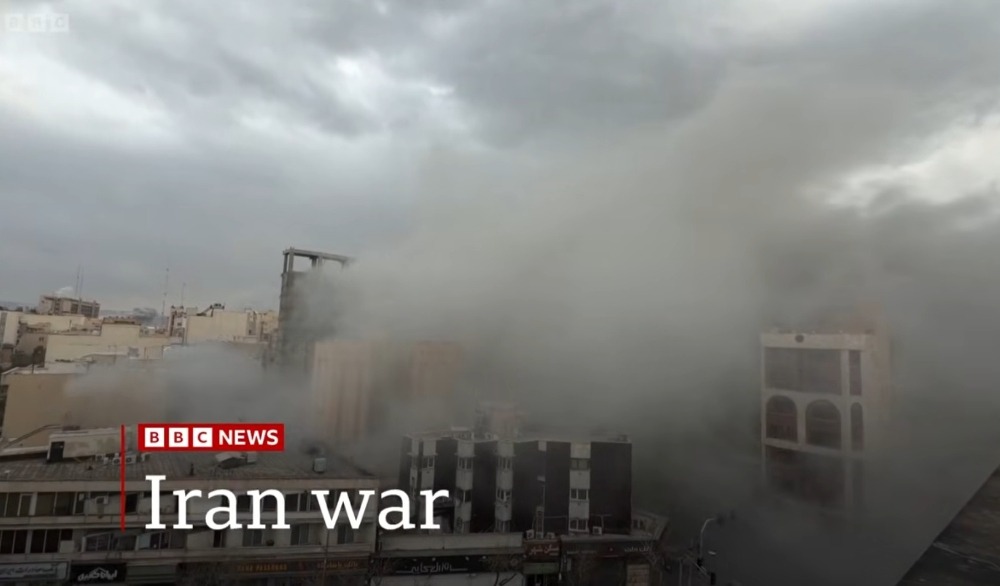

Few in the Western world are mourning the assassination of Iran’s Supreme Leader Ayatollah Ali Khamenei in the opening salvos of the U.S. and Israeli war on the Islamic Republic.
But the decapitation of Iran’s clerical regime “crossed a red line” for the surviving Iranian authorities and provoked swift retaliatory strikes on U.S. bases and Middle East allies in nine regional countries.
Trump told a news briefing Monday that he expected the mission to take four to five weeks to destroy Iranian ballistic missile stores, Iran’s naval forces and all components of nuclear weapons construction. Trump claimed he had to take action to protect U.S. troops and territory from an “imminent attack” by Iran, whose nuclear architecture he had proclaimed “totally obliterated” eight months ago after a 12-day U.S.-Israeli bombing campaign.
Then as now, Trump ignored the constitutional imperative that Congress vote on behalf of the American people on a declaration of war against a foreign adversary. The massive bombing campaign that began early Saturday is the seventh military aggression launched by Trump since he returned to the White House barely one year ago.
The president vowed on the campaign trail to keep the United States out of “forever wars” like the Iraq and Afghanistan conflicts that dragged on eight years and 20 years, respectively. Those conflicts cost at least 8,500 American lives and $4 trillion in taxpayer dollars and federal debt.
In the first briefing of U.S. media on Monday, 48 hours after the war began, Defense Secretary Pete Hegseth denied the administration was seeking regime change in Tehran. That posture contradicts Trump’s appeal to the young people of Iran to rise up and take control of their allegedly decimated governing bodies.
“This is not Iraq. This is not endless,” Hegseth responded to concerns among voters that the United States has provoked a conflict that won’t be easily resolved with a short-lived bombing campaign.
In a 2:30 a.m. Saturday video announcement posted on his Truth Social platform, Trump swore to avenge the deaths of three U.S. servicemembers killed in Kuwait during the initial bombardment. He warned in a second taped appearance Sunday that “Sadly, there will likely be more before it ends. That’s the way it is.”
Trump said variously that the war could be over in a couple of days if Tehran’s leadership capitulates to his demand that it surrender all nuclear weapons components, or in “four to five weeks” if Iran remains defiant, or “as long as it takes” because U.S. armed forces have “the capability to go far longer.”
“Combat operations will continue until all of our objectives have been achieved,” Trump said Sunday in a more equivocal outlook on the war’s expected duration. He cast the attempt to depose the Iranian leadership by the United States as “the duty and burden of a free people,” that as the richest and most powerful country in the world it is incumbent on Americans to spend blood and treasure to resolve global threats.
Initial polling on Americans’ support for the new war reflected more opposition than consent to putting U.S. troops in another armed conflict against the heavily militarized country of 93 million people.
A Reuters/Ipsos poll found only one in four Americans questioned said they supported Trump’s intervention in Iran on the country’s behalf.
CNN polling reported almost six in 10 respondents opposed U.S. involvement in another foreign conflict.
After Khamenei was killed, along with his wife and undisclosed numbers of other family and staff, Iran’s civilian government announced 40 days of mourning for Khamenei and a seven-day public holiday. A provisional governing council was formed consisting of reform-minded President Masoud Pezeshkian, hardline judiciary chief Gholamhossein Mohseni Ejei and senior Shiite cleric Ayatollah Ali Reza Arafi.
A successor to the slain supreme leader will be chosen by the 88-member Assembly of Experts, a clerical council dominated by hard-liners unlikely to select a reformer. This is only the second time since the 1979 Islamic Revolution that a new supreme leader will be chosen. Khamenei succeeded Ayatollah Ruhollah Khomeini after the fiery extremist died in 1989. Foreign Minister Abbas Araghchi said Sunday that a new supreme religious leader would likely be chosen this week.
Iran swiftly denied that the regime would resume negotiations with the United States over its right to enrich uranium for civilian uses after Trump and Israeli Prime Minister Benjamin Netanyahu executed the barrage of strikes on a broad swath of Iranian territory. U.S. military analysts report at least 40 senior government, military and clerical leaders were killed in the weekend bombardments.
Trump on Sunday appealed to the legions of young Iranian activists to take the reins of power now that he and Netanyahu have eliminated some of the regime figures repressing the masses of disillusioned and impoverished citizens.
“I urge people to be brave, be bold, take back your country,” Trump said after claiming to have destroyed the religious hierarchy. “The rest is up to you.”
Fears that the U.S. and Israeli attacks could ignite a wider war in the Middle East were quickly validated. Iran fired retaliatory strikes on U.S. bases and Sunni Muslims in nine countries on the Mediterranean Sea, the Persian Gulf and the Arabian Peninsula.
By Sunday evening, Israel and the Shiite Hezbollah militia in Lebanon were trading missile strikes, spurring evacuation orders in vulnerable communities along the border.
Iranian naval forces warned commercial shipping against entering the Strait of Hormuz, the strategic waterway that carries at least 20% of the world’s daily oil shipments. The prices of gasoline and oil rose as soon as U.S. markets opened Monday morning after the weekend bombing blitz on Iran. U.S. stocks fell sharply at the start of trading but recovered later in the day to post marginal losses.
Hundreds of thousands of air travelers remained stranded after airspace closed across the Middle East over the weekend while missiles and drones soared through the skies.
One Iranian strike set fire to a luxury hotel in Dubai, a capital of the United Arab Emirates. Iranian counterattacks also targeted Oman, which had been mediating negotiations between Tehran and Washington and had announced on the eve of the U.S.-Israeli strikes that a deal to avert threatened military action was close at hand.
At least 10 people died in violent clashes outside the U.S. consulate in Karachi, Pakistan, where Iran-allied Shiites attacked the diplomatic compound. The mob stormed the U.S. site in retaliation for the Trump administration’s hand in killing Khamenei, an 86-year-old at the head of the clerical regime for the past 37 years.
Some retaliatory Iranian strikes targeted Gulf Arab states that have no U.S. forces on their territory. That raised the prospect among some analysts that the Islamic Revolutionary Guards Corps, the all-powerful regime militia, was fracturing in the wake of the strikes. Iranian Foreign Minister Araghchi also made vague references to factions of the IRGC becoming “independent” in the wake of the U.S.-Israeli strikes on their hierarchy.
Iranian Defense Minister Aziz Nasirzadeh and Army Chief of Staff Gen. Abdol Rahim Mousavi also were killed in the weekend bombings of Iranian military sites. A top figure in the IRGC, Mohammad Pakpour, was also reported by Iranian media to have died during the attacks but the government had not confirmed that as of Monday.
The U.S. and Israeli targeting of Iranian leadership and Trump’s appeal to Iran’s young population to rise up and take control of their country sparked widespread concern that the U.S. military has again been deployed to lay the ground for “regime change.”
Netanyahu coordinated with Trump in strikes across Iran and promised “thousands more targets” would be hit before Operation Epic Fury concludes.
Among the potential successors to Khamenei is his public policy advisor and former parliamentary speaker Ali Larijani, believed to be responsible for ordering the brutal crackdown on student demonstrators in January that left at least 7,000 dead.
Iran’s elected president, Pezeshkian, is one of the few candidates backing domestic reforms and moderation of the regime’s hostile relations with Western powers. While he is theoretically in the mix of candidates as the next supreme leader, his Reformists Front coalition has been decimated by the mass arrests of his closest allies accused of supporting “foreign interests.”
Trump spewed false and contradictory reasons for bypassing Congress in unilaterally declaring war on Iran. He claimed the right to order the strikes because there was an “imminent threat” of an Iranian attack on the United States. Pentagon officials were quoted as saying there was no imminent threat, rather Trump had decided to attack Iran without warning or support from Congress and the American people because heavier casualties would be expected if he waited for Iran to strike first.
U.S. Rep. Adam Smith, D-WA and ranking member on the House Armed Services Committee, called Trump’s unauthorized strike on Iran a “miscalculation.”
“Where does the war go from here? And what are our strategic objectives?” Smith asked in a CNN interview. “What are we trying to accomplish and what are the reasonable means for achieving that? The president needs to clearly explain to the American people what he is trying to do.”
U.S. Rep. Jason Crow, D-CO, a veteran of the Iraq and Afghanistan wars and member of the House Armed Services and Intelligence committees, lambasted Trump for involving the United States in Israel’s long-running confrontation with Iran and other fundamentalist Islamic governments that deny the Jewish state’s right to exist.
“He knows nothing about the costs of war, nor do his billionaire donors,” Crow said of Trump, who dodged the draft during the Vietnam War with a diagnosis of debilitating bone spurs. “He’s very quick to play with other peoples’ lives.”
Crow agreed that “Iran is bad. The regime is bad,” as were the extremist regimes of Iraq and Afghanistan when the United States went to war against those countries and paid a steep price in U.S. lives and treasure.
The New York Times editorial board issued a stark warning in its Sunday commentary about the potentially overlooked consequences of an American president acting alone.
“The bigger risks may lie in the future. The president of the United States has just helped assassinate a foreign leader without the approval of Congress, the support of most allies or a plan for the future,” the collective opinion piece noted. “History suggests that unilateral American involvement along these lines often has consequences that are not immediately apparent. When American officials helped orchestrate the 1953 coup (that installed a corrupt shah), they surely did not imagine that they were planting the seeds for the Middle East’s most radical anti-American government.”
U.S. intelligence officials have warned that the power vacuum in Tehran now could encourage the IRGC militants to seize power. They also point out the risk of civil war wracking Iran, with staggering casualties and further instability spilling across the Middle East.
Nearly half of Iran’s population is under 30 and struggling through the economic collapse brought on by Western sanctions and diplomatic isolation. Unemployment is widespread and the Iranian state is a pariah for its role in arming Russia and a network of Islamic terror groups throughout the Middle East.
While Pezeshkian’s Reformists Front brought a modicum of hope for relaxation of strict Islamic rules governing social behavior, there are no independent opposition groups in Iran that could guide the restless young people who face brutal consequences for demonstrating against the despotic clerical and military regimes.
Trump’s toppling and detention of Venezuelan dictator Nicolas Maduro earlier this year left the rest of his corrupt Socialist government in power, providing little hope for Iranians that his execution of the Khamenei regime will be followed with support for a more democratic governance and stability in Iran.
Discover more from Post Alley
Subscribe to get the latest posts sent to your email.


Trump has been very cavalier about this war and the deaths on both sides. The fact that he was at his Florida country club raising MAGA money, while other Americans were fighting his war says all we need to know about this man. We are now stuck in this quicksand of war while our people pay a huge price and a very big economic bill, all to divert attention from Epstein and tariffs. When Barron signs up I’ll reconsider my thoughts.
“Trump told a news briefing Monday that he expected the mission to take four to five weeks to destroy Iranian ballistic missile stores, Iran’s naval forces and all components of nuclear weapons construction.”
And just to be very clear, four or five weeks is maximum. Nor was it simply pulled out of thin air. Melania has told Donald in no uncertain terms that she does not want ongoing blaring headlines about Iranian blood and gore spoiling the sweet ambience of the upcoming annual Easter egg hunt to be held on the White House lawn. And that event is about exactly five weeks down the road.
It makes me wonder: if Putin wasn’t bogged down in Ukraine, would Assad, Maduro and Khamenei still be in power? Certainly Russia could have provided new air defense systems to Iran if they weren’t all being needed for their “special operation.” It seems like Trump is rolling through Putin’s strategic partners. I assume Cuba is next.
David: I don’t believe Cuba has been a strategic partner of Russia for a number of years. However to Trump and especially his lap dog Rubio they are still Commies. You bet they’re next on the list and already being denied oil from Venezuela they need to survive. I suspect people are or will soon be dying in Cuba because of lack of fuel for all sorts of purposes, particularly medical.