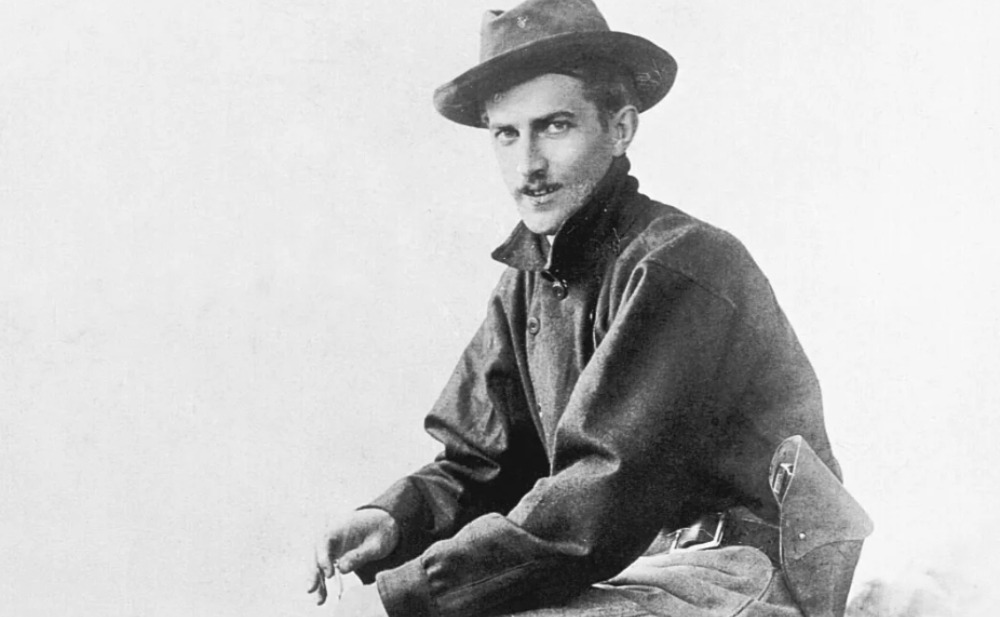

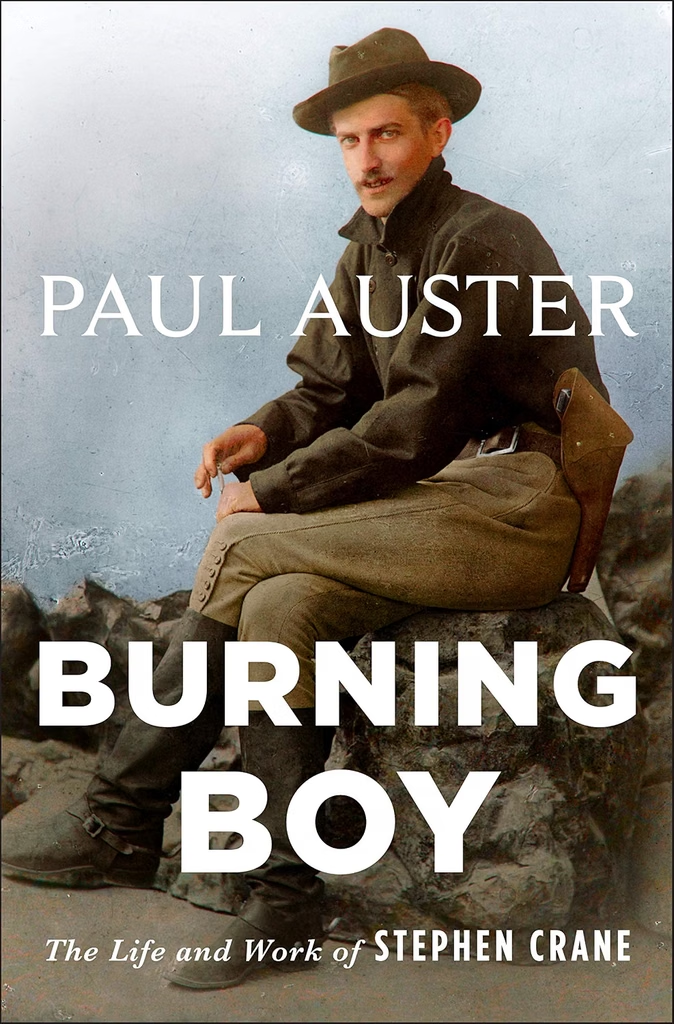
Burning Boy, The Life and Work of Stephen Crane by Paul Auster
(Henry Holt and Company, New York, 2021, 783 pages).
In his short eventful life, writer Stephen Crane leaned incandescent. Early enkindled, his writer’s vocation was evinced at age eight in a poem of touching precocity about his desire for a pet dog. An apostate from strict Methodism, he remained always alert to the world’s injustices and maintained compassion for the underdog. He excelled at baseball and could plunk proficiently on the banjo. As a correspondent in zones of war he displayed equanimity in the midst of danger. With bohemian nonchalance, he was easygoing and slow to anger. In 1900 at 28 and sickened with tuberculosis, Crane died in Germany where he had gone in a futile attempt to bolster his waning health. Born in New Jersey, his body was returned there. Too soon was America and the world deprived of this scintillating luminary of words.
Crane has been called “the herald of twentieth century literature.,” a writer who “made a clean break with the past.” The Pulitzer Prize winning author Hamlin Garland came to know Crane and was deeply moved by Crane’s early story “Maggie, A Girl of the Streets.” It’s an unsentimental portrait of a simple young woman entrapped by poverty in a stultifying New York City slum. Indigent and fearful Maggie turns in desperation to prostitution. A riveting story, it is considered the first foray into modern American realism, a shocking and harsh rendering of urban life’s darker side. Crane borrowed money to publish the tale under the pseudonym Johnston Smith. Duly impressed, Garland stated: “The author had the genius which makes an old world new.”
Crane’s raw impressionistic perspective pried open the door for others. Ernest Hemingway was born the year before Crane’s death. According to one of Hemingway’ biographers the trajectory of their lives was remarkably similar. Consider that Crane and Hemingway “chose journalism instead of college, both were personally and professionally interested in the lives of prostitutes and criminals. Both covered a Greco-Turkish war (Crane in 1897, Hemingway in 1922); both spent considerable time in Key West and Cuba; both became romantic and legendary figures; both had the unusual experience of reading their own obituaries.” And each was “fascinated by violence.”
The late Paul Auster loomed large on the international stage of arts and letters. An acclaimed author of novels, essays and poetry, he had also written screen plays and directed films. A potent offering is his sprawling biography of Stephen Crane entitled Burning Boy. After achieving his celebrated status, Auster admitted a limited acquaintance with Crane’s work. Paying a closer look, Auster immersed himself in the writer’s life and artistry. He became deeply drawn into Crane’s fiction, poetry and journalism. He found Crane a master psychologist and a forerunner of the existentialists. Auster intended a modest appreciation, but ineluctably it evolved into a sweeping chronicle, a homage to the first American modernist.
Recall Crane’s immortal Civil War story The Red Badge of Courage published in 1895. Its impact was sensational. Many veterans were still alive. The consensus was that Crane must have been a combatant. Only an old veteran who fought amid bullets, blood, and carnage could so convincingly limn the psychic vertigo of battle. All were astonished to learn Crane was born six years after Appomattox and had never been in any war. It was a work of a sophisticated imagination. Hemingway put it plainly: “It is one of the finest books of our literature.”
Crane’s name became known throughout the land. Writes Auster: “By then, his book was beginning to circulate around the country, and before the month was out, the life he had been leading for the past four years came to an abrupt end.” Yet despite impressive sales and burgeoning fame, Crane was fleeced. In England, the book was a huge hit but not one coin fell into Crane’s hands. Financial stability would elude the writer to the end. There seemed to be a perennial hole in his wallet.
Crane knew poverty and homelessness up close. Once, he deliberately spent time as a Bowery ragamuffin and stayed at overnight shelters that served New York City’s destitute. Auster describes Crane and a friend setting “out to explore lowlife Bowery haunts ranging from seven-cent flophouses to bottom-of-the-barrel free lunch saloons, to mingle with drifters, drunks, and panhandlers in order to learn something about their world, which meant standing in their shoes both figuratively and literally…launching out on their mission as though they were secret agents in disguise.” Inspired by this experience, his story “An Experiment in Misery” escorts the reader into the gloom of a sorry enclave of the weary and marginalized where “strange and unspeakable odors” assail a young homeless man “like malignant diseases with wings. They seemed to be from human bodies closely packed in dens; the exhalations from a hundred pairs of reeking lips; the fumes from a thousand bygone debauches; the expression of a thousand present miseries.”
That striking tale ends with the young outcast adrift aimlessly in a cold indifferent cityscape. Writes Crane, “And in the background a multitude of buildings, of pitiless hues and sternly high, were to him emblematic of a nation forcing its regal head into the clouds, throwing no downward glances; in the sublimity of its aspirations ignoring the wretches who may flounder at its feet.” Here it should be noted the tuberculosis that would eventually kill Crane was in his day a leading cause of death. Known as the White Plague, it intensified as industrialization in the 18th and 19th century lead to increases in urban populations throughout Europe and the United States. Even today TB kills up to two million people annually. The cramped circumstances and stench endured by dilapidated denizens of cheap overcrowded Bowery flops were no doubt hotbeds of TB and other afflictions.
On one exploration, Crane visited an opium den. His six-page vignette titled “Opium’s Varied Dreams” provides a peak, says Auster, into “an aspect of New York life that was all but invisible to the rest of the world…” Crane notes the majority of the meconophagists are not Asians but white men and women, not Asians. He estimated that there were about twenty-five thousand users in the city. Crane details the process of cooking the drug and the implements employed. Once the habit has become ingrained the addict, says Crane, “has placed upon his shoulders an elephant which he may carry to the edge of forever.”
Perhaps Crane tried opium to authenticate and enhance his understanding. He was sensitive to opium’s ethereal promise of respite from worldly travails. Crane opined, “Opium holds out to them its lie, and they embrace it eagerly, expecting to find a definition of peace, but they awake to find the formidable labors of life more formidable. And if the pipe should happen to ruin their lives they cling more closely to it because then it stands between them and thought.” In our time of economic and environmental uncertainty, of political turmoil and deaths of despair, addictions are widespread. Written over a century ago, Crane’s words are poignant.
He made enemies in the New York City Police. Animosity sparked when Crane made a public defense of a prostitute wrongly accused of solicitation on the street one night. Crane witnessed that she had solicited nobody. Questioning the veracity of the arresting cop while upholding the innocence of a trollop was considered audacious. It was typical of Crane. In the wake of his courtroom advocacy he became subject to harassment. Eventually he departed the Big Apple.
There is a fascinating addendum to this story. Crane had been given a journalistic assignment to go to Sing Sing Prison to write a piece about the electric chair ensconced there. Of this unique item Crane observed it to be a “commonplace bit of furniture” that waits silently for a condemned occupant. Crane muses: “It is patient—patient as time. Even should its next stained and sallow prince be now a baby, playing with alphabet blocks near his mother’s feet, this chair will wait. It is as unknown to his eyes as are the shadows of trees at night, and yet it towers over him, monstrous, implacable, infernal, his fate—this patient, comfortable chair.”
Ironically, after Crane’s death, the policeman who had wrongly accused the prostitute was executed in the very chair Crane had described. A crooked cop convicted of orchestrating the murder of a bookie, his execution in 1915 was the first of an American police officer for murder. The deadly procedure was performed clumsily and took more than nine minutes, said to be the most botched in the prison’s history.
Of Crane’s compelling fictional creations “The Monster” stands out. Like Auster, another biographer Linda H. Davis came late to the works of Crane. She writes: “Somehow Crane and I had missed each other through all my long years of schooling. I was thirty-five years old when I read “The Monster” and it stunned me.” It is a story of a black man Henry Johnson in a place called Whilomville. Henry is a hired hand employed by a kindly white physician, Dr. Trescott. One night a fire breaks out in the doctor’s home while he is away attending to patients. His wife is dragged out of the flames by a neighbor. Hysterically she cries that their only child is trapped. It is Henry who braves the inferno to save his little friend. He succeeds but Henry is burned horrifically, his face deformed beyond recognition. Henry will likely not survive. Yet he does.
The injustices and violence of Jim Crow were manifest when Crane wove this searing tale. Auster states that valorous Henry becomes a symbol of “black sacrifice. As with his ancestors, the cost of martyrdom will not be death, pure and simple, but a symbolic death that robs him of his humanity and turns him into a faceless idiot, shunned, feared, and hated by the righteous citizens of the American anywhere called Whilomville.”
Trescott feels a duty to care for Henry, now transmorgrified and grotesque. Old Judge Hegenthorpe says to the doctor: “No one wants to advance such ideas but somehow I think that poor fellow ought to die.” He goes on: “Perhaps we may not talk with propriety of this kind of action, but I am induced to say that you are performing a questionable charity in preserving this negro’s life. As near as I can understand, he will hereafter be a monster, a perfect monster, and probably with an affected brain. No man can observe you as I have observed you and not know that it was a matter of conscience with you, but I am afraid, my friend, that it is one of the blunders of virtue.” Venomous repercussions vitiate the lives of Henry, Trescott and his family, and the whole town.
Ralph Ellison, author of Invisible Man, said “The Monster” denotes a “failure of social charity.” He states: “Here Crane presents the cost of two acts of human loyalty and courage when they occur in a small, smug Northern town. Henry Johnson’s self-sacrificial act, which destroys his face and his mind, is repaid first with applause and then with demands for his death or banishment. Dr. Trescott’s loyalty to his oath as a physician and to the man who has saved his son’s life costs him his practice, his friends and ultimately his social identity. In short, “The Monster” places us in an atmosphere like post-Civil War America, and there is no question as to the Negro’s part in it, nor to the fact that the issues go much deeper than the question of race. Indeed, the work is so fresh that the daily papers tell us all we need to know of its background and the timeliness of its implications.”
Ellison spoke of the Civil War still festering: “In this sense the conflict has not only gone unresolved but the line between civil war and civil peace has become so blurred as to require of the sensitive man a questioning attitude toward every aspect of the nation’s self image. Stephen Crane, in his time, was such a man.”
Crane’s final days were spent in England with his common law wife Cora Taylor. They befriended literary lights Henry James and H.G. Wells. Joseph Conrad became Crane’s best friend. Physically diminished by TB, Crane went to Germany seeking a cure. He died there. On hearing of Crane’s death, it was said that Henry James wept.
Auster’s impressive tome vibrates with all of the vitality Crane packed into his twenty-eight years. At the book’s end Auster muses on the dis-ease and darkness that permeates much of our nation and the world. A revived appreciation for the genius of Stephen Crane might bring forth some needed light. Those moved by this splendid homage will, in Auster’s words, “dig the burning boy out of his grave and start remembering him again. The prose still crackles, the eye still cuts, the work still stings. Does any of this matter to us anymore? If it does, and one can only hope that it does, attention must be paid.”
A marvelous book.
Discover more from Post Alley
Subscribe to get the latest posts sent to your email.

