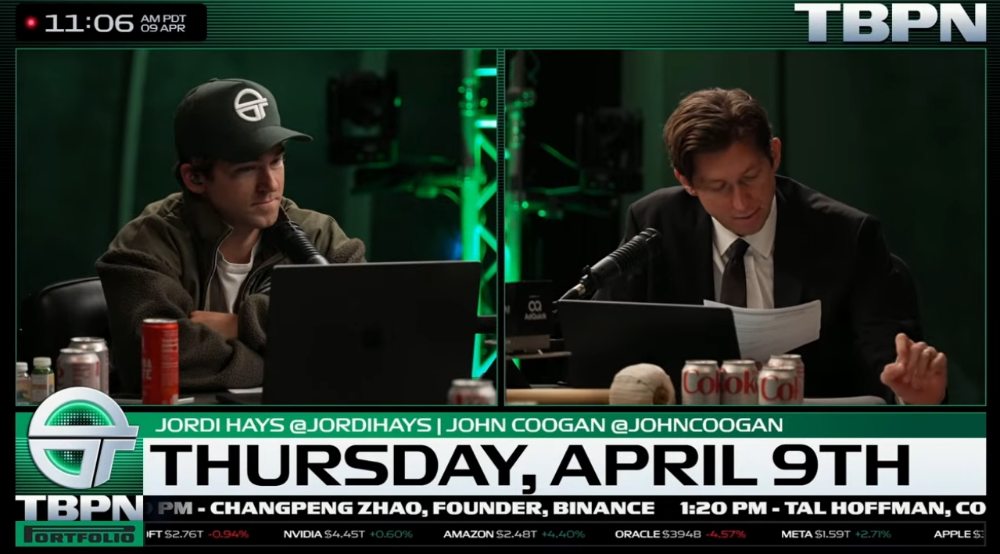

OpenAI, the creator of ChatGPT, announced on April 2, 2026, it had purchased the TBPN, a live, daily 3-hour tech talk show and podcast founded by John Coogan and Jordi Hays. In an internal memo, Fidji Simo, CEO of Applications for OpenAI, wrote that the company feels a “responsibility to help create a space for a real, constructive conversation about the changes AI creates.”
With the infusion of funding from OpenAI, TBPN will wind down its advertising operations. The 11-person online streaming service generated about $5 million in advertising revenue last year.
Simo’s memo indicates that trading advertising for a sole sponsorship will not change the show’s editorial direction: “TBPN will continue to run their programming, choose their guests, and make their own editorial decisions. That’s foundational to their credibility, and it’s something we’re explicitly protecting as part of this agreement.”
Which begs the question: Have editorial decisions ever been free from external pressures?
Early news outlets in America were funded by political patrons who expected editorial allegiance to their positions. Over time, newspaper owners became less interested in political persuasion and more interested in advertising revenue. But advertising dollars also came with strings attached. Marketers threatened to withhold advertising dollars from news organizations that did not align with their interests.
Benjamin Day’s New York Sun, founded in 1833, was one of the first media organizations to adopt the advertising model. The paper sold for one cent – less than the cost of production – and made up the difference by selling advertising. The profitability of advertiser-supported news attracted big investors. By the early 20th century, newspapers from small towns to big cities attracted owners who saw media as a tool for generating revenue.
By the middle of the 20th century, radio and television replicated and amplified the model of advertising-supported content. With their captive audiences and ability to provide compelling multi-media messages, broadcast stations were able to survive on advertising alone – making content “free” to listeners and viewers.
But media were far from “free.” As The New Yorker critic A.J. Liebling wrote in May of 1960, “Freedom of the press is guaranteed only to those who own one.” The creation, curation, and distribution of news content had become big business built largely on advertising revenue. Marketers bought space and time in print and broadcast media – not because they wanted to subsidize the news but because they wanted to gain the attention of the audiences that those media attracted.
The digital revolution affected news organizations even before the Internet became widely accessible. From the late 1970s through the 1980s newspapers began to change production processes. Hot metal type was replaced by cold type and then early word processors and desktop publishing systems that allowed writers and editors to work directly on a screen. Typesetting jobs were eliminated. The cost of printing dropped significantly. The resulting increase in profits lined the pockets of media owners.
The rise of the digitally connected Internet promised to further reduce the cost of content creation. Stewart Brand noted in an article published in the Whole Earth Review in May of 1985 that: “On the one hand, information wants to be expensive, because it’s so valuable. On the other hand, information wants to be free, because the cost of getting it out is getting lower and lower all the time.”
In 1995, Craig Newmark started an email newsletter that began a chain of Internet-based disruptions. That newsletter became the Craigslist website in 1996. Eventually it decimated classified listing revenue which had long been one of the most profitable forms of advertising for newspapers.
Through the 2000s Google developed an underlying infrastructure for “programmatic” advertising. Marketers could now deliver messages to individuals based on web-browsing history rather than the demographic and psychographic characteristics that had previously been used to define audiences.
News organizations initially posted free content on the Internet hoping to cover their costs with advertising revenue. But the advertising revenue went to companies like Google rather than to content providers. With the contraction of the economy in 2008, advertising spending declined dramatically. The media industry lost roughly a third of its newsroom jobs between 2008 and 2020.
By the mid 2010s media outlets created metered paywalls that enabled individuals to access a limited amount of content before having to pay a subscription for unlimited access. But many consumers still wanted information to be free. They found what they were looking for on social media sites that aggregate content without editorial gatekeeping. In exchange for their time and attention, social media users got news and marketing messages tailored directly to their behaviors.
As revenues continued to decline, struggling media organizations took on new appeal as affordable “vanity projects” for the wealthy. In 2013, Jeff Bezos purchased the Washington Post for $250 million. Bezos initially invested in hiring journalists and maintained some distance from editorial decisions. But then in January 2025, the Post’s Pulitzer Prize-winning cartoonist Ann Telnaes resigned after the paper refused to publish a satirical cartoon depicting Bezos and other tech billionaires laying bags of cash before a statue of Trump. Telnaes described the refusal to publish as “dangerous for a free press.” Bezos did not stop exercising editorial control – instead he expanded it.
Media owners now face a new threat to the “attention economy” on which they are built: AI agents that promise to read the news, summarize, filter, and decode what’s relevant. The professionally-developed journalistic content used for “training” the agent becomes invisible infrastructure. The user never visits the media website. The media company earns no advertising revenue and sells no subscription.
Now, OpenAI is buying TBPN, whose streaming show focuses on artificial intelligence. With a relatively small audience of 70,000 viewers, the purchase seems less like a vanity project and more like an attempt to shift from a model of gaining the attention of a mass audience to targeting the “right” audience. OpenAI isn’t buying mass reach. It’s buying a direct line to the engineers, investors, and executives who shape the industry. The company suggests that “freeing” the media from advertising dependence will be a good thing and promises editorial independence.
History suggests otherwise.
Discover more from Post Alley
Subscribe to get the latest posts sent to your email.