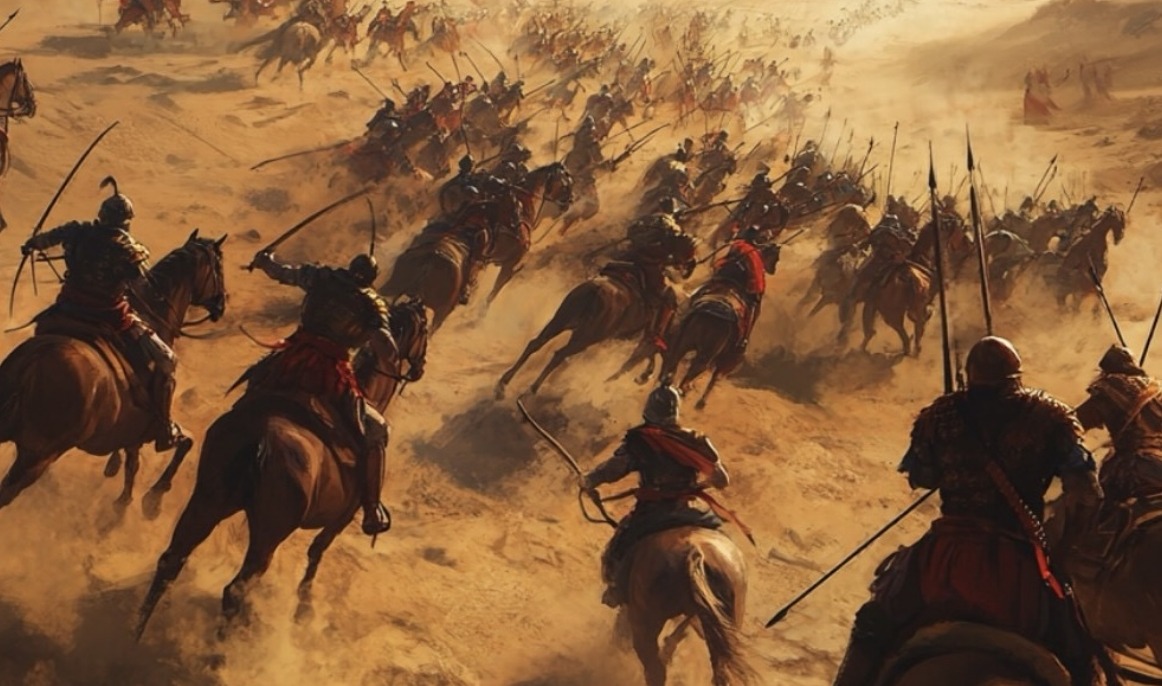

Two thousand years separate the Roman Marcus Licinius Crassus in his failed attempt to invade Iran from President Donald J. Trump’s faltering current military effort. Nevertheless, they share the same character flaws that led them to make disastrous decisions. Crassus’s effort resulted in the Roman Army’s worst defeat since the Battle of Cannae against Hannibal. Trump has lost fewer than a dozen soldiers as of the end of the first month in the Iranian War, but if he continues to follow Crassus’s path, the outcome could be similar.
When comparing their rise in power and prestige, the most noticeable similarity between Crassus and Trump is how national leaders who find success in making money start to believe they are unbeatable in military pursuits. Crassus has been called a fool in history for literally losing his head by invading Iran, which was then known as Parthia. We need to wait and see how historians will view Trump’s invasion.
The flawed logic shared by Crassus and Trump does not come from Trump’s lack of military or government experience. Crassus had both. He had won several major military battles as a commander and held two of Rome’s highest political offices. Yet, both showed two serious flaws: jealousy of a rival’s undeserved honors—honors they should have received—and an inability to accept thoughtful advice that opposed their plans for a great victory.
In the case of jealousy, Pompey received public recognition for capturing a defeated Spartacus, even though Crassus was responsible for crushing Spartacus’ army of slaves revolting against Rome. Nonetheless, Pompey the Great, as he was often addressed, was awarded the highest honor Rome offers—a state-sanctioned parade honoring a victorious general—and Crassus received none.
Trump’s jealousy of Barack Obama began a month after Obama announced his presidential run in 2012. Trump appeared on The View and other news platforms, expressing ‘real doubts’ about Obama’s birthplace, suggesting it was in Africa or elsewhere outside America and thus disqualifying him from being president. Previously, Trump had contemplated running in 2000 and 2011 but withdrew.
A significant injury to Trump’s ego was Obama receiving the Nobel Peace Prize, which Trump has repeatedly claimed was undeserved, since “He did nothing. And they gave it to him.” Trump’s envy of Obama receiving the peace prize may have sparked his desire to overshadow Obama’s credit for peacefully achieving the 2015 agreement with Iran to limit their nuclear weapons threat. The deal required dismantling 13,000 centrifuges and storing them under the International Atomic Energy Agency’s constant monitoring.
Trump criticized Obama’s deal as a terrible agreement, which led the U.S. to withdraw from the 2015 nuclear accord in May 2018. Subsequently, Iranian leaders threatened to stop fulfilling some of Iran’s commitments under the deal. They followed through on January 5, 2020, and announced they would no longer adhere to any limits set by the 2015 nuclear agreement on centrifuge use or uranium enrichment.
Still, Trump, at the urging of Israel, attacked Iran, bombing the installations and facilities that he had allowed them to build when he killed their agreement, believing that they were building nuclear arms. That premise was only verified by Israel, which sees Iran as an existential threat. However, it was rejected by the International Atomic Energy Agency, finding no evidence or indication of a systematic, ongoing program to produce a nuclear weapon by Iran.
Joe Kent, appointed by Trump as the Director of the National Counterterrorism Center, concluded after reviewing data collected by his department that there was no imminent nuclear attack by Iran on America. Trump discounted his director’s information and initiated bombing Iran at the same time his administration was negotiating a ceasefire. He has hinted that he has won the war and that the conflict will end soon.
Consequently, Trump is claiming he has achieved more than Obama did in securing our safety from Iran. This is because President Obama had already accomplished what Trump now aims to do, except that now he faces Iran, which may have more nuclear capacity than it had before he withdrew from Obama’s agreement.
The Iranian conflict has been fueled by Trump’s arrogance, similar to how Crassus’ invasion of Parthia was driven by hubris. Both leaders aimed to prove they were more powerful than their adversaries — Obama for Trump and Pompey for Trump. Moreover, both ignored their advisors and allies’ advice, underestimating their enemies’ strength.
In preparing to invade Parthia, Crassus was strongly advised by his quartermaster, who was responsible for logistics and ensuring his troops had supplies and equipment, not to take the shortest route across the flat desert to engage the enemy. Confident in his superior numbers and better-equipped army, Crassus believed he could quickly deliver a crushing defeat to the Parthians, possibly in just a month of fighting.
He also declined the support offered by his ally, the King of Armenia, who would have sent more soldiers if Crassus had taken a different route through the mountains that would have provided safety from the Parthian cavalry. Crassus ignored both pieces of advice.
There is another factor that shows how overconfidence in their technology affects both wars. The Roman Army was the most powerful in the world, with highly trained soldiers protected by the strongest armor. What did the Parthians bring to the fight? Lots of horses, some camels, and bows and arrows. Still, only a few Romans escaped being slaughtered.
The Parthian bows were designed for high-volume firing and lighter shots, while Roman archery used stiffer, specialized bows meant for heavier, armor-piercing shots to combat armored enemies. Crassus’s arrogance led his army into terrain that favored the Parthians and was useless for the Romans, who were stuck on a flat plain under a continuous, day-long barrage of deadly arrows with nowhere to hide and nothing to drink.
Two thousand years later, Americans are using the world’s best military equipment, operated by the best-trained soldiers, led by a Secretary of War, Pete Hegseth, who told his top military commanders, “Your only mission is ‘warfighting, preparing for war, and preparing to win, unrelenting and uncompromising.‘” Like Crassus, he ignored the landscape, forgetting how to protect the Strait of Hormuz, which Iran blocked, causing a near-total halt in commercial shipping and 20% of the world’s oil supply.
He also failed to consider how asymmetric warfare with Iran would develop. They are using inexpensive drones to cause major disruptions to the world’s oil supply lines and damage to local countries hosting U.S. military bases, even though their top-tier weapons are largely destroyed. Our soldiers haven’t borne the full impact of these attacks, but like the Parthians of old, the Iranians can sustain the conflict much longer than Trump anticipated.
Hegseth likely believed that simply telling his commanders, “You kill people and break things for a living,” would be enough to win battles. There has been a lack of planning on a scale that is increasingly costing America financially, which can affect our lives. One small note: the supply of helium, which is essential for conducting MRIs for critical conditions, is being cut by 40% due to the war. As one doctor said, “Don’t plan on having an MRI soon.”
The real danger is that if Trump keeps escalating the conflict, such as sending ground troops into Iran, there will be human costs for our soldiers and possibly for American citizens facing deadly retaliation. If Trump and his Republican allies in Congress continue to pursue the war, Republicans like Sen. Lindsey Graham, who has said the U.S. would “blow the hell out of these people,” are likely to push closer to using “weapons of mass destruction” on Iran. We can then expect Trump to mirror Crassus’s arrogance, inviting the war to end badly for America.
The Republican Party is to blame for not demanding that Trump act in the nation’s interest rather than his own. This is exactly what happened 2,000 years ago, when Rome’s highest authority, the Senate, was mute as Crassus invaded a country the Senate had not requested. In both situations, on paper, the final authority lay with the legislative body, not the executive branch.
History once again shows that when a nation’s leader is free to act erratically without restraints, the entire nation suffers from the partnership of an arrogant leader’s blind military ambition and the Senate’s loyalty to being deaf to reasoned objections to such folly.
Discover more from Post Alley
Subscribe to get the latest posts sent to your email.