
In the economic boom the followed the Second World War, modern architecture came roaring into American cities with ambitions to replace everything that was outmoded and dilapidated with sleek modernist buildings that symbolized a whole new way of living. As we know well in Seattle, some members of the public reacted against this tear-it-down mentality by initiating preservation movements dedicated to protecting beautiful and beloved old buildings, movements that succeeded not only in saving many urban treasures, but also in establishing legal processes by which the destruction of our cities’ architectural heritage must be justified to the public.
In recent years, ironically enough, the modern buildings that replaced so many classical and Art Deco wonders have now reached the point where they too are becoming outmoded and dilapidated, and must either be extensively renovated or replaced. Many criteria must be weighed in deciding which it will be, including historical importance, aesthetic significance, environmental impact, and cost. For a building to be preserved, the public must embrace it, architectural experts must admire it, and public officials must see the cost and trouble of preserving it as a service to the people.
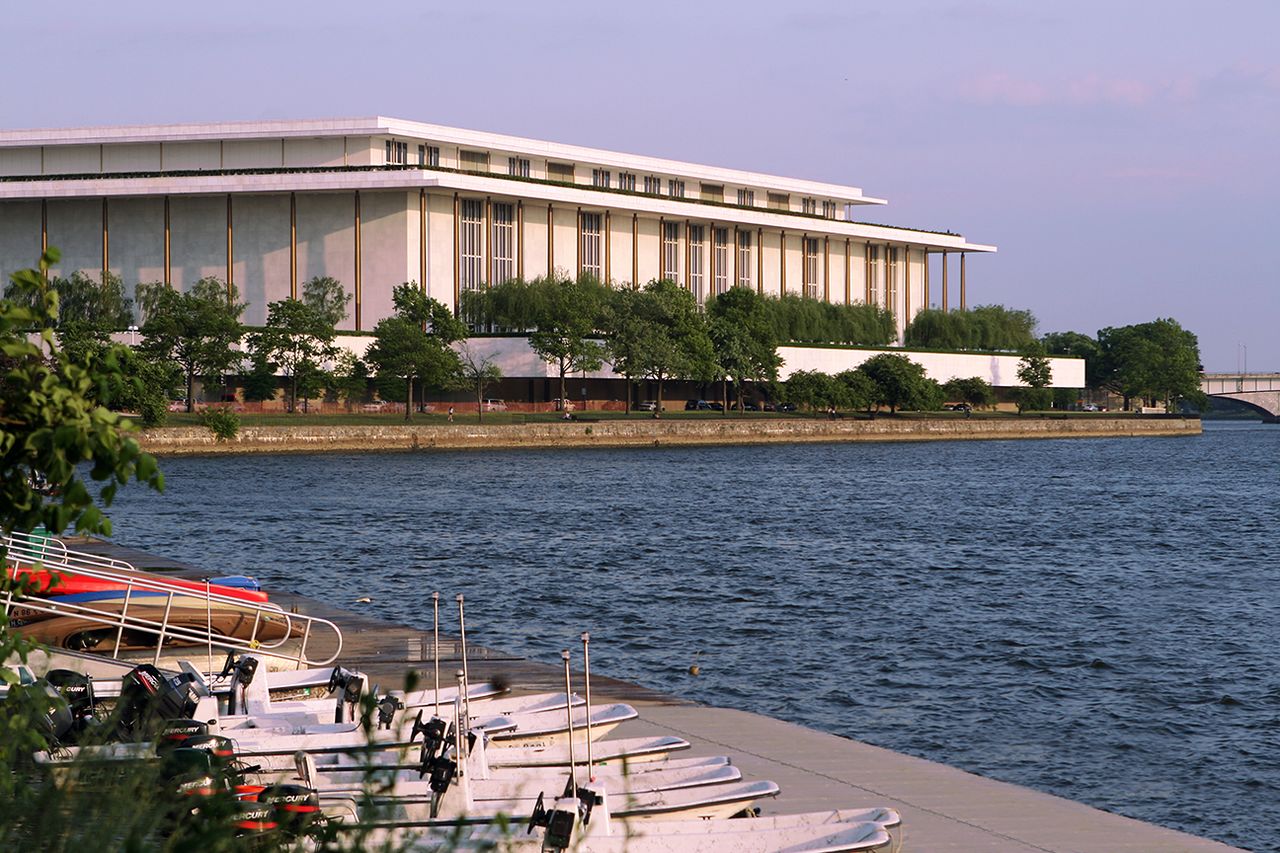
The current precarious situation of the Kennedy Center for the Performing Arts in D.C. provides a striking case in point. Wishing to take control of the programming at the center to align it with his ideologies, President Trump replaced its leadership with epigones, who returned the favor by adding his name to the building, elbowing Kennedy into second billing. In reaction and protest, artistic leaders resigned, scheduled performers withdrew, and attendance at events plummeted. Trump announced, then, that the center would be closing this summer for two years to undergo what he called a “complete rebuilding.” The center is “tired, broken, and dilapidated,” he said, echoing the modernist rhetoric of obsolescence.
One could see this closure as a way for Trump to stymie the furor over his commandeering of the institution, for it would conveniently render the immediate question of programming and attendance moot. But evidently Trump has something far grander in mind: to remake the building according to his specifications. A facility completely rebuilt under his direction would truly belong to his personal legacy, as the White House ballroom will be. Perhaps he could even knock that Democrat, Kennedy, off the marquee altogether.
Fears that Trump will pursue his ambitions by suddenly tearing down the building, as he did the East Wing of the White House, have prompted Rep. Joyce Beatty, Democrat of Ohio, and ex-officio member of the Kennedy Center board, to file a lawsuit aimed at preventing any such surprise by asserting the legal requirement of congressional authorization. Trump has denied plans to demolish the building, saying he would be keeping the underlying steel structure and some of the marble of the exterior. But that statement still implies a rebuilding so extensive as to essentially constitute a new building.
Moreover, we know from experience that Trump can easily change his mind, citing or inventing circumstances that required him take a different course. He did so with the East Wing; he did so in the 1980 demolition of the Bonwit Teller building (to make way for Trump Tower) when he promised to preserve two large Art Deco friezes to donate to the Metropolitan Museum of Art, but then decided to destroy them instead to avoid expense and construction delays.
Surprise demolitions are in part a response of developers to increased preservationist regulations. One must get the building down before it has a chance to come before a preservation board, before the research can be done to assess its historical significance. There are many examples of swift demolitions in the work of master builder Robert Moses in New York City, and a notable one in the case of Trump’s father Fred, who in 1966 hastened to demolish the Steeplechase Park Pavilion of Fun on Coney Island before it could be granted landmark status.
The question, then, whether the “complete redesign” of the Kennedy Center can and should be prevented rests on two basic questions. First, can legal decisions be made before the backhoes arrive? Second, is the building sufficiently loved to be saved in its present form? A response to the second question is complicated, for although the public has come to embrace the stately modernist structure perched over the Potomac, architects and professional critics have always had mixed feelings about it.
The center’s architect, Edward Durrell Stone, was a New Formalist, which means he sought innovative ways to incorporate classical features into modern structures. In the case of the Kennedy Center, this can be seen in the symmetry of its large, rectilinear form set on a raised platform and adorned with ultra-thin columns. It is by no means engineered like a Greek temple, yet it loosely recalls one in its design and ornamentation. But for architectural professionals the mimicry of classical forms and the addition of ornamentation was a retrograde move, a concession to public taste that sacrificed the serious values of mainstream modernism.
Ada Louise Huxtable, then architecture critic for The New York Times, called it a “glorified candy box.” It was an example, for her, of “derrière-garde design,” a monument to middle-brow culture. Stone’s efforts to appeal to popular tastes, to make the grand space welcoming and comfortable, was not popular with the experts.
Stone’s building for the Gallery of Modern Art in New York City was similarly aimed at popular appeal. Clad in white marble and supported it on Byzantine-inspired decorative columns with circular insets of Red Rose granite, the building rebelled against the deadpan austerity of surrounding glass skyscrapers. Huxtable likened Stone’s building to “a die-cut Venetian Palazzo on lollypops,” and critic Wolf Von Eckardt called it “a big hunk of marble kitsch.” In 2005 when the exterior was degrading, a redesign by Allied Works Architecture enclosed the whole building in glass, obscuring most of the features that had drawn so much ire from critics.
Stone’s Kennedy Center building is being supported by the advocacy organization specifically dedicated to the preservation of modern buildings. Named “Documentation and Conservation of the Modern Movement,” it is far better known by the catchy abbreviation “Docomomo.” The U.S. national chapter’s executive director Liz Waytkus called the center “a celebrated work of Modern architecture and a landmark achievement by master architect Edward Durrell Stone” and announced that Docomomo US is “joining with like-minded organizations to assert the public’s right to review and participate in decisions affecting these nationally significant places.”
An extraordinary amount of love and effort will need to be gerated if the Kennedy Center is to be protected. Legal challenges such as Rep. Beatty’s would seem to be prerequisite for bringing those arguments before an audience that might be more persuadable than Trump.
If these efforts fail, the building that replaces the current center will likely look more classical than modern, but the President encourages us to rejoice in the fact that the “new and spectacular Entertainment Complex” will have brand new heating and air conditioning. It will be a fully modern pre-modern building.
Paul Kidder is Professor Emeritus in Philosophy at Seattle University, is the author of “Minoru Yamasaki and the Fragility of Architecture.“
Discover more from Post Alley
Subscribe to get the latest posts sent to your email.