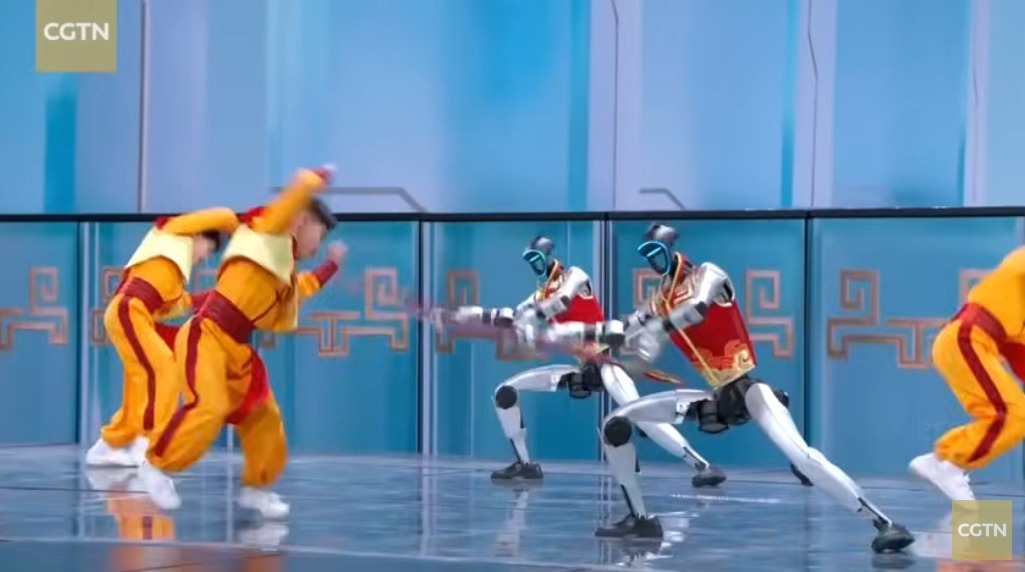

Maybe you’ve seen the video below this week? It features the latest robotics by a Chinese robotics firm harnessed for a demonstration at this year’s Spring Festival Gala. Give it a minute. I’ll wait.
Having seen the videos of dancing robots by Boston Robotics at MIT, I’m blown away by this. Also unsettled. The robots are incredible. And also: are they? What does incredible even mean here? That complicated mix of reactions is what I want to explore. Those of you who follow my work know I’m wary of how AI will change the creative landscape. But I’m also excited by the possibilities for new creative expression.
There’s a building backlash against all things AI right now, particularly in the creative world. The hype, the threat, the uncertainty about jobs and relationships. Then there’s the tsunami of AI slop that has overwhelmed us. It’s gotten easier and easier to spot, and while some of it is really quite good, the “fakeness” of it is repellant.
A year ago, these robots couldn’t do anything like what they’re doing now on this video. A year from now, this video will likely look primitive as the technology evolves. The same thing, more or less, could be written about AI-generated images, music, text, and code. The technology isn’t standing still while we try to grasp what it can do, it’s lapping us.
Which puts pressure on critics and gatekeepers who keep insisting that AI can’t do this or that, that it can’t make real art, can’t achieve genuine creativity, can’t be conscious in any meaningful sense. Who knows if they’re right about this? But they sound, uncomfortably, like every prior generation of gatekeepers defending an established definition of excellence against something new that didn’t fit.
The Impressionists were rejected by the Paris Salon for being too loose, too subjective, too interested in light rather than established forms. Jazz was considered screech by people who had coherent, well-trained musical reasons to think so. Hip-hop was a fad. Cinema wasn’t art. Photography might be magic but certainly wasn’t art. Each time, definers of excellence were defending genuine craft, genuine standards, genuine accumulated wisdom. And each time, they were also defending a definition that the next generation found outdated.
This is not to say that anything goes or that all aesthetic judgments are equally valid. It’s something simpler and harder to argue with: “better” is a conversation that cultures have with themselves over time, it gets constructed by the accretion of those conversations and it continues to evolve. “Better” is not a verdict that gets handed down once to the exclusion of everything that comes after. Repeating a great conversation doesn’t make it better, it makes it… unsurprising.
Postmodernism spent fifty years making this argument philosophically, with mixed results. If there’s no fixed standard of excellence, the objection goes, then nothing is excellent. But that’s not what postmodernism says. It says the map of what excellence can be is bigger than any particular moment’s version of it.
DEI work in the arts has been making a related argument: that the map of excellence has been drawn by a narrow demographic slice, and that whole traditions of achievement — musical, literary, visual, culinary, architectural — were left out not because they failed the test of excellence but because they were never thought worthy of being considered. Outside the definition. Expanding the definition of what counts as serious music, serious literature, serious art isn’t lowering the bar. It’s acknowledging that the bar that was installed in a particular room doesn’t measure everything in the house worth measuring.
Both the postmodern and pluralist arguments come to the same uncomfortable conclusion for cultural institutions: your definition of “better” has a history, which means it has a future, which means it will (has to) change. Culture is never a fixed point.
Anxiety about AI aesthetics is following the age-old trail, though it seems more unsettling because… machines? But the history of art has always been driven by technological progress — better horn valves, better paints, better stagecraft. Each advance opened new opportunity for those who learned to use them.
But this time is different, right? When critics say AI can never be truly creative, they are using a definition of creativity that was itself constructed. The romantic ideal of the solitary genius, the authentic person expressing the artist’s unique inner world is about 200 years old. The notion that genuine art must flow from pure individual inspiration is a 19th-century construct we have interpreted as eternal truth. But this definition has been decaying even before consideration of AI.
Today we’re obsessed with nailing down a definition of consciousness and the goalposts are moving. Not because AI evangelists are winning, but because the more we try, the more we get tangled up in uncomfortable challenges to what we used to think was uniquely human. This doesn’t mean AI is conscious, it means we don’t know what consciousness is well enough to be confident defining it. We’ve long since blown by the Turing Test.
Meanwhile, AI slop seems to be taking over. People are repulsed by it — an aesthetic that feels inauthentic, like it was assembled from averages rather than choices. But that repulsion is important data. It tells us that human aesthetic sensitivity can detect when something is off. Today’s AI aesthetic won’t stay where it is. The robots at the top of this post were, not long ago, lurching and falling over. The distance between “clearly mechanical” and “disturbingly fluid” turned out to be crossable, and the speed of progress right now is exponential, hard to even conceive.
Here is the thing about “good enough” that the “better than” camp continually misses: good enough, in a new medium, sets the new baseline from which “better” is subsequently measured. Digital photography was good enough to displace film. Then it became the standard. YouTube was good enough to watch on a laptop in 2006 but it also created an entirely new visual language — the jump cut, the direct address to camera, the confession-booth intimacy, a new “authenticity” — that leaked into and quickly redefined quality in prestige television and film. YouTube didn’t just lower standards. It generated new aesthetics that became new standards.
I’m guessing AI will do the same. Not by replacing what we already value, but by generating formal possibilities that don’t exist yet that will in turn produce new things worth aspiring to. We just can’t see them yet. That’s what history keeps showing us.
The question isn’t whether AI will change our definition of creative excellence. The question is how we will engage with that change: with curiously and critical insight, with our existing values intact but our existing definitions loosely held? Or defending the current map as if it were the entire territory.
The AIs are going to get better. And defining “better” is going to get more complicated. Both things are true, but I think the second is the far more interesting story.
Discover more from Post Alley
Subscribe to get the latest posts sent to your email.


OK, AIs could generating formal possibilities that don’t exist yet, but when they aren’t rooted in human experience? This is part of the process in art – the art you’re talking about, that takes years to accept, but eventually we find that root and learn to feel it. Just generating possibilities at random is deadly.
The other end of the art spectrum, though, I optimistically think may benefit. Singing around the campfire, making quilts, open mike at the coffee shop, live music for dancing. Recorded, processed music put a dent in that when it came along, but AI won’t finish the job, it will push the whole industry into a category of inauthenticity.
So does a horn valve or a camera or a printing press have to be rooted in human experience? They’re tools that in the hands of skilled artists can do/be amazing things. One of the things I dislike about our debates about AI is that we assume “a” definition of what AI is. It’s actually very many things which can be used in many many ways.
For any creative activity there is scut work involved, work that is uncreative, boring, repetitive. The amount of time and energy it takes to build skills that may be just utilitarian can be extraordinary. Now, one can argue that in building those skills, a creative person builds an aesthetic and a way of expressing themselves. If we take away that effort, the resulting creativity could be very different. That’s undoubtedly true — we’re all a product of our experiences.
But I think better tools, while they change the art, open up new possibilities, which then get built on by others. That’s the nature of art, I think. The “best” art is not always more advanced or most complex, or biggest, I think. A simple two-voice fugue can be mightier than a Mahler symphony. They’re just different and they express different things. But at the heart of the best is the ability to spark a reaction, a recognition that seems true.
If autonomous AI art fails to do that, I believe most people won’t be attracted to it. But I have to admit — there is lots of music (and art) that revels in its “machine-ness” — electronic dance music for example, and auto-tune. The “Wicked” movies or “Barbie” special effects are obviously CGI-made and enhanced and completely unreal. But somehow we find things in them (amazing performers in “Wicked”, for example) which resonate and are magnified by the technology that frames them.
I may be selling the AI of the future short. Today, we could get a data-trained esthetic, or something rather randomly selected, but some AI of the future may have sensibilities and intellect that surpass humans. In that case, fine – maybe worth a listen. But today, I think autonomous means some combination of trained – pablum by definition – and random, and that’s what I think will poison the well before it generates a new esthetic that becomes a standard.
I asked AI about how it works today, and she said
” AI-created music uses algorithms and machine learning to generate original compositions, lyrics, and, in some cases, full songs in seconds, with platforms like
Suno AIUdioAIVA, and Beatoven.ai leading the industry. These tools can produce high-quality, genre-specific audio from simple text prompts, shaking up the music industry, topping charts, and creating copyright and ethical discussions. ”
High quality! For sure – really impeccable, even better than the manicured music from the recording studios. I hope this really blows up, and people learn to associate this chart topping kind of “genre-specific audio” as synthetic background noise or worse, and traditional live acoustic music will be a refuge.
The same thing is happening in visual art, I believe – AIs can generate an elaborate, colorful picture from a low effort human input. To the dismay of human artists, and here I can’t think of any optimistic upside. At best, we will learn to distrust all images.
Doug: Thank for hike through reality. Technologies come and go and with them ascetic standards. Our kids will view things differently than we boomers. Me? I miss The Lennon Sisters and Myron Floren, true human beings setting approachable standards.