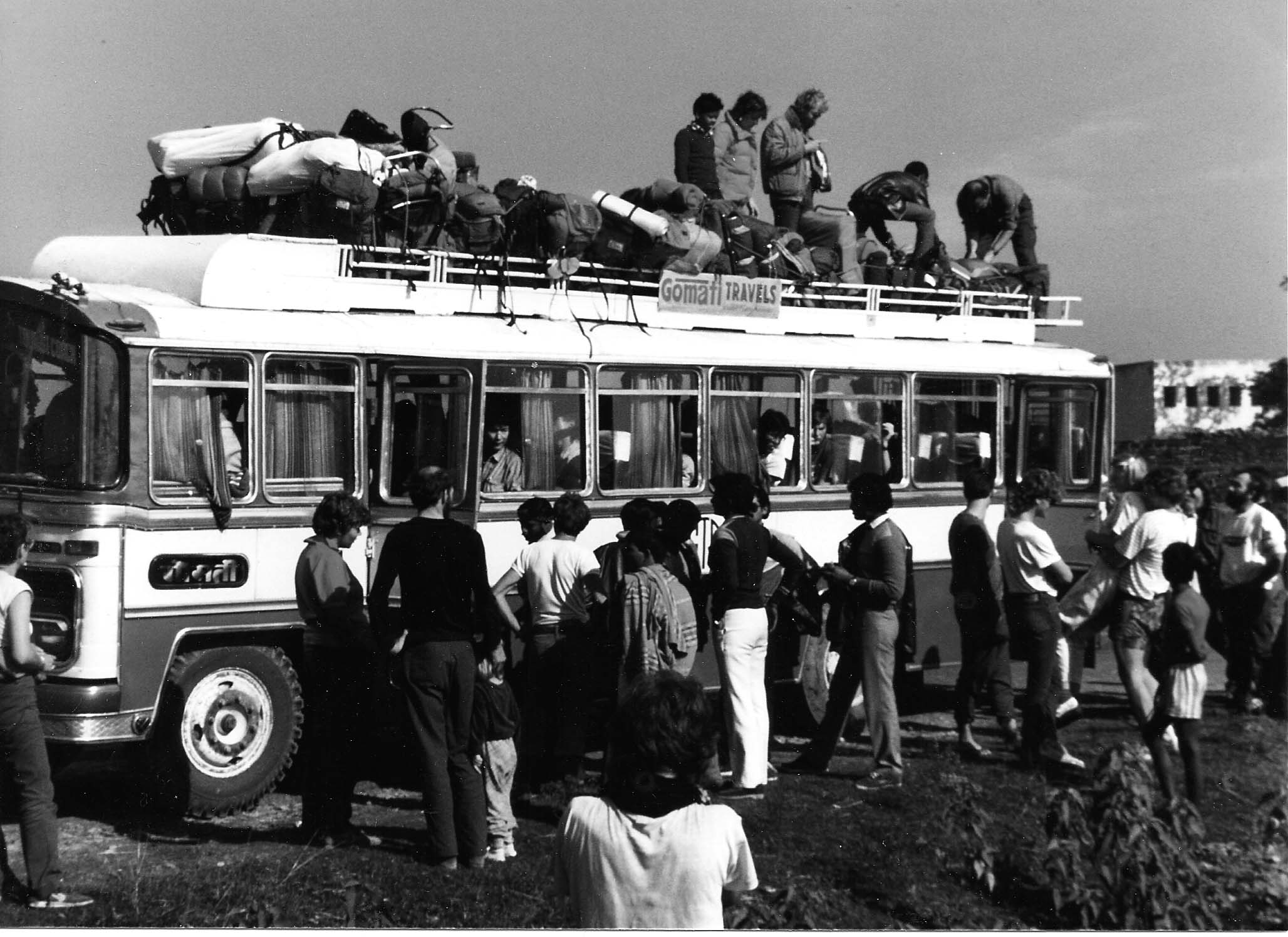

I was never on the Hippie Trail, but I did have breakfast at one of its end points. In my journal for August 19, 1972, I wrote of the Pudding Shop, a small counterculture rendezvous in Istanbul, Turkey:
“It had a bulletin board on the wall with stuff like, ‘Ride to Spain wanted’ and ‘Two female riders wanted to Kabul, Delhi, with pleasure.’ An Indian freak with a headband and black frizzy hair walked through the serving area, calling out, ‘Does anybody need a ride to Sofia tomorrow?’ A girl came by. ‘Would you like a ride to Sofia?’ the freak pleaded. ‘You don’t have to worry. I’m a homosexual.’”
Half a century ago, the encounter was strange enough for me to record, and to refer to the guy as a “freak,” as in The Fabulous Furry Freak Brothers. I had long since forgotten the Pudding Shop, but a couple of weeks ago was a picture of it on a screen at the Edmonds Center for the Arts. Travel entrepreneur Rick Steves was telling the audience about the Pudding Shop’s bulletin board as a signpost on the Hippie Trail.
I thought, “Hey, I remember that.” I spent two summers backpacking in Europe with buddies from Edmonds — my hometown as well as Steves’ — traveling on seven or eight dollars a day. Thousands of baby boomers from North America were lugging backpacks onto second-class train compartments and sleeping on cots in dollar-a-night youth hostels. Like Steves, I was so enthused that I dreamed of becoming a travel writer.
I never did, but Steves did. He wrote the classic guidebook, Europe Through the Back Door, which started a company that publishes dozens of travel books and takes 30,000 people to Europe every year. And Steves is ubiquitous on Cascade/PBS.
Steves’ presentation in Edmonds was about his new book, On the Hippie Trail: Istanbul to Kathmandu and the Making of a Travel Writer. The book is an edited version of his journals of 1978, when he set out with his friend Gene Openshaw to travel the Trail through Turkey, Iran, Afghanistan, Pakistan, and India, and on to the fabled city of Kathmandu, Nepal. At the end of the 1970s, Russia’s invasion of Afghanistan and the Islamic revolution in Iran shut down the Trail, and it is no more. Back then it was a road to adventure.
Steves was no hippie; he had never smoked weed until he reached Afghanistan, where everybody did. Maybe the gray-haired folks listening to him at the Edmonds Center for the Arts had been genuine hippies 50 years ago, but it was hard to imagine it. Still, the Hippie Trail was what that route was called, and Steves has a fun account of it.
The book is an easy read, colorful and non-judgmental. In Herat, Afghanistan, he writes. “I didn’t really know how [the people] accepted us strange, short-panted, pale-skinned, weak-stomached, finicky people who came into their world to gawk, take pictures, and buy junk to bring home and tell everyone how cheap it was.”
One of the rules of travel-as-adventure is to cross borders on land. Steves describes crossing into Afghanistan: “It was a desolate place bordered by abandoned, disassembled VW vans.” The vans had been torn apart by border guards looking for drugs. At the customs house was a dusty exhibit about smugglers “who tried to smuggle what in, how they got caught, and where they are doing time in prison.”
Independent travel comes with risks. On the Hippie Trail one that came with 100-percent certainty was biological warfare in the GI tract. In his book, and to the Edmonds audience, Steves steps delicately over this. “There were two types of travelers,” he says. “Those who knew they had worms, and those who didn’t know they had worms.”
A high-school buddy of mine, Mel Conner, also traversed the Hippie Trail, a year before Steves did. Conner spent most of his career teaching math to Kirkland kids at Kamiakin Middle School, but he began in Australia. When his contract was up, he took the Hippie Trail home. In his self-published book, On the Road, Off the Grid, Conner tells of his travails with ‘the Bug’ in more graphic language than Steves’.
Conner’s memory of Afghanistan is queueing up for squat toilet at 1:30 am, each victim of the Bug clutching a roll of TP and making dark jokes of impending disaster. The disasters were not all hypothetical. “One guy actually threw up while squatting,” Conner writes. “He called out, ‘I can’t take this anymore. Will somebody just slit my throat, please?’ Three of us in line eyed one another, unable to tell if he was joking until the guy let out a viscous chuckle.” The next day, Conner and his sufferers sat in a café playing poker, “too sick to move.” To bet with, they used squares of toilet paper, and argued whether the two-ply should count double.
Boomers are too old for that stuff now. Today’s world is richer, less exotic, and more comfortable than it was in the Seventies, though it is still different, still worth seeing and thinking about.
The thinking-about part is what makes the best travel books. They have personality in them, both of the traveler and the people who challenge, inspire, and irritate the traveler. My favorite accounts are the grumpy ones, especially Paul Theroux’s Dark Star Safari: Overland from Cairo to Cape Town, with his takedown of foreign aid do-gooders, and Anthony Daniels’ Utopias Elsewhere, a Brit’s jaundiced trek through communist dictatorships. The classic, of course, is Mark Twain’s Innocents Abroad, which takes grumpiness to perfection.
If Steves’ book doesn’t measure up to these, give him a break. He was 23 when he wrote it. He was, as people used to say, “wet behind the ears,” taking in far-off lands with wide eyes and no guide. Youth can still do that. The Hippie Trail is no more, but there must be something out there like it.
Discover more from Post Alley
Subscribe to get the latest posts sent to your email.


Yes, I know the Pudding Shop. !968 on the Trail from London to Kathmandu in a VW van. !969 returning to London. 1972 during a drive from London to Baalbek down the coast of Turkey.