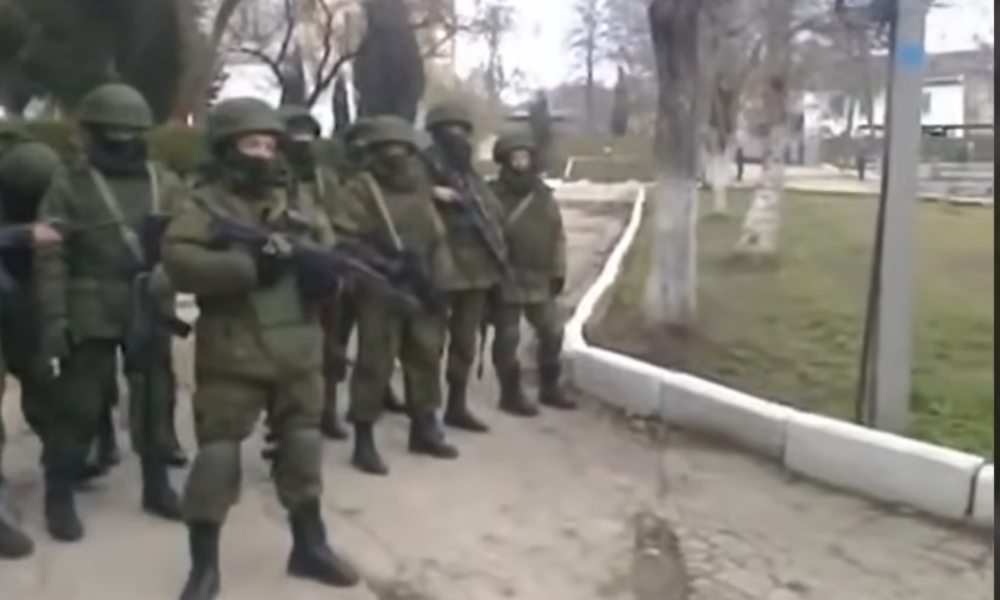

Russian President Vladimir Putin drags his decimated forces into a fifth year of war against Ukraine next week, guided not by concern for the million-plus young Russian men already killed or disabled but by President Donald Trump’s destructive efforts to help Russia win.
Trump suspended aid to Ukraine soon after he took office for his second term and his infamous Oval Office brow-beating of Ukrainian President Volodymyr Zelensky a year ago. He held up congressionally authorized U.S. assistance and inserted his real-estate mogul advisers into “peace talks” instead of the career diplomats trained for such mediation.
Even Trump’s norm-busting summit in Alaska in August, when he treated Putin to a red-carpet reception more befitting a trusted ally than an indicted war criminal, failed to elicit any concession by the Kremlin leader that would have moved forward Trump’s claimed wish to end the Ukraine war.
After the massive Russian invasion of Ukraine on Feb. 24, 2022, the Biden administration donated more than $66 billion in military assistance, weapons and humanitarian aid to the victims of Putin’s unprovoked aggression. Since Trump took office 13 months ago, he has converted that financial support to Ukraine to his personal benefit. Under a lucrative scheme forcing European allies to pay for the U.S. armaments destined for Ukraine, Trump’s military-industrial weapons manufacturers profit from the European contracts and donate significant sums to Trump’s and other MAGA and Republican political campaigns.
Trump’s failure to make any moves toward renewing the New START nuclear arms limitation treaty that expired earlier this month was another gift to the Kremlin. As of Feb. 12, there are no longer any limits on the number of nuclear-armed missiles that Russia and the United States can build or deploy. The expiration of the last arms control treaty that emerged during the Cold War removes all constraints on the former superpowers’ nuclear ambitions.
Putin offered back in September to continue abiding by the treaty’s terms if the United States did so as well. Russian defense experts at the time called the proposed gentlemen’s agreement on extension of New START’s provisions “low-hanging fruit” that would benefit both sides, according to The Moscow Times.
“If it expires, it expires,” Trump told The New York Times in an interview last month, after ignoring the Russian offer of continued adherence. “We’ll do a better agreement.”
Freeing Russia to resume building and deploying nuclear warheads and their launchers amid his bogged-down war in Ukraine offers Putin a globally catastrophic option for achieving his goal of conquering Ukraine that his forces have failed to accomplish on the battlefields.
Trump is the only U.S. president to withdraw from or fail to extend the agreements since the first Strategic Arms Reduction Treaty was signed in 1991 by President George H.W. Bush and Soviet leader Mikhail S. Gorbachev. The series of arms control agreements over more than three decades led to an 80% reduction in the strategic weaponry of both the United States and the Soviet Union/Russia.
Enabling the nuclear option for Russia further undermines the sincere efforts of other countries and alliances attempting to broker a peaceful end to the 4-year-old war against Ukraine. Putin’s grinding war that has hit his country with withering economic sanctions is fast approaching the duration of the Soviet Union’s fight against the fascist forces of World War II, from the Nazi invasion in April 1941 to the vanquishing of Berlin in May 1945.
Trump’s infatuation with Putin intensified soon after he returned to the White House and appointed billionaire real estate developer Steve Witkoff as his special envoy to the Middle East and peace negotiations on conflicts from the Middle East to the Asian Pacific.
Witkoff has met six times with Putin and the Kremlin point man on Ukraine Kirill Dmitriev in the past year. He has returned each time to deliver Putin’s conditions for ending his war on Ukraine. Each time the Kremlin’s demands have become more extensive and unacceptable to Ukraine, such as U.S. recognition of Russian-occupied Crimea as part of sovereign Russia and Ukraine ceding all of the Donbas industrial basin to Russia, even the parts of it that Russian forces have failed to seize and occupy.
Early in 2025, Trump and his wannabe-diplomats waged an aggressive campaign to force the leaders of half a dozen long-simmering regional conflicts into short-lived peace agreements. Trump had promised on the 2024 campaign trail to end the war in Ukraine “on Day One” and became visibly and vocally frustrated with the failure to make any progress toward that objective, especially in his widely expressed expectation of being awarded the Nobel Peace Prize last year. Since that honor proved delusional, he has spent far less time on trying to get a ceasefire agreement from Putin for a pause in the war that Ukraine has agreed to.
Western military analysts and think tank pundits point out that how the war is being fought changed significantly over the past year, partly due to Trump’s obvious efforts to deliver Putin’s wish list for Ukrainian concessions that would amount to capitulation and an end of sovereignty. Fighting has shifted from the stalemated frontlines to targeting of civilian infrastructure including power-generating facilities and apartment buildings in Kyiv, Kharkiv, Odesa and other major cities far from the battlefields.
What has become a drone-centric attack strategy has benefitted both sides. Russia has succeeded in damaging so much of Ukraine’s energy infrastructure this winter that daily power outages in the major cities have expanded to an average of 22.5 hours a day in the past month of below-freezing cold.
Ukraine, with its pivot to sophisticated drone manufacturing and deployment, inflicted significant damage to Russia’s oil refining and storage facilities, causing gas shortages in some areas of Russia’s vast territory and cutting into Moscow’s revenue from fuel exports.
The revised strategies are unlikely to change the pace of the protracted war that Putin initially expected to capture Ukraine in two weeks.
Foreign support to both sides has been more influential. China has failed to follow the Western alliances’ sanctions on Russia for waging war and has sustained important trade, diplomatic and political support to Putin’s country. The European Union states have rallied to raise billions for weapons to Ukraine and, if professions of assistance to Kyiv made at the Munich Security Conference last week materialize, Ukrainians should be the beneficiary of significantly more weaponry and humanitarian support.
NATO Secretary-General Mark Rutte pledged at the Munich gathering to “keep them strong in the fight” against Russia. Rutte said Russia is not winning its war in Ukraine and lost 65,000 soldiers over the past two months. He said NATO pledged hundreds of millions of dollars for urgent military needs detailed in the alliance’s Prioritized Ukraine Requirement List, known as PURL.
U.S. Secretary of State Marco Rubio used the annual security forum to make a slightly less combative and adversarial address to the allies than was rudely delivered last year by Vice President J.D. Vance. Rubio assured the global diplomatic and security officials that America “belongs with Europe” and that the administration is committed to working toward peace in Ukraine. But he made no mention of Russia in his address and conceded during later questioning that those in the Trump administration “don’t know (whether) the Russians are serious about ending the war.”
Witkoff and other Trump surrogates have conducted multiple negotiating forums only to stumble up against rejection by Putin and his emissaries of a ceasefire as a first step to provide the necessary pause in fighting to discuss how to end the war.
Zelensky, in his address at Munich, said he hoped a new round of talks in Geneva this week would be “serious and substantive.” But he sounded doubtful of that prospect given Putin’s opposition to a ceasefire and insistence that Ukraine hold elections despite martial law prevailing throughout the country.
“The Americans often return to the topic of concession, and too often those concessions are discussed in the context only of Ukraine, not Russia,” Zelensky said. “Give us two months of ceasefire (and) we will go to elections.”
In Munich, German Chancellor Friedrich Merz issued a powerful warning to the United States, Russia and China about the threat of great-power quest for supremacy and domination, reminding the security crowd of the costs to his country from Nazi Germany’s attempt to misuse power to the detriment of other nations and peoples.
“We have crossed the threshold into a gloomier era that is once again characterized by power flexing and great-power politics,” Merz warned. “The United States’ claim to global leadership is being challenged, perhaps even squandered. And the international order that was based on rights and rules, imperfect as it was even in its best days, no longer exists.
“Russia’s violent revisionism in its brutal war against Ukraine is only the most glaring expression of this new era. China is also laying claim to great-power status and has, with strategic patience, been laying the foundations for influence over world affairs for decades,” Merz wrote in Foreign Affairs last week under the headline “How to Avert the Tragedy of Great-Power Politics: Germany Knows the Costs of a World Governed by Power Alone.”
In the first three years of the war Putin recruited mercenaries, released prisoners and offered lucrative signing bonuses to fill the constantly depleting ranks of Russian fighters killed or permanently injured. The staggering death tolls haven’t engendered popular opposition to the war and its human costs, largely due to regime control of all media and punishment of those who speak out against what is still euphemistically labeled a Special Military Operation, not a war.
But in 2025, and continuing this year, Russian recruiters failed to attract enough new fighters to replace the average 30,000 per month lost due to death, injury and desertion, according to a Monday article by the Carnegie Endowment for International Peace titled “Ukraine’s War of Endurance.”
The independent Russian news site Mediazona, together with the BBC and a team of volunteers, researched social media, obituaries and government websites and found over 160,000 confirmed deaths from the war last year, including more than 550 foreigners from two dozen countries.
Despite the mounting pressures on Russia’s economy, population and international standing, none of the scholars, politicians and diplomats tracking Putin’s war losses are predicting an imminent end to the war. The conflict has pitted an avaricious Kremlin leader bent on rebuilding Russia’s czarist empire against a fiercely determined Ukrainian nation willing to fight against what were at first overwhelming odds to preserve their sovereignty, independence and alliance with democratic nations.
What it will take to end the war in Ukraine remains evermore elusive a year after the intrusion of the Trump administration and its pivot from defending democracy to ingratiating himself, and the United States by default, with the instigator of the deadliest armed conflict since World War II.
Discover more from Post Alley
Subscribe to get the latest posts sent to your email.