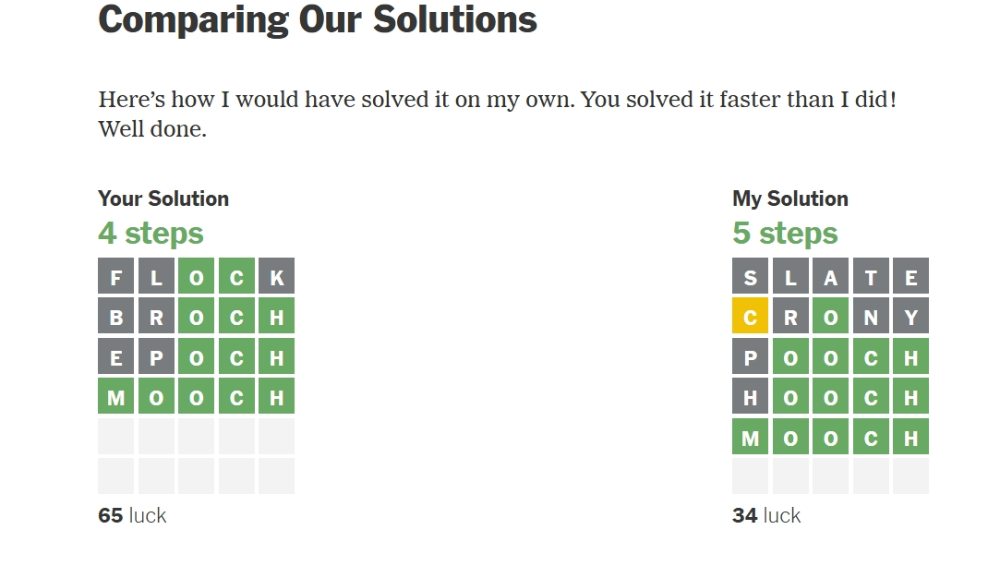

A confession: I share an obsession with none other than the world’s most celebrated leader: Pope Leo XIV. Like millions of other devotees, we begin each day playing Wordle, The New York Times’ on-line puzzle.
Wordle is a daily game that gives players up to six tries to guess a five-letter English word. Once you make a guess, Wordle tells you whether any of the letters you chose are found in the secret word and if those letters are properly placed or not.
Wordle has an enchanting back story. It was invented by Josh Wardle, a Brooklyn, New York software engineer. He created the game in 2020 for Palak Shah, his partner at the time, because she loves word puzzles. As a play on his last name, Josh dubbed the game Wordle. It became a daily contest between the two of them during the pandemic.
Ms. Shah played a key role in further developing Wordle. From a list of all five-letter words in English—about 12,000 of them – she eliminated words that were too obscure and impossible to guess. After Shah’s narrowing, there remained a list of 2,500 possible words, enough she figured to last for quite a few years.
Because it was so much fun, Josh introduced the game to his family’s WhatsApp group where it became an instant success. From there it went viral. Realizing he had something, Josh sold Wordle to the New York Times Company. The Times acquired the game, outbidding The Washington Post and paying an undisclosed sum, said to be in the low seven figures. The Times introduced Wordle to the public in January 2022, prompting Jonathan Knight, head of the Times’ games department, to say, “I’ve never seen a puzzle move this fast.” The game almost instantly attracted widespread attention and today has an estimated 3 million daily players.
The Times further shaped the list of possible words, eliminating those that were offensive or insensitive, among them SLAVE, LYNCH, FETUS, WENCH and COVID. Also excluded were words with British spellings like FIBRE. The Times’ reshaping still left many difficult words including GNOME, INBOX, DOWEL, EDIFY and KEFIR. There also were tricky ones with repeat letters like MUMMY and most recently MYRRH.
Tracy Bennett took over as editor in January 2023. One often hears complaints from Wordle players about such unfamiliar words as RUPEE, FUGUE, REBOS, GROUT and PARER. But Bennett tries to avoid words that have too many common letter combos like FOUND which has eight possible permutations.
She sometimes picks seasonal words. There was FEAST on Thanksgiving, MEDAL on Veteran’s Day and BEGIN on Bennett’s first day as editor. Wordle not only gets credit for attracting tens of millions of new players to The Times puzzle site, but many of them have remained to play The New York Times’ other puzzles.
Wordle set out to never to repeat a solution, but that constraint has changed. The word CIGAR, the contest’s first answer, recently showed up again. This may signify that puzzle lovers will be able to play indefinitely.
One thing that devoted players frequently debate is their choice of a starting word. Some rely on words that mix vowels and consonants like SLATE, CRANE, TRACE and RAISE. Others prefer such vowel-heavy words as ADIEU and AUDIO. Still a third group starts with a different word each time simply for variety’s sake.
The contest’s universal appeal led The Guardian news to award Wordle five stars out of a possible five. There’s even a Brazilian version of the game titled Termo, which also is popular in Portugal.
Meanwhile creator Josh Wardle, no longer in charge, has been working as a freelance creative consultant through Powerlanguage, his Brooklyn-based company. A seldom-mentioned fact about Wardle’s background is that he graduated from the University of Oregon. The U of O colors (yellow and green) may have inspired his use of yellow backgrounds for letters found somewhere in the puzzle and green backgrounds for letters placed correctly.
Whatever the game’s charming origins — Wardle invented it out of love — it now functions as a low-frills gift to players, free to use and available to all without ads or distracting pop-up banners. Rabid fans initially had clamored for more than one puzzle per day but those behind Wordle didn’t want an intense relationship. Instead, The New York Times games department settled on airing a single game each day with the unsaid opportunity to brag about one’s better attempts: Got it (the solution) in four tries or better still: “Got It in Three.”
Discover more from Post Alley
Subscribe to get the latest posts sent to your email.


Love that Post Alley and you have this for Valentine’s Day. I also love Wordle. I have played 1,384 times. I have hit once with my first starting word “Spare.” Now waiting for “Lingo” to hit. Continued good luck to all followers.
Pick a first word with as many vowels as possible.
I’m a risk taker and optimist, using a self-inspired word every day. Today, of course, I started with HEART which was no help at all! You didn’t mention “Hard Mode” — another layer of challenge and MUCH harder to get the 100-day streak medal.
We have been enjoying your work for years, Jean! Keep it up!