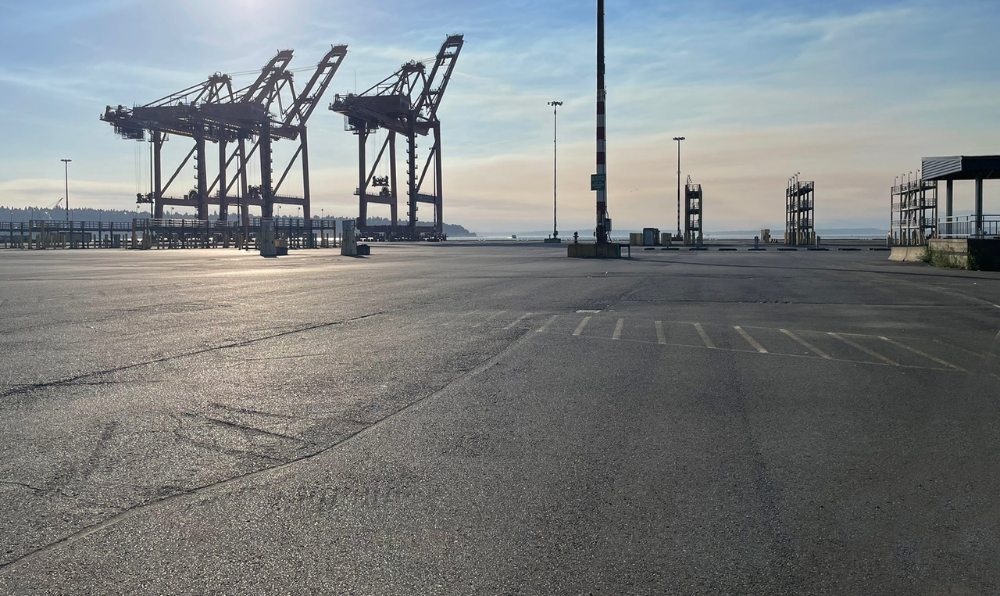

There is an ironic situation on the Seattle waterfront: the Port of Seattle has become the kind of obstacle to economic development it was created to overcome.
About 100 years ago, the railroads had a lock on the waterfront. Their arrival had connected Seattle to the rest of the continent, but they were strangling waterborne trade. In 1911, the community formed the Port, which went on to build new docks at Salmon Bay, Smith Cove, Bell St., and south between the railroad tracks and Elliott Bay.

Today, however, about 250 acres of that land, stretching from Interbay on the north to the mouth of the Duwamish on the south, sits vacant, paved over, and locked behind high fences. There is enough land here to build three Seattle Centers, and if just one of these properties, Terminal 46, were overlaid on downtown, it would stretch from First Ave. on the west to I-5 on the east, and from Pine St. on the north to James St. on the south.
Mandated to serve as the lead economic developer for Seattle and the surrounding areas, the Port could reuse that land to attract new investment to the region. But, rather like the railroads, the Port is now an impediment to commerce, because it is sitting on its holdings while doing nothing to redevelop them.
The shipping business is now gone, probably permanently, and even if that business were coming back, automation would have so decimated the jobs that it would do little for the city economically. At a time when immigration restrictions, research cuts, and software cutbacks are hurting our universities, research institutions, and software industries, we need this land to lure talent and investment.
Here is my vision for how we can reuse this land, based on decades of planning for this kind of development. I suggest a new way of planning, one that will result in the creation of exciting places integrated with the rest of the city, rather than the standard “destination development” that is so typical on many waterfronts.
Avoiding Boring Development
One of the biggest problems with large-scale waterfront redevelopment is that it is formulaic. The second problem is that, because it is usually detached from its surroundings and the daily life of the city, few residents go there regularly.
The standard mix of uses in waterfront redevelopment, not only at the Port’s own Bell Harbor complex but in Bremerton, Everett, and other cities up and down the West Coast, is a marina and waterfront restaurants, a hotel and small conference center, some office space, and some apartments. This formula was developed 50 years ago. Aside from some concerts and festivals in the middle of summer, it usually generates little life.
The formulaic process for this is driven by design and generic uses rather than starting with an idea for how a place could compete for people’s time, money, attention, and loyalty. Formulaic master planning uses a paint-by-numbers approach that colors in the resulting blocks red, yellow, orange, or blue for retail, residential, hospitality, and office space. It’s like laying out large subdivisions in the suburbs. We need to think and plan differently, especially for how we live and work post-COVID.
Taking a Cinemagraphic Approach to Development
“Place-making” focuses so much on the buildings, streets, and landscaping of a place that it neglects why people are there in the first place. It’s as if someone made a trailer for a new movie and showed only stills of the sets, without any of the music, motion, drama, and characters that are the essentials of a compelling story. Great stories, and great places, have drama. We care about the characters and we “inhabit” the stories.
In the last 40 years, there have been two great movies that depicted modern life in Seattle and that helped draw new people and business here. The first, and most obvious one, is Sleepless in Seattle. The less obvious one is the 1989 movie, The Fabulous Baker Boys, which set the stage for the city being a good place to live again. Starring Michelle Pfeiffer and Jeff Bridges as two jazz musicians working together and falling in love, the movie is set downtown.
One scene, shot at a time when Pioneer Square was coming back, shows Michelle Pfeiffer coming down the fire escape outside the apartment in her old brick building, landing on a street that is silent and empty in the early morning. The movie also contrasts their life with that of the Jeff Bridges’ character’s life in the suburbs, where he teaches music to children.
The new idea for our vacant waterfront land would be about a place at the foot of the city, right next to the Sound, where people live and work day-to-day without having to get in a car. Imagine the following scenes, set not with young singles but a family newly moved back into the city from the suburbs. In late afternoon, a man and a woman open the drapes to their living room, and beneath them a ferry is sweeping away from Colman Dock. The woman, a slight smile on her face, says, “Toto, I’ve got a feeling we’re not in Kansas anymore.”
The next morning, that same woman is dressed in white overalls in a workshop. For decades, Seattle has sent companies that make things to the suburbs. We need space in the city for the next generation of manufacturing of drones and other smart devices will be small and medium-sized, and we need a place for them within biking distance of where we live.
In the midday, their teenage son boards a van from the new division of Raisbeck Aviation High and rides over to an internship at an aerospace company near Boeing Field. To attract families, Seattle needs better schools that will engage students in hands-on experiences.
In mid-afternoon, the man walks into a local coffee shop, smiles at a barista he obviously knows, and sits down at a long table filled with other people working at their laptops. Today, software and business professionals work from home more than two days a week, and many want to take a break from their home screen and see other people.
All of these scenes take place within a short walk or bike ride of one another. We have world-class waterfront sites downtown that are vacant. Most of those sites look across the mountains that are capped with snow year-round. Terminal 46, the site that is so big that you could lay it over much of downtown, is just a ten-minute walk from Pioneer Square. Let’s get new life in them.
From TOD To GOD
With so much land, how do you keep this redevelopment from becoming a collection of disparate neighborhoods and commercial districts? With greenways. If transit-oriented development (TOD) has been the big planning idea of the last 30 years, greenway-oriented development (GOD) is both an old idea and the one that is working today. People are now living more locally, and to the extent they can, they want to get out and walk or bike to their destinations. The High Line in Manhattan, the Belt Line in Atlanta, and the Emeryville Greenway south of Berkeley have each attracted billions of dollars in both commercial and residential investment.
We have an example of greenway-oriented development here in Seattle, along the Burke-Gilman Trail in Ballard and Fremont. To the west, one of the most interesting and lively parts of Seattle is now the old industrial area in Ballard west of the 99 Bridge and south of Leary Way. This includes not only the old shipyards and the supply houses serving the fishing industry, but West Marine, PCC Markets, and, across 15th Ave. from Sephora, Made Cascade, an industrial design and machining firm that prototypes new parts. To the east, at the base of Stone Way in Fremont, Brooks Sports’ headquarters is just steps from the Burke Gilman.
In the future, it is quite possible that biotech companies will locate in University Village, a ten-minute bike ride down the Burke Gilman from the UW Medical Center. Why are these “lifestyle locations” popular? Because they help companies draw good people.
Creating Places for Everyone
Whenever there is talk of redeveloping vacant, publicly owned land, someone says, “Let’s put low-income housing there.” But we need these lands for economic development, and they must include not only a mix of uses and activities, but of people.
One way to make a place affordable for both businesses and people is to reduce or eliminate the need for a car. The present value of owning, operating, and garaging one is about $250,000, or about 30 to 40 percent of the cost of a smaller dwelling unit. Make the place more car-free and it will also be more affordable.
Facilitating Change
In terms of redevelopment, the Port is both the best and worst owner of this land. Best because the Port’s mission is economic development, and it has the financial capacity to undertake large-scale development. Worst” because the Port is a slow-moving institution focused almost solely on the airport.
The biggest obstacle to changing our waterfront is probably lack of awareness that these sites are even there or available for new use. You can drive over SR 99 and look over at all the vacant land next to Puget Sound. Then think about what your life would be like if you could do many of the things in your life without getting in a car. And then tell family or a friend about this idea. Those steps will help get things moving there again.
Discover more from Post Alley
Subscribe to get the latest posts sent to your email.


In the late 1980s I worked for the Port of Seattle as a project manager for the Central Waterfront Project, which was Pier 66 and the adjacent uplands. Pier 66 was a warehouse turned into the Port’s offices, and the rest of the area was vacant land that had been abandoned when all of the shipping moved to container terminals on Harbor Island.
I worked in a small real estate group that was buried within the large Port engineering department. The Port focused on marketing and managing container shipping operations and Seatac airport. Our work to redevelop the central waterfront was viewed as alien to the Port’s mission and was sandbagged by the Port bureaucracy because it saw our project as neither fish (seaport) nor fowl (airport).
Thus the design was watered down and mediocre and the project was only developed because Paul Schell became a Port commissioner. In the end it was just a shadow of what it might have been.
I thought about that project a lot while I was writing this article and wondered what, if any land-side waterfront project the Port had done since. The only one I could come up with is the ‘Maritime Innovation Center’ at the Fishermen’s Terminal, the reuse of an old warehouse as an incubator for new, marine-related industry. At about 15,000 square feet, that project is about the same size as a Petco store, and yet the Port has spent at least nine years developing it so far, and it is not yet open. The cost for that facility, about $2000 per square foot, is exceedingly high, for that’s about twice what it would cost to build a hospital or a biotech lab, both of which have very specialized requirements. It seems the Port is no longer interested in much outside the airport, for it has even outsourced management of the seaport operations to Tacoma.
A good model might be something like Lake Union. A mix of houseboats and multi family housing.
Unfortunately, it’s “visions” like this that continue to make terminal 46 unattractive to many stevedoring companies. The coast guard, billionaire real estate developers, shady local government officials all see visions of a “viable and attractive urban dwelling space right here on Seattle’s liquifaction zone”. All of these “visionaries” are conveniently forgetting that industrial lands like Seattle’s ports are the region’s gateway to global trade and our state’s foot hold to economic relevance. That this area is in the epicenter of the area’s largest rail operation at BNSF. Industrial lands are vital to our city, our state, and our country and we aren’t making anymore of them. I say we keep industrial lands safe from short term development opportunities and cash grabs.
Exactly! The Shoreline Management Act necessarily protects waterfront property for maritime use. It’s easy to disparage the maritime protections when it’s someone else’s livelihood. This is yet another article extolling the transformation of this property for private gain. It makes me wonder who is behind the scenes beating this drum. How about all the surface parking lots downtown be developed first?
I think the Duwamish should buy some of it.
Preserving central City property for “industrial development” suggests that Yesler’s Mill should have been maintained in Pioneer Square, or the gas plant should have continued to operate on Lake Union. The industrial lands of this community are now in the SR 167 corridor from Renton to the Port of Tacoma, and beyond.
The Port properly underwrites our still-viable fishing industry at Fishermen’s Terminal. But we are not a significant manufacturing center. Timber and coal no longer drive our economy.
Waterfront properties were once known by derogatory names because of their use, populations, and poverty. Those lands now are in high demand for redevelopment. We profess to modernity and progressive ideas in so many areas. But change not likely to happen here any time soon. So, our publicly-owned lands remain unproductive and without a return on the public’s investment.
Sure, who needs a port anyway?!? Supply chain infrastructure is overrated. Goods and necessities will just magically appear on the store shelves.
Regarding future shipping needs for our waterfront land, see my previous article in Post Alley:
https://www.postalley.org/2025/10/15/seattles-downtown-has-changed-perhaps-forever-time-to-reconsider-a-major-public-asset/
One salient statistic: Singapore now puts through seven times as many containers per acre of waterfront land as Seattle. If and when there is ever an increase in demand for shipping here, it will be much more highly automated and require far less land. The important concept here is “wage density”, or how many good paying jobs does a given acre of waterfront land generate. The longshoremen of the future will be sitting in front of a screen, operating a crane or surface vehicle remotely, to the extent that machinery needs any guidance at all. We are long past the days of casual labor showing up on the dock to get a job carrying burlap bags on their shoulder all day. If Ai is coming for software coding, imagine what its doing to shipping? Amazon, the one company in the world that did more to automate logistics, is based here. We shouldn’t be naive about how automated everything has become. At the same time, there greater need than ever for great face-to-face places for people to live and work. Over a hundred years ago, the Olmstred Brothers created the plan that gave rise Madrona, Montlake and Ravenna. Those places have enduring value, socially and economically, and now, more than ever, we need more of them. Let’s not kid ourselves that the marine-related trades are coming back.
The central waterfront piers and uplands were used for break-bulk shipping until that was replaced by containerized shipping, and the waterfront didn’t work anymore for multiple reasons. The area sat vacant and unused for decades until the port, aquarium and others developed new facilities and activities. Now the original port land has a cruise ship terminal a trade center and the jobs and revenue from that and related tourism probably rival that from shipping.