
Like you, I have imbibed a great deal of commentary and speculation regarding the recent actions of the United States in Venezuela. They range from words touting U.S., and Trumpian triumphalism, to cries of illegality and vainglory. The President is acclaimed as a man of action, or derided as a dealer in distraction.

What I know, from some decades of observing such “triumphs,” is that the triumph phase tends to be short-lived, while the subsequent phase(s) are long-lived and tragic. I do understand that Venezuela’s recent history has already been a decades-long tragedy of violence and repression in a once prosperous and beautiful land.
Of late, I’ve been working my way through a very large volume of the poetry of T. S. Eliot. I do not know if Eliot is currently in or out of fashion, nor do I care.
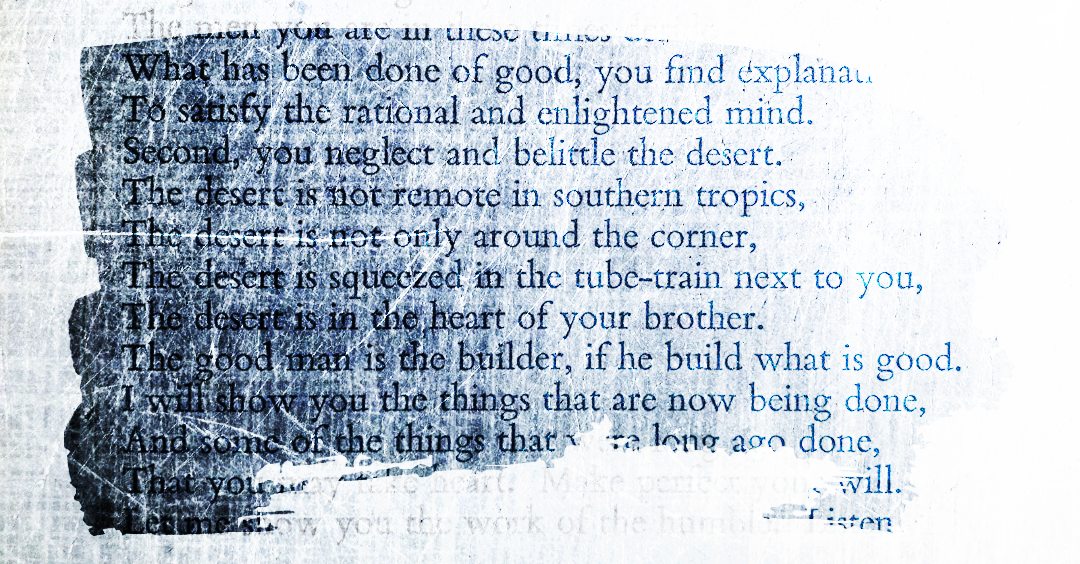
I find Eliot’s words and images powerful and, somewhat unexpectedly, laced with humor. At any rate, my response to the Venezuela adventure shall be, at this point in time, the following verses from Eliot’s poem, “Choruses from The Rock”:
“Oh weariness of men who turn from God/To the grandeur of your mind and the glory of your action/To arts and inventions and daring enterprises,/To schemes of human greatness thoroughly discredited,/Binding the earth and the water to your service,/Exploiting the seas and developing the mountains,/Dividing the stars into common and preferred,/Engaged in devising the perfect refrigerator,/Engaged in working out a rational morality,/Engaged in printing as many books as possible,/Plotting of happiness and flinging empty bottles,/
“Turning from your vacancy to fevered enthusiasm/For nation or race or what you call humanity;/Though you forget the way to the Temple,/There is one who remembers the way to your door:/Life you may evade, but Death you shall not. You shall not deny the Stranger.”
Do some of Eliot’s words and phrases touch or speak to you? I hope so. But, “Say what?; I thought you were addressing what’s all over the news — Trump, Venezuela, Maduro.” My response is to say, as I think Eliot does, we are rudderless, pulled about by the shifting winds, calling might right. Having turned from God to the grandeur of our minds and the glory of our action . . . turning from our “vacancy to fevered enthusiasm.” We are without humility, slaves of our strength, blind to our weakness.
Eliot, as he claims throughout “Choruses from the Rock,” says that we are heedless, unaware that we are finite, mortal. “Life you may evade, but Death you shall not. You shall not deny the Stranger.” Or maybe we are acutely aware of Death, and so eager to craft our own immortality.
In another part of the poem, which I especially love, Eliot again imagines the Stranger, who is the One who asks the questions. “When the Stranger says, ‘What is the meaning of this city?/Do you huddle together because you love each other?/What will you answer? We all dwell together/To make money from each other?/or ‘This is a community’?/And the Stranger will depart and return to the desert.”
The poet William Carlos Williams said, “It is difficult/ to get the news from poems/yet men die miserably every day for lack of what is found there.” Amen to that.
Discover more from Post Alley
Subscribe to get the latest posts sent to your email.


As with many relationships,
“In for a penny, out for a pound.”
Enjoyed your application of the words of T S Eliot to our troubled times.
Thanks to Anthony for reviving the word “vainglory.” It sent me off to my Oxford English Dictionary (fifth edition) to discover the origins. I found that it comes from Old French vine gloire, suggested by the Latin van gloria. The definition reads: “inordinate pride in oneself off one’s achievements; excessive vanity; his vainglory put the Republic at risk. What better word to describe Trumpianess.