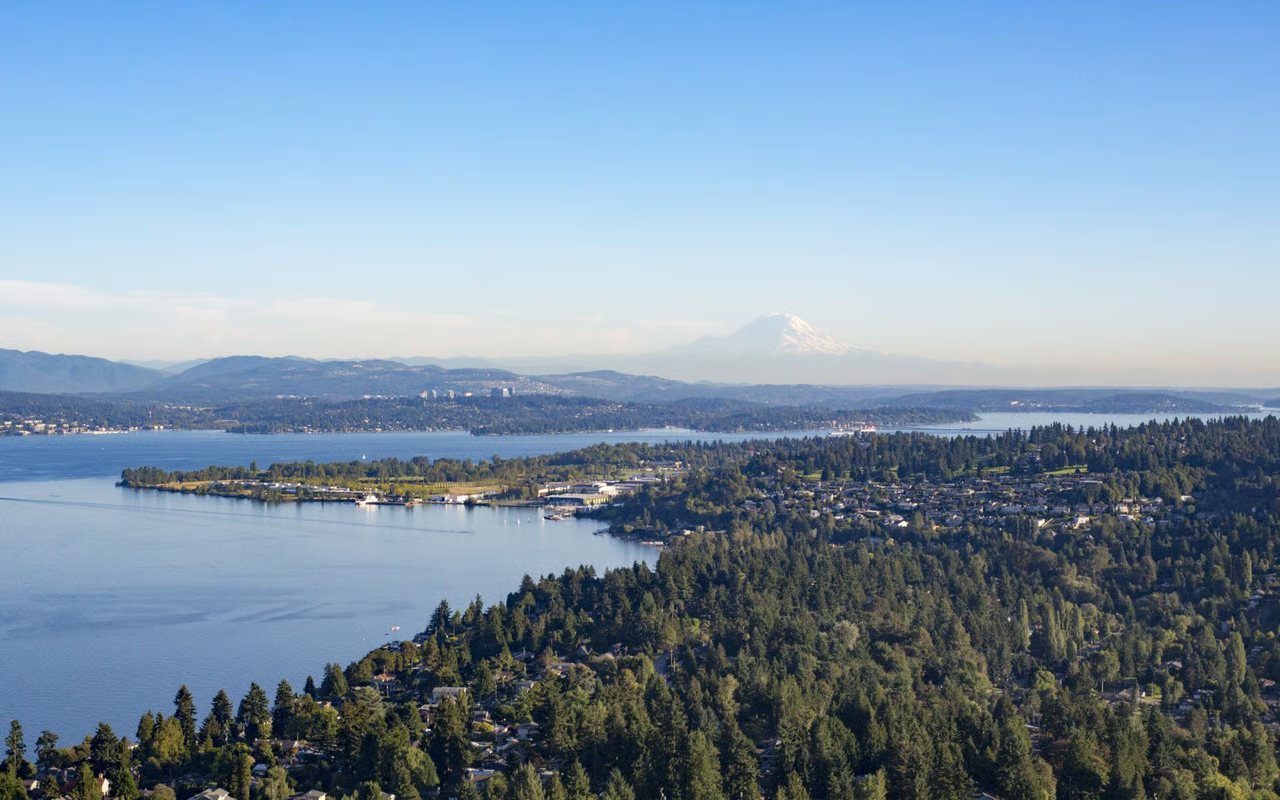

It is difficult to envision Native American life as it was in modern, metropolitan Seattle. Along the northwest shore of Lake Washington, building the Lake Shore & Eastern Railroad in the 1880s and subsequent industrial and commercial development obliterated potential archaeological sites. A gardener or a child at play along a lake or stream bank may find stone tools (hundreds, possibly thousands of years old), yet they provide little more than hints.

But native Duwamish place names and mythology can broaden our perspectives and conjure visions. One of these is SAH tsu tseed, the mouth of McAleer Creek, in Lake Forest Park. The creek’s six-mile length drains Lake Ballinger bordering 205th Street Southwest. The lake is SAH tsu, “face,” and tseed identifies the mouth of the face.
But before treating this composite, we must travel first to Seattle’s nearby suburb, Lake City. There, a lakeside bluff where NE 125th Street meets Riviera Place SE here marked STLHUP, “Deep [at the] point”. Lowering the Lake Washington level 9 feet in 1916 surfaced shallows, but a deep remains nearshore. Some 1920s Duwamish informants described it for ethnographer Thomas Waterman as “a ‘very dangerous’ place at the edge of the lake. People swimming here were formerly ‘taken away’ by something supernatural.”
This describes a Dzug wah, a water monster that sucked people down to their deaths. Further south on the lake, Seward Peninsula may image such a monster: a long nose necked to a dangerous section of shore. STLHUP appears to be where a
Dzug wah, a terrible, deadly monster, haunted the Lake City shore.

SAH tsu, whose mouth extended six snaky miles to Lake Washington, is like a Dzug wah. So do tributaries draining into Lake Ballinger, especially those heading at Halls Lake and Chase Lake. But unlike Dzug wahs, these are bountiful sources of life, not its destroyers.
Lake Ballinger’s modern fishery is a shadow of its former bounty. The lake is polluted and, only 35 feet deep, subject to increased warming. Common non-native fish introduced are yellow perch, smallmouth and largemouth bass, carp (discarded goldfish), invasive and destructive northern pike and the black crappie (from Middle English and French meaning “worthless, waste, crap”). Its few cold-loving native fish — coho, chinook and sockeye salmon, cutthroat and rainbow trout, char, Dolly Varden, pea mouth (minnows) and lampreys — are supplemented yearly by hatchery-raised lake rainbow trout and jumbo trout, a rugged hybrid of trout and char.
Before American settlement, large runs of salmon migrated from Lake Washington via McAleer Creek into Lake Ballinger and its tributaries. Most died after laying eggs, the effect of Dzug wahs. And Lake Ballinger holds a dark secret. As seen from maps, its face has an eye, Edmount or Ballinger Island, the first name unsourced, the second commemorating Richard Henry Ballinger, father of logger and developer, Ira Ballinger.
A bathymetric map shows a landslide entering from the southwest, an avalanche that sent a wave sweeping across to destroy fishing camps, burning into survivor memory the lake’s awful power. But fish came back and laid eggs. Hatchlings feed and grow into free-swimming fry and smolt and return to the sea, recycled in geographical features much like Dzug wahs. But these instead are powerful symbols of life; in SAH tsu’s case, six miles long.
In myth, DOH kweh bahl, Transformer, the demiurge who redeemed the world wrought by Old Creator, was kidnapped as a child by the Salmon Sisters who took him to live with their kin in houses beneath the sea. When he grew up, he returned to his
people, travelling up-river and transforming a dangerous world into a habitable home.
He convinced the Salmon People to return as he did, but every year and give their robes of flesh to feed humankind if these would honor and celebrate their return. Taking the first arriving salmon and ceremoniously cleaning and roasting it, people shared in a sacramental meal. Afterwards they returned its bones to the river so its spirit could return to the Salmon People and assure them that humans still honored their sacrifice by taking only what they needed.
Salmon were a miracle one could witness, catch in abundance, prepare, taste, and eat. At SAH tsu tseed, the miracle happened annually, the lake’s long mouth consuming migrating fish that, if treated respectfully, would through rebirth disperse as new-born to repeat the miracle. This was true of every stream that entered Lake Washington and the sea, making waterways and landscapes sacred in a world of miracles.
In our short history, we Americans do not come off well. We made the spiritual Duwamish homeless in their homeland; we commoditized and tore up the land, cut down the forests, and polluted the waters. Cut logs floating in Lake Ballinger were released down McAleer Creek, destroying gravel beds where fish spawned. Settlement of Lake Ballanger’s shore erased vegetation and wildlife, and phosphorus from lawn and garden fertilizer made it the most polluted lake of 34 lakes surveyed in the Puget Lowland in 1972. Raw sewage and other toxins flushed into lowered Lake Washington devastated its native fishery.
Yet thanks to Duwamish informants and their recorders, we know native names and myths. And the monstrous lethality of swallowing land and habitats awakens a desire to heal. Lake Forest Park is not alone inheriting a sacred, dynamic geographical feature, a holy symbol. If honored, it can be restored to make life abundant again and itself whole.
The cognates holy and whole derive from the Old English Halig, “consecrated, Holy.” We have grown in wisdom enough to seek environmental healing, to renew abundant land and waters. It may take time to accommodate the conception of wholeness with holiness, but by studying the Duwamish heritage, we learn that restoring waterways and landscapes are essential to our survival. We need all the help we can get.
Discover more from Post Alley
Subscribe to get the latest posts sent to your email.


Thank you for this lovely essay and map, David! You are right that we need all the help we can get in learning to restore our landscapes and waterways.
Especially since the City of Seattle does not seem to see it this way. Council Bill 121093, still in committee, seeks to remove State Environmental Policy Act review (which includes public comment) from most projects. The Seattle Dept. of Construction and Inspections says that it is, “out of step with current public policy priorities”.
I’ll spare you the details of the map they shared that shows no Native presence in NE Seattle, except possibly right on the coast of Lake Washington.
Help needed now!
Every light – David Buerge, thank you, again – that helps us see “Wat was there before” aids our building an ecologically and culturally informed perspective on how we must move forward.
The more we can see even what’s now hidden, the better we can understand, and act..
I hope Buerge will write soon on Roland Bog in Shoreline and the historic trail from Lake Washington to Haller Lake and Shilshole.