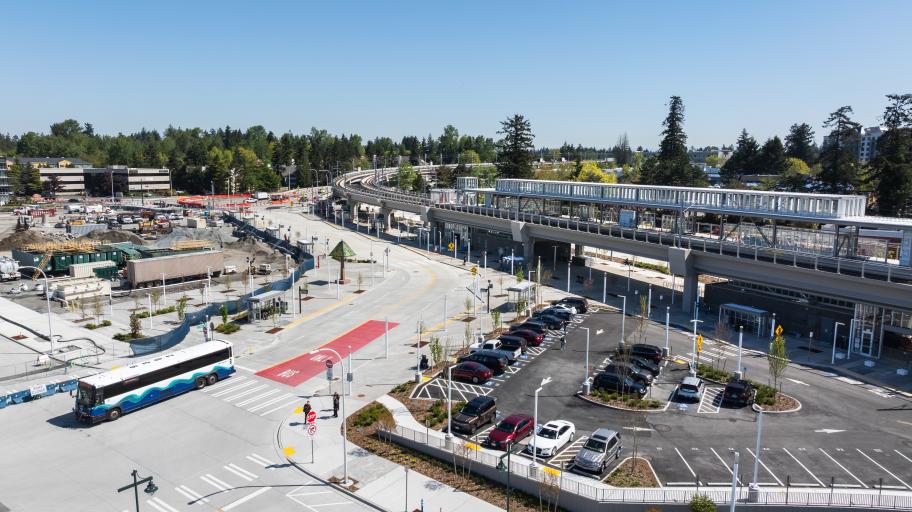

In the late 1980s, legislators captained by current US Sen. Maria Cantwell passed the state’s Growth Management Act. Rep. Ruth Fisher, then the chair of the House Transportation Committee, pushed the effort to pass the state’s Regional High-Capacity Transit Act. The motivation for both pieces of legislation came from the realization that our region could not afford to meet the exorbitant needs of growth with our post-WWII developmental strategies of metropolitan sprawl. However there were some hidden costs in higher expenses in housing.
Prior to WWII, growth largely occurred in cities, mainly the City of Seattle which
annexed additional areas for development, frequently in partnership with private sector
investors who financed transportation infrastructure to access the development. The
result: several streetcar routes like Alaska Way to Lake Washington on Madison Street.
After WWII, Seattle declined to expand further, so responsibility defaulted to King
County to provide the spaces for new housing and retail. However King County lacked
the institutional authorities that cities had, since counties were traditionally rural-service
providers, focused on farm-to-market transportation systems, courts, elections, and jails
— not urban development and transportation systems.
Consequently, development sprawled across the county, low density, with scant initial
infrastructure investment. As the decades passed, more development occurred infilling
the dispersed development and placing demands on the rural infrastructure. Congested
two-lane roads needed upgrades to three and four lanes. Those upgrades often
happened expensively at night to maintain traffic flows to farms and residential
development.
As wells and septic systems began to fail, neighborhoods created special-purpose
districts to build water and sewer systems, often tearing up the recently improved
roads. In one example, a case east of Kent, Seattle-King County Public Health forced
sewer improvements after observing raw sewage in barrow pits along county roads.
As county planners began to place restrictions on density, citizens reacted by
incorporating to gain control of unwanted developments. By the 1990s, we had created
well over 100 governments in King County as we sprawled toward the Cascades. By the 1980s, planners understood the ruinous costs of these choices and the need to change the way we developed and to find less expensive ways to meet the infrastructure needs of the region. Enter Sen. Cantwell and Rep. Fisher.
The 1989 Growth Management Act was intended to corral development inside an urban
growth boundary and to assign the role for municipal services to cities, limiting counties
to their traditional role of providing rural services. City comprehensive plans would
demonstrate how they would channel projected growth and more efficient infrastructure
investments. A new concept for Washington State, “concurrency,” required that these
plans be funded before permits for development could be issued. However, where would the money come from?
The GMA introduced the concept of impact fees to partially meet this need. That was the
idea that cities could charge developers a fee for the infrastructure impacts of their
developments. These fees could fund city streets, water and sewer capacity, or school
facilities. Another idea to fund development — “tax-increment financing,” capturing
prospective development’s increased taxes to fund infrastructure — never got traction.
The Growth Management Act authorized counties to put county-wide policies in place
that cities would implement through their comprehensive plans, zoning, and
infrastructure plans. In King County, a collaborative effort created the King County
Growth Management Policy Council (the GMPC) to shepherd draft these plans. The
council consisted of King County elected officials, City of Seattle electeds, and electeds
representing the 38 non-Seattle cities.
At the same time, Rep. Fisher worked to authorize the creation of a high-capacity
regional transportation system. She recognized that capturing the real estate infill
development would require in Central Puget Sound traditional transportation systems
that just couldn’t be done for both political and financial reasons.
Building freeways, always difficult, became much more problematic as people rebelled at vast concrete ribbons bulldozed through their neighborhoods, and environmental regulations also began to crimp highway impacts. For instance, I-90 construction involved a 20-year process to design the roadway, and the R. H. Thompson
Expressway never got past some off-ramps to nowhere in the Arboretum.
The solution to this challenge was the Joint Regional Planning Committee for High-
Capacity Transportation (the JRPC), a three-county committee representing King, Pierce,
and Snohomish counties, which was tasked with drafting a plan for a regional high-
capacity system expected to be less expensive than the post-WWII regional freeway
system.
The post-WWII freeway system forced planners to realize the cost of massive freeway
systems, especially as real estate values increased with economic growth. A freeway
lane optimally moves 2,000 vehicles per hour, and congestion ensues as trip demand
exceeds capacity. Within limits, new lanes can be added, but experience shows they fill
up quickly. Light rail provides an alternative. Light rail trains create capacity for 20-
24,000 trips per hour in the same space as a freeway lane. The trains also operate
more reliably than a freeway.
The JRPC convened in the early 1990s and drafted a plan for a three-county regional
high-capacity system subsequently ratified by the three county councils. That created
Sound Transit — which finally got to Federal Way.
I participated in this complex process, serving on both the GMPC and co-chairing the
JRPC. I also chaired a GMPC sub-committee doing economic analysis of our proposed
policies, which did civic benchmarking to look at choices different regions made and
their systemic impacts over time — for example not just the public capital cost of highways against the capital and operating costs of light rail but the total cost of mobility and infrastructure.
The analysis persuaded me that the GMA and JRPC policies made sense, but I remained skeptical they would work. As a region we were so used to a particular form of development, namely, low-density sprawl. How could that transition to a more urban
form?
I was wrong: it turns out that it can, as my recent Saturday ride to Federal Way made it clear. Lumbering down MLK we passed multiple post-Link developments, all muti-use, multi-story. If one traveled North, the same pattern appeared, only more so. The number of new multi-family developments inside the City of Seattle in the last 20 years more than doubled the multi-family units. Most of these new units lie close to Link stations.
The same is true on the Eastside. Line 2 passes through downtown Bellevue where
residential population in the ‘60s resided in low-density single-family homes. Today,
mixed use, multi-family dominates. Similarly for the Spring District, Bel-Red, Overlake,
and downtown Redmond. Astonishing, and I did not expect this much change.
But I was also disturbed by the collateral impacts we should have planned for.
Restricting supply always increases prices. The price of land increased, and we should have known. Redeveloping single-family housing doesn’t result in affordability even as it saves greenfields.
So, where can we go from here? Well, Federal Way for starters. Line 1 will bring
mobility to the south county and there will be development from SeaTac to Federal Way
just as from Northgate to Lynwood and from Wilburton to Redmond. Challenges will remain for housing affordability, local parks, and feeder systems. Sound Transit’s investments create an economic reality the market will continue to respond to — and produce a lower infrastructure cost than the post-WWII trend would have.
It remains for us to mitigate collateral damage from this dramatic transition. A 21st century Forward Thrust, maybe?


Your article is right on point. To meet our current and future housing needs we will need some type of public intervention to create the planning, land acquisition and infrastructure required. A few years ago a group of like minded individuals advocated for the creation of Housing Benefit Districts to do just that.
https://soundcommunitiesps.org/
While we received some funding from the State, we were not able to get to implementation. May be time to take another look.
Greatly appreciate the thinking. Made for a long discussion this morning
The reference to Forward Trust acknowledges the web of amenities, infrastructure and services needed. With the success of ST and the recent speed of private sector TOD development it seems there is an opportunity here
Seattle’s building codes and zoning are a big reason for the affordability crisis.
We don’t really need wide streets for emergency vehicles. Europe does just fine without the massive ladder and pump trucks.
We don’t need restrictive floor area ratios (FAR).
We don’t need 48″ sidewalks when 36″ is the code back east.
We don’t need codes that require oversized elevators which means that the costs are 3-5x more than in Europe. Stacked flats don’t pencil out for builders if that is the case.
We don’t need onerous architectural design reviews.
Seattle is one of the few cities that allow multistory single-point access buildings, just like Europe. More of that please.
The lesson learned is that you can’t impose growth management while retaining archaic and out-of-date zoning and building codes which promote single-family urban sprawl.
At the end of the day, land is finite. There are problems with sprawl and unencumbered development, there are challenges to managing growth. Perhaps we should be looking a little more closely at places where housing is more affordable and take notes from that. I don’t think it’s the zoning at the heart of the affordability problem.