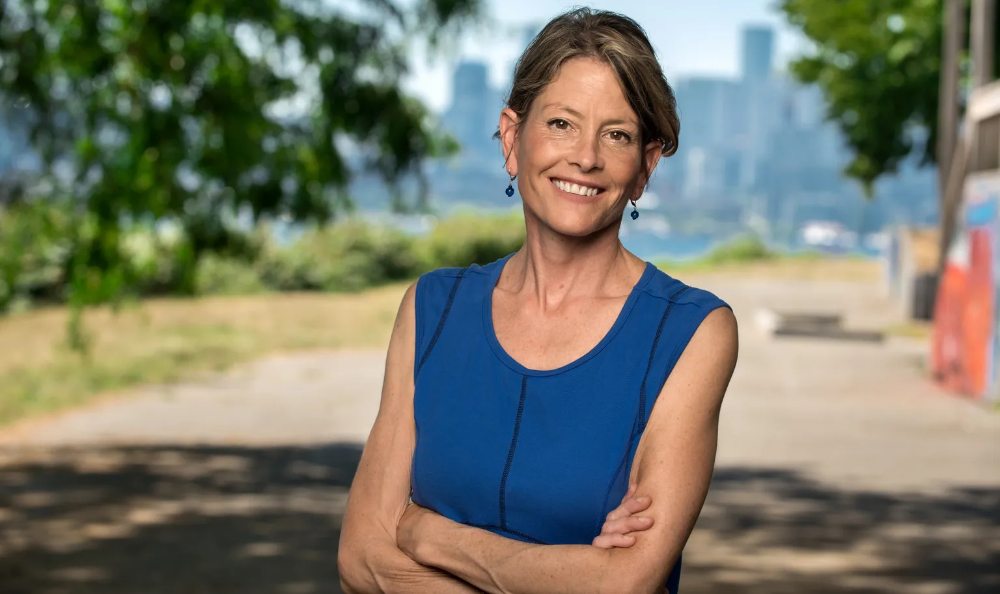

Sara Nelson won election to the Seattle City Council in 2021 championing a turn to the moderate in Seattle politics. She’s an advocate for small business, a strong police force, and drug treatment. Two years later she was joined by five like-minded allies, in what was the biggest council shake-up since 1911. It seemed voters had repudiated the policies of defunding the police, a hands-off attitudes toward public drug use, street crime, and homeless encampments.
But just as quickly, the tide of Seattle politics has shifted again. Nelson finished in the August primary well behind her opponent, Dionne Foster, a labor-backed former city staffer and head of Washington Progress Alliance. Foster ran on a progressive platform of worker protection, stopping encampment sweeps, promoting social housing, and favoring a city capital gains tax. In November, Nelson lost 63 percent to 37 percent.
First-term Mayor Bruce Harrell, another centrist, lost to progressive transit advocate Katie Wilson, while City Attorney Ann Davison, a former Republican, was defeated by Erika Evans, who said she will not enforce a city ordinance cracking down on drug offenders.
On the City Council, Nelson has packed in more legislative battles, many won and some lost, in four years than most council members can claim over several terms. She claimed victories in reversing the loss of Seattle police officers, boosting funds for drug treatment, encouraging small businesses, and building workforce housing. She drew fire for legislation reducing gig workers’ wages, raising cops’ wages, and toughening penalties for public drug use.
“I didn’t govern to get re-elected. I governed to fix things. Not just fix things, but to also build new things,’’ Nelson said. “I had four years to get shit done. And if voters still like my brand, great, I’ve got four more years. If not — oh, well. But all of this means I took the hard things on. I took risks. I pushed and I fought, and I was a royal pain.”
Nelson’s determination — often framing her issues in moral terms — inspired her staff and friends, yet her stubbornness and blunt temperament often was a source of frustration. Her council colleagues chafed at strong-arm tactics she sometimes used to push bills. Many times, she infuriated her opponents, while also earning their grudging respect for her doggedness.
Nelson had spent many years preparing for the City Council. The California native with a PhD in anthropology was teaching at the UW when she learned of a job opening on the staff of City Council member Richard Conlin. It was, she recalls, “the perfect job’’ for the self-professed policy nerd. While she lacked any legislative background, Conlin said her training in anthropology gave her “a real understanding of the way people are motivated. She really wanted to go deep.”
She spent 10 years as Conlin’s chief legislative aide. If Conlin outwardly was the calm consensus-builder, Nelson was at his side with the sharp elbows needed to build winning majorities. She recounts successes developing a forward-looking plan for handling the city’s solid waste, along with adoption of land-use legislation that paved the way for the sweeping redevelopment of South Lake Union. “That was putting environmentalism into practice,” she said.
She was with Conlin in 2013 when he was defeated by Socialist firebrand Kshama Sawant, which marked the leftward turn of the City Council in subsequent elections. “It was a turning point. We took a turn for the worse,’’ Nelson added.
She mounted an unsuccessful bid for the City Council in 2017. Even so, she quickly found a new outlet for her energies. She and her husband, Matt Lincecum, had founded Fremont Brewing in 2009, and she became a leading advocate for the craft-beer industry. She plunged into small-business issues on a Chamber of Commerce committee.
In the depths of the pandemic economic slowdown, crime was rising, the Police Department was losing officers, homeless encampments were spreading, as was open drug use. All this added to the woes of the downtown, afflicted by growing office vacancies. Nelson saw the opportunity to offer a pro-police, pro-small business platform. “I was worried about the future of my city. I thought the fresh perspective of a small-business person could do some good,’’ Nelson said.
Running against community activist Nikkita Oliver, the contrast was clear. Oliver campaigned to cut police funding and impose rent control, while Nelson emphasized keeping streets safe. “Nothing happens without a foundation of public safety,’’ she said, winning with 54 percent of the vote.
Once in office, Nelson wasted little time gearing up “to really reverse the damage wrought by years of failed policies,” setting the stage for the battles to come over police, homelessness, and efforts to reverse the loss of small businesses. Her efforts gained momentum in 2023 when five new council members, all political moderates, won election. Nelson was voted council President in 2024, the year Sawant left the council.
Among her top priorities was reversing the hemorrhaging of officers from the Seattle Police Department. The department has been roiled for years with changing leadership and public dissatisfaction with policing in minority communities. Federal oversight of the department, brought on by accusations of excessive use of force and bias in policing, ended only recently.
Some 36 public safety bills have been passed by the council, including hiring bonuses and improvements for recruitment. A new contract with the Seattle Police Officers Guild with significant pay hikes recently was approved, despite complaints the agreement does not go far enough to ensure police accountability. Voting against the contract were Rob Saka and the two newest members — Eddie Lin and Alexis Mercedes Rinck.
For Nelson, the city is finally on the right track with public safety, reversing the trend of losses. Next year the department is set to hire 94 new officers. To help small businesses suffering from vandalism, she backed legislation providing cash to repair damaged storefronts. “Public safety is sexy again,’’ she said, with pride.
Councilmember Bob Kettle, who credits Nelson’s encouragement for his decision to run in 2023, said the council’s backing has made a difference with the police rank and file. While visiting a precinct house early in his term, “I had an older captain say, ‘I’ve never seen a council member do this.’”
Nelson also has championed more funding for drug treatment and rehabilitation, $2.85 million next year, a priority driven by her own problems with alcohol. Without services, housing alone will not solve the city’s drug problems, she said. “It’s good to have affordable housing,’’ she said, but the experience of other cities demonstrates that “we have to get people off the streets and into treatment.’’
Nothing more clearly demonstrates Nelson’s willingness to do battle for her priorities, even at political cost, than her bill earlier this year to allow mixed housing and small business “makers’’ spaces near T-Mobile Park in the SODO stadium district. The legislation, Nelson said, would ease the city’s housing crunch while also creating space for craftspeople and artisans who were being forced out of the city by high rents.
Such development was initially included in Mayor Harrell’s 2023 draft legislation protecting industrial lands. Harrell’s office had been engaged in painful and protracted negotiations with the Port of Seattle, developers, and industrial interests, but the inclusion of housing on a site close to port shipping operations and freight streets threatened to blow up the deal. Harrell backtracked and removed the housing element, despite the city’s own environmental review that found small housing developments were no threat to the port.
Nelson had assembled an impressive coalition backing her housing bill: building-trades unions, baseball and football/soccer stadiums, public authorities, housing activists, and small-business groups. Then the Port of Seattle threw its full weight against the legislation, along with longshore workers, the industrial community, and several legislators. Harrell was officially neutral on her bill, but privately his office counseled against it.
Nelson slotted the legislation in her own committee and moved to bring it to the full council, overruling critics who said the bill was moving too fast. She and the Port staged dueling press conferences, highlighting the city’s enduring conflicts over industrial development, especially near the waterfront.
“It was the right thing to do. It was the right thing to do in 2023,’’ when the original land-use legislation was being drafted, Nelson said. Traffic generated by about 1,000 housing units would be far less than the tens of thousands attending stadium events, and longshore workers would lose no jobs, she said, pointing to the city’s environmental review. Property owner Chris Hansen, backer of the failed Sonics arena project, had promised the housing projects would employ union labor.
“This was a progressive idea,’’ Nelson said. But she lost the backing of council members Kettle, Dan Strauss, and Mercedes Rinck, who sided with the Port. “This is about how we govern and how we lead by example. This process has created division,” Strauss told the council when passage of the bill seemed assured. “Once we make this change, our deepwater port is forever threatened.”
The bill passed 6-3 but was immediately challenged by the Port. The state Growth Management Hearings Board backed the Port on several issues and sent the bill back to the city for review. The city is seeking court review of that decision.
Nelson remains bitter over the Port’s opposition. Four Port Commissioners endorsed Foster, as did councilmembers Strauss and Rinck. Nelson accused the Port of wanting the SODO site for its own office uses. “Our housing crisis is so acute, I couldn’t not do it. I was morally obligated to go forward,” she said. The housing project’s future is uncertain with a new mayor and city attorney, both endorsed by Port Commissioners. Foster, Nelson’s successor, said she opposes the bill.
“It was the bold thing to do,’’ said Conlin, her mentor. “It wasn’t the prudent thing to do. She deserves a lot of credit for it. You can’t always base your decisions on what’s politically right.’’
After November’s election results were in, Nelson sparked controversy again with legislation barring candidate consultants from also holding city contracts. The bill seemed aimed at top political consultant Christian Sinderman, who was working for Harrell and advising Foster, her opponent. Nelson said the cozy relationship compromised her ability to work candidly with the mayor and could create ethical conflicts for consultants on future ballot measures.
Sinderman told the Seattle Times his dealings with the city were transparent and followed city rules. “So now, on her way out the door, she wants to change the rules to justify her unfounded political grievances,” Sinderman charged.
Criticized as being overbroad, the consultant bill was significantly amended to require only registration of contract work. It passed on a divided vote on Nelson’s last day as council president.
Strauss praised Nelson’s commitment to Seattle, despite the battles with her over SODO housing and other issues. “What I know to be a fact is that you are an incredibly dedicated public servant,’’ he said. “You’ve made the city a better place.”
So what were the turning points in this year’s elections? There are common themes that emerge in the defeats of Harrell, Davison, and Nelson.
Neighborhoods with younger voters, predominately renters, turned out in higher numbers than did neighborhoods dominated by older home-owning voters. They appeared to be impatient with rising housing costs and the general pace of change. “There is a pervasive sense, they feel like this group of people weren’t getting things done,” said Ben Anderstone, Nelson’s campaign consultant.
Where Harrell, Davison, and Nelson insisted the city was on the right track, younger voters were saying, “this is not the time for stability. They are just sick of that,’’ Anderstone said.
Wrote the Seattle Stranger in its endorsement of Foster: “Seattle is immobilized in Nelson’s… full Nelson, controlled by business interests who shelled out hundreds of thousands of dollars for her meandering status quo that squeezes the renters, the poor, the homeless, and the disadvantaged on the margins.’’
Michael Charles, who advised winning King County Executive candidate Girmay Zahilay, sees the November election as a changing of the guard, replacing an older generation of leaders. He cites Wilson, who had never held elective office and had run only small non-profit advocacy program. “She had ideas. Experience was overrated,’’ he said. Among these voters, it may be that affordability, police accountability, halting harsh treatment of homeless, and taxing wealthy businesses are higher priorities.
National politics and President Donald Trump’s threats to punish Seattle for its liberal ways also energized voters, many observers agree. Nelson said she realized voters favored candidates “who were the most unlike Trump.” Too late, she said, “I needed to do a better job saying I’m the better fighter against Trump.”
In the end, Nelson concedes her messages were drowned out by the mayor’s race and progressive media’s portrait of her as combative conservative and a tool of big business. Foster, she said, never detailed positions much different from her own.
So far, Mayor-Elect Wilson appears to be charting a course more moderate and pragmatic than her critics feared. She is retaining Police Chief Shon Barnes. As her deputy mayor, Wilson appointed Brian Surratt, formerly head of Greater Seattle Partners, which promotes business investment for the region. Her interim transportation director will be Angela Brady, who has deep project-management experience as head of the mammoth Seattle waterfront project.
Conlin does not expect a return to the far-left progressivism of the Sawant era. “I think we are more sophisticated now. Look at Katie Wilson. She is very smart,’’ he said. “We are not dealing with bomb throwers.”
Nelson vows to stay involved in Seattle public affairs. “We put public safety back to the top of our priorities. When you look outside, downtown is no longer dead,’’ Nelson said. “This is a great town, and it was a thrill to be a part of it. I’m excited to see what it becomes.”
Discover more from Post Alley
Subscribe to get the latest posts sent to your email.


“… Erika Davis, who said she will not enforce a city ordinance cracking down on drug offenders.” That isn’t a very fair take. I assume the ordinance in question is Stay Out of Drug Areas, which is a license for the police to harass people “on suspicion” within certain areas. It may have been conceived as a way to crack down on drug offenders, but it’s obviously quite limited geographically, and there’s room for doubt that it has significant overall effect on the problem. We already had laws, that’s how they would be “drug offenders” in the first place, and I don’t recall seeing anything from Evans (her real name!) indicating she wouldn’t enforce them.
I’m not the only one who voted for Sawant because she wasn’t Conlin. History repeats. I didn’t much care for what we got with Sawant, and Johnson took over for Conlin, so it wasn’t after all a big step forward, but it was a step.
I long ago lost understanding, patience or interest in Seattle city politics. But my old colleague once again managed to not only capture my attention but to also lure me into a topic I cared little about. And provide a window to a world I don’t understand . The very definition of a journalist. A damn fine one.